

Two-Tone Gold Band With Black and White Diamond Row
$$$
14k yellow gold, 14k white gold, natural black diamonds, natural diamonds
D. wanted a two-tone wedding band with a line of black stones alternating with clear ones running around the center. Over the course of the design process the black stone choice shifted from onyx to black diamonds for durability, and the colorless stones moved from moissanite to natural diamonds as his preference became clearer. When it arrived, he wrote simply: 'Yes, it's amazing! Thank you!'
'Yes, it's amazing! Thank you!' — on delivery
Quick specs
Primary Metal
Secondary Metal
Shape / Cut
Primary Stone
Design Complexity
Intent: Certainty
Size
Ring size 11 US. Band width 6mm.
How they made it distinctive
-
01
Three-section soldered construction — yellow gold on both outer edges with a white gold center channel, rather than a single-metal band
-
02
Five bezel-set black diamonds spaced evenly around the full circumference, alternating with pave colorless diamonds
-
03
Stone spacing designed around the solder seam — stones could not be thinned out because doing so would expose the metal join between the two gold colors
-
04
Material upgraded mid-design from black onyx to black diamonds for better durability at small stone sizes
-
05
Colorless stones upgraded from moissanite to natural mined diamonds at the client's request
How you'd make it yours
Stone type: this piece uses natural diamonds for the colorless stones; a new commission could use lab diamonds or moissanite for a similar look at a different cost
Dark stone: this piece uses black diamonds; a new commission could use black onyx for a similar look, with a durability tradeoff at small sizes
Metal: this piece is 14k yellow and white gold soldered together; the same two-tone language could use rose gold in place of either section
Stone count: this piece uses 5 black stones with pave colorless stones between them; a new commission could use more or fewer
Width: this piece is 6mm; a new commission could be made narrower or wider depending on the wearer's hand
One of a kind: this exact ring was designed for one client's specifications and is not reproduced — a new commission is an original piece inspired by this one, not a copy
Design changes made
The original concept used black onyx with moissanite or lab diamonds, but the design shifted to black diamonds after durability concerns were raised about onyx at this small scale, and the colorless stones were upgraded from moissanite to natural diamonds per the client's later request.
Who this is for
This piece is for someone who wants a wedding band that looks deliberately different from a standard single-metal design — one with a visible line of contrasting stones and two gold tones working together. It's especially right for someone who cares about the details holding up under daily wear and is willing to go through a few rounds of refinement to get the materials exactly right.
How it's made
Once the design was approved, the ring was first printed as a wax model using a 3D printer, then attached to a wax tree and invested in plaster inside a flask. The flask was fired in a kiln to burn out the wax, leaving a hollow mold, and molten 14k gold was cast into the mold to form the raw three-section band before it was cleaned and prepared for finishing.
Because the band combines yellow and white gold sections soldered together, the two metals were finished to a seamless polished surface along the solder seams before stone setting began. The five black diamonds were bezel-set evenly around the center white gold channel, and the small colorless diamonds were pave-set in the gaps between them, following the curve of the band continuously around its circumference.
Key note
The stones could not be spaced further apart by removing every other colorless stone, because doing so would have exposed the solder seam between the white and yellow gold sections and compromised the band's durability.
Pricing guidance
A two-tone wedding band with alternating black and colorless stones set around the circumference sits toward the higher end for custom bands of this width. Soldering two gold colors together and setting ten-plus small stones evenly around a curve both add labor beyond a single-metal band. Stone choice — natural diamond versus lab-grown or moissanite — is the largest lever on cost from there.
Moves price up ↑
- ↑ Using natural mined diamonds instead of lab-grown or moissanite for the colorless stones
- ↑ Increasing the number of black diamonds or colorless stones around the band
- ↑ Using rectangular or baguette-cut stones instead of round, which are harder to set along a curve
- ↑ Widening the band beyond 6mm, which increases metal and stone-setting area
Moves price down ↓
- ↓ Substituting moissanite for natural or lab diamonds in the colorless stones
- ↓ Using black onyx instead of black diamonds for the dark stones, though durability is reduced at small sizes
- ↓ Choosing a single metal rather than a soldered two-tone construction
- ↓ Narrowing the band width to reduce the stone-setting area
Questions people ask
Small onyx stones set at ring size can be more fragile than people expect, because onyx is softer than diamond and the stones in a band like this are quite small. For daily wear pieces, black diamonds are a more durable substitute that look nearly identical to onyx but resist chipping and wear much better. The price difference between small black diamonds and black onyx is often minimal, so durability is usually the deciding factor rather than cost.
Natural and lab-grown diamonds are chemically identical and equally durable, with lab diamonds typically costing less for the same clarity and color grade. Moissanite is a different mineral entirely — it's extremely hard and durable, but has a different light refraction that gives it a slightly different sparkle than diamond. For small pave-set accent stones in a band like this, all three options are durable enough for daily wear; the choice usually comes down to appearance preference and budget.
A 14k two-tone band with black diamonds and colorless accent stones set around the circumference falls toward the higher end of custom wedding band pricing. The two-tone construction requires soldering yellow and white gold together, which adds labor beyond a single-metal band, and setting multiple small stones evenly around a curve is time-intensive. Stone choice has the biggest effect on final cost, with natural diamonds priced highest and moissanite or onyx priced lowest.
The design phase for a band like this typically takes about one week, including a 3D render for approval before anything is cast. Once the design is approved and production begins, casting and stone setting usually take three to four weeks. A resin or wax preview may be shared partway through production so the client can see the piece take shape before the final metal casting.
Yes, but the metal seam where two gold colors meet needs to stay covered by metal or stones consistently around the band to avoid exposing the solder joint, which would be both a visual flaw and a durability risk. This is why stone spacing on a soldered two-tone band is more constrained than on a single-metal band — removing stones to create gaps can expose that seam. A skilled setter plans the stone layout around the solder line before any stones are placed.
It's possible, but rectangular stones are significantly more difficult and costly to set in a continuous curve than round stones, because the straight edges have to be individually aligned to follow the band's curvature. Round stones naturally follow a curve with minimal adjustment, which keeps labor lower. If a client wants a rectangular or baguette look on a curved band, expect increased setting labor and potentially a modified stone layout.
Renders are a close approximation but metal and gemstone coloring can vary slightly between the digital render and the finished physical piece, due to differences in lighting and how metal reflects in a 3D rendering versus real life. The overall design, stone placement, and proportions will match what was approved. Reputable custom jewelers will flag this variance before production so there are no surprises at delivery.
Two-tone bands with a soldered seam running the full circumference can generally be resized within a modest range, but the resizing process requires extra care to avoid disturbing the solder joint between the two metals. Bands with stones set all the way around, like this one, have less room for resizing than a plain band because there is less uninterrupted metal to work with. It's best to confirm sizing before production begins rather than relying on resizing after the fact.
Explore Similar Creations
Every masterpiece starts with a spark. Explore how our clients raw ideas - sketches, heirlooms, inspirations - were transformed into bespoke works of arts.
This wedding band was built around a single requirement: it had to be safe to ...

This platinum wedding band was built as a companion piece to an existing engagement ring, ...

This wedding band uses a half-eternity layout, with marquise-cut moissanite stones set east-west along the ...

This wedding band pairs a straight, flat-profile shank with a graduated row of five prong-set ...

This wedding band was designed as a companion piece to an existing engagement ring, with ...
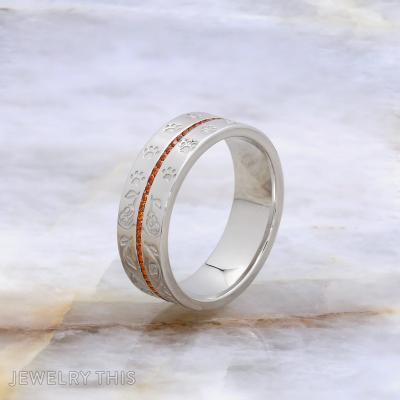
This wedding band pairs two engraved motifs on a wide sterling silver band, separated by ...

This men’s wedding band pairs a substantial platinum profile with two princess-cut blue sapphires set ...

This band recreates a wedding ring that had been worn daily on a necklace for ...

This ring recreates a lost wedding band as closely as possible from photographs alone. Six ...
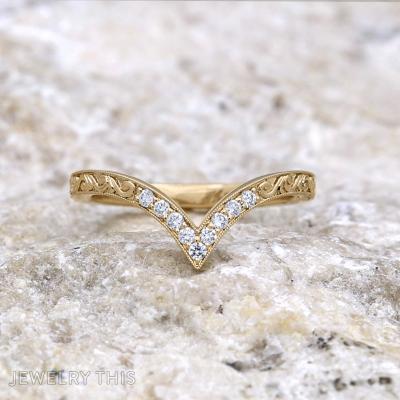
This wedding band was designed as a companion piece to an existing engagement ring, built ...

This men’s wedding band is built around a single-branch design, textured to read like real ...

This wedding band was rebuilt from a single surviving photograph and an old order confirmation ...