

Architectural Cut-Out Wedding Band in 14k White Gold
$$$
14k white gold, natural diamonds
A wife set out to design a wedding band for her husband that would hold up to his work in construction, after being advised that a fully closed metal band could be a safety risk on the job. She sketched her own concept first, then worked with the design team to turn it into a sturdier 10mm white gold band with a geometric cut-out pattern and diamond-set bars, inspired by a reference photo she found. When it arrived, she wrote simply: 'Yay!!!!!!!!!!! Thank you so much! We are so excited!'
'LOVE ITTTT!!!!!! Thank you!' — on seeing the first render
'Yay!!!!!!!!!!! Thank you so much! We are so excited!' — on delivery
Quick specs
Primary Metal
Shape / Cut
Primary Stone
Accent Stones
Style
Design Complexity
Intent: Certainty
Size
Ring size 13 US. Band width 10mm.
How they made it distinctive
-
01
Geometric cut-out pattern chosen specifically to reduce snag risk for a husband who works in construction
-
02
Band widened to 10mm at the client's request for a bolder, more substantial look despite the added cost
-
03
Diamonds set only into the horizontal connecting bars rather than across the full band, keeping the open structure intact
-
04
Original hand-sketched design reinforced by the design team into a sturdier structure built to withstand daily wear
-
05
Design inspired by a reference photo the client found, adapted to reduce diamond coverage per her preference
How you'd make it yours
Stone type: this piece uses natural diamonds — a new commission could use lab diamonds or moissanite for a similar look at lower cost
Metal: this piece is 14k white gold — the same cut-out design works in platinum or 14k yellow gold
Band width: this piece is 10mm — a new piece could be made narrower or even wider depending on hand size
Diamond placement: this piece places diamonds on two bars only — a new design could add or remove stone-set sections
One of a kind: this exact band was designed for one client's husband and is not reproduced — a new commission is an original piece inspired by this one, not a copy
Design changes made
The client's original hand-sketched design was reworked by the design team into a sturdier structure after they flagged it as too delicate for daily wear, and the band width was increased from a thinner profile to 10mm at the client's request for a bolder look.
Who this is for
This piece is for someone who needs a wedding band that can survive a demanding, hands-on job without sacrificing how it looks off the clock. It's especially right if you want something with real visual weight and a distinctive structural pattern, not just a plain safety band.
How it's made
Once the design was approved, the ring was 3D printed in wax using the finalized digital model, then attached to a wax tree and set in a flask. The flask was invested in plaster and fired in a kiln to burn out the wax, leaving a hollow mold, and molten 14k white gold was cast into that mold under pressure to form the raw band.
After casting, the band was cleaned, polished, and finished to a high-polish surface across both the outer band and the cut-out geometric interior. The horizontal bars designated for stones were then channel-set by hand with round diamonds, spaced evenly along two of the connecting bars to match the approved render.
Key note
The open geometric cut-out pattern was deliberately engineered as a thicker, reinforced structure rather than the original delicate sketch, specifically so the band could withstand daily wear without weak points.
Pricing guidance
A wide geometric wedding band with diamond accents in 14k white gold sits in the mid-to-upper range for custom bands of this complexity. The band's width and the amount of metal required are major cost drivers, along with the cut-out pattern, which takes more design and finishing labor than a solid band. Diamond quality and count are the other main variables that move the price.
Moves price up ↑
- ↑ Increasing band width beyond 10mm, which requires more metal and more finishing time
- ↑ Upgrading diamond clarity and color grade, such as moving from G-H/SI to F-G/VS
- ↑ Adding diamonds to additional bars or extending stone coverage further around the band
- ↑ Switching to platinum instead of 14k white gold for added durability and weight
- ↑ Adding a secondary finish like black rhodium or matte contrast to the cut-out sections
Moves price down ↓
- ↓ Narrowing the band width to 6-8mm, reducing metal and labor cost
- ↓ Choosing a lower diamond color/clarity combination
- ↓ Reducing the number of diamond-set bars to just one
- ↓ Using moissanite or lab diamonds in place of natural diamonds
- ↓ Simplifying the cut-out pattern to fewer geometric openings
Questions people ask
Yes. For someone who works with their hands, especially in construction or other hands-on trades, open or cut-out band designs reduce the risk of the ring catching on machinery or materials because there are gaps rather than a fully solid surface. Some clients also choose a slightly domed or rounded profile so there are fewer sharp edges to snag. This band uses a geometric cut-out pattern that keeps a bold look while reducing full-surface contact. It's still a solid metal ring, so it's not a substitute for a job-specific safety ring, but it is designed with daily wear in mind.
Most wedding bands range from about 2mm to 6mm, with anything 8mm or wider considered a statement or wide band. A 10mm band, like this one, has a noticeably bolder presence on the hand and works best for someone with a larger hand or finger size who wants that substantial feel. Wider bands do weigh more because they require significantly more metal. Comfort depends on the profile — a comfort-fit interior curve (slightly domed on the inside) makes wider bands feel less bulky during daily wear.
Color and clarity are two separate diamond grading scales. G-H color is a near-colorless grade, while F-G is slightly whiter and more colorless. SI (Slightly Included) clarity means small inclusions are visible under magnification but typically not to the naked eye, while VS (Very Slightly Included) clarity has fewer or smaller inclusions and a cleaner look under close inspection. Both grades look similar to the naked eye in small accent stones like the ones set into this band. The main practical difference is cost, since higher color and clarity grades cost more per carat.
A wide band with a cut-out geometric design and diamond accents in 14k white gold typically falls in the mid-to-upper range for custom wedding bands. The band width is one of the biggest cost factors, since a 10mm band uses significantly more metal than a standard 6mm band. Diamond count and grade are the other major variable, with higher color and clarity grades costing more. The cut-out design itself also adds labor cost compared to a solid band.
The full process from design approval to delivery typically takes several weeks. After the client approves the 3D render, the ring is 3D printed in wax, cast in metal, and then goes through polishing, finishing, and stone setting. A resin or wax preview is sometimes shared partway through so the client can see the piece before it's cast in final metal. For a band of this width and complexity, production typically runs around three to four weeks from the start of casting to shipping.
A wide band, especially one with a cut-out geometric pattern, has less flexibility for resizing than a plain band because resizing affects the spacing and alignment of the cut-out sections and any set stones. Minor resizing, typically half a size in either direction, is usually possible, but larger size changes can distort the pattern or require cutting into a section with a diamond-set bar. It's best to confirm sizing as precisely as possible before production rather than relying on resizing afterward.
Both are durable choices, but platinum is noticeably heavier and more resistant to scratching over time, though it will develop a soft patina that some people prefer to keep polished. 14k white gold is lighter, more affordable, and requires occasional rhodium replating to keep its bright white finish, since the rhodium plating wears with daily use. For a wide 10mm band, the weight difference between the two metals becomes more noticeable than it would be on a thinner band. Either metal works well with a cut-out geometric design.
Yes. Diamonds don't have to be set continuously around a ring — they can be placed only on specific design elements, like the horizontal connecting bars in this geometric pattern, while the rest of the band remains plain polished metal. This approach reduces both the stone cost and the structural risk of a snagging edge, since fewer surfaces have raised stone settings. It also lets the metalwork and pattern itself be the main visual feature rather than the diamonds.
Explore Similar Creations
Every masterpiece starts with a spark. Explore how our clients raw ideas - sketches, heirlooms, inspirations - were transformed into bespoke works of arts.
This wedding band recreates the look of an antique ring from around 1860, rebuilt in ...

This wedding band uses a half-eternity layout, with marquise-cut moissanite stones set east-west along the ...
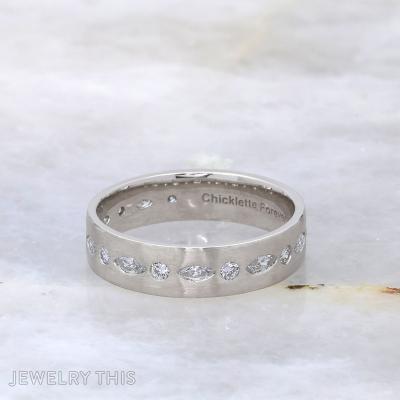
This men’s wedding band was built to mirror an existing engagement ring design, carrying the ...
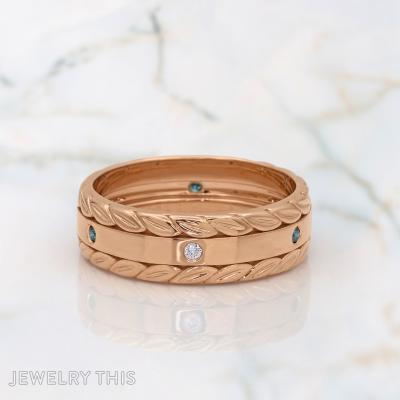
This wedding band was built around a design the client found and loved, then rebuilt ...

This men’s wedding band was built around a channel of rectangular baguette diamonds running the ...

This wedding band was rebuilt entirely from a client’s memory and description after the original ...
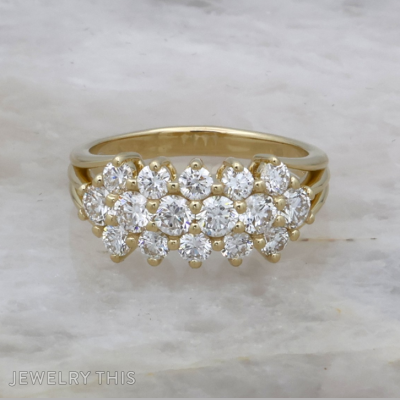
This 14k yellow gold ring recreates a wedding band that had been lost after years ...

This wedding band was designed as a companion piece to an existing engagement ring, continuing ...
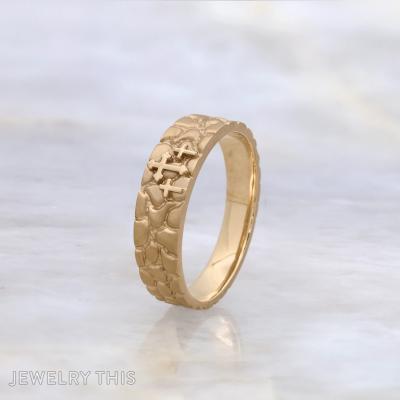
This wedding band was built around a specific request: a nugget-textured gold surface with three ...
This thin men’s wedding band is crafted in 14k white gold with a soft matte ...

This men’s wedding band is built around a single-branch design, textured to read like real ...

This wedding band was rebuilt as a faithful recreation of a piece that had been ...



