


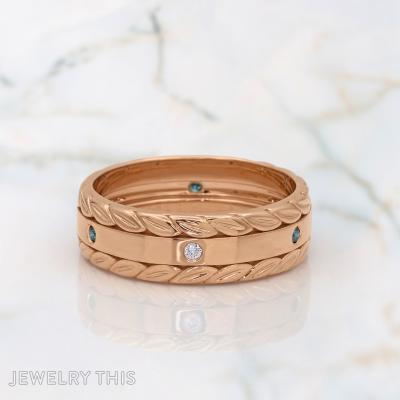

Rose Gold Leaf Wedding Band with Diamond Accents
$$
14k rose gold, lab-created diamonds, natural blue diamonds
A client came to us with a photo of a ring design she loved and asked if we could build something similar for her husband's wedding band. She specified 14k rose gold with lab-created diamonds alternating with blue diamonds, sized for his hand at a substantial 7mm width. When the render came back, she wrote: 'That's perfect!! I understand the metal might look slightly different... I'm excited to move to the next step!'
"That's perfect!! I understand the metal might look slightly different. As long as it's as close to rose gold as you can it's fine. I'm excited to move to the next step!" — on seeing the first render
Quick specs
Primary Metal
Shape / Cut
Primary Stone
Design Complexity
Intent: Certainty
Size
Ring size 8.5 US. Band width 7mm.
How they made it distinctive
-
01
Leaf engraving confined to the top and bottom edges only, leaving a smooth polished channel for the flush-set stones
-
02
Alternating stone colors — three lab-created colorless diamonds and two natural blue diamonds — create a rhythm rather than a single dominant stone
-
03
Built at a substantial 7mm width specifically to suit a man's hand, wider than a typical women's band
-
04
Design was adapted from a reference photo the client found rather than built from scratch, then customized in rose gold and a different stone mix
-
05
Flush setting keeps all five stones protected and level with the band surface for daily wear
How you'd make it yours
Stone type: this piece uses lab-created colorless and natural blue diamonds; a new commission could use all-natural stones or a different color combination
Metal: this piece is 14k rose gold; the same engraved-edge design works in yellow or white gold
Band width: this piece is 7mm; a new commission could be made narrower or wider depending on the wearer's hand
Engraving: the top and bottom leaf pattern could be adapted into a different motif on a new piece
One of a kind: this exact ring was designed for one client's husband and is not reproduced — a new commission is an original piece inspired by this one, not a copy
Design changes made
The initial band width discussed was 6mm, but the client asked for it to match a reference photo more closely, and the final width was confirmed at 7mm to suit a man's hand.
Who this is for
This piece is for someone who wants a wedding band with real detail and dimension but not a flashy centerpiece stone. It suits a wearer who prefers texture and pattern — like the engraved leaf edges here — over a plain polished band, and who likes the idea of a subtle color rhythm rather than uniform diamonds.
How it's made
Once the design was approved, a wax model was 3D printed and attached to a wax tree inside a flask, which was then placed in a kiln to burn out the wax and leave a hollow mold. Molten 14k rose gold was cast into that mold, then the piece was extracted, cleaned, and polished ahead of finishing.
The engraved leaf pattern along the upper and lower edges was refined after casting so the detail read cleanly at 7mm width, while the center channel was left smooth and polished to contrast with the textured edges. The five stones — three lab-created colorless diamonds and two natural blue diamonds — were then set by hand in an alternating pattern along that polished center strip, flush with the surrounding metal.
Key note
The leaf engraving is confined to the upper and lower edges of the band specifically so the center channel stays smooth and flush for the flush-set stones — mixing a textured finish with a set stone surface on the same narrow band is a deliberate finishing sequence choice, not a default.
Pricing guidance
A 7mm engraved rose gold wedding band with five alternating diamonds sits in the mid range for custom bands of this complexity. Most of the cost comes from the hand-finishing required to keep the leaf engraving crisp at this width and from setting five stones flush into a polished channel. Stone count, stone type, and band width are what move the price most from there.
Moves price up ↑
- ↑ Increasing stone count beyond five across the center channel
- ↑ Upgrading the blue diamonds to natural colorless diamonds of the same size
- ↑ Extending the leaf engraving to cover the full band rather than just the top and bottom edges
- ↑ Increasing band width beyond 7mm, which adds material and engraving surface
- ↑ Adding matching engraving to the interior of the band
Moves price down ↓
- ↓ Reducing band width from 7mm to a narrower profile
- ↓ Using all lab-created diamonds instead of mixing in natural blue diamonds
- ↓ Reducing the stone count from five to three
- ↓ Simplifying the leaf pattern to a single edge rather than both top and bottom
- ↓ Choosing 10k gold instead of 14k
Questions people ask
Yes, a reference photo is a common and effective starting point for a custom band. The design team builds a sketch and then a 3D render based on the photo and your specifications, and you can request adjustments before anything is cast. In this case the client provided a reference image and asked for the same alternating diamond pattern in a different metal and width. The render stage is where small deviations from the photo — like exact stone placement or engraving depth — get corrected.
Lab-created diamonds are chemically and optically identical to natural diamonds, just grown in a controlled environment rather than mined, and they typically cost less for the same size and clarity. Natural blue diamonds get their color from trace boron during formation and are considerably rarer, which is why they carry a different price point than a lab-grown colorless stone of similar size. Combining both in one piece, as this band does, lets you get a color contrast without paying a premium for every stone to be a natural fancy color. Durability-wise both are genuine diamond, so they perform identically on the hand.
14k rose gold is a strong choice for daily wear because the alloy mix that gives it a pink tone also makes it harder than higher-karat yellow or white gold. An engraved pattern on the edges, like the leaf motif on this band, will soften slightly over years of wear the way any engraving does, but it holds up well under normal use. The flush-set stones in the center channel are protected by the surrounding metal, which reduces the risk of snagging or chipping compared to raised prong settings. Occasional professional polishing can help keep the engraving crisp over time.
A 7mm rose gold band with hand engraving and five flush-set diamonds sits in the mid range for custom wedding bands of this complexity. The main cost drivers are the labor for keeping the engraving clean at that width and the hand-setting of multiple stones into a polished channel rather than a single setting. Simpler versions with fewer stones or a narrower band bring the cost down, while wider bands or additional stones raise it. The metal choice and whether stones are lab-created or natural also shift the price.
The design phase typically takes about a week, during which a sketch and then a photorealistic 3D render are produced for approval. Once the design is approved, production takes roughly three to four weeks, covering wax modeling, casting, polishing, and hand stone-setting. So the full process from first conversation to a finished ring is usually five to six weeks total. Timelines can extend if a design requires custom-cut stones or additional sourcing.
A band like this, with engraving on the top and bottom edges and flush-set stones in the center, can generally be resized within a modest range using standard jewelry techniques. Because the stones are flush-set rather than raised, resizing doesn't put them at risk the way it might with prong-set stones near the shank. Larger resizes may affect the spacing of the engraved pattern near the join, so it's worth discussing the specific range needed with a jeweler before committing. Minor adjustments of half a size or so are usually straightforward.
Yes, alternating stone colors around a center channel is a straightforward design element to build into a custom band. The key considerations are stone size consistency and making sure the setting style — flush, bezel, or prong — works with the spacing you want between colors. In this case five stones were set alternately in a flush pattern, but the same idea works with more or fewer stones depending on band width. Getting the render approved before casting is the best way to confirm the rhythm of the color pattern looks right.
Explore Similar Creations
Every masterpiece starts with a spark. Explore how our clients raw ideas - sketches, heirlooms, inspirations - were transformed into bespoke works of arts.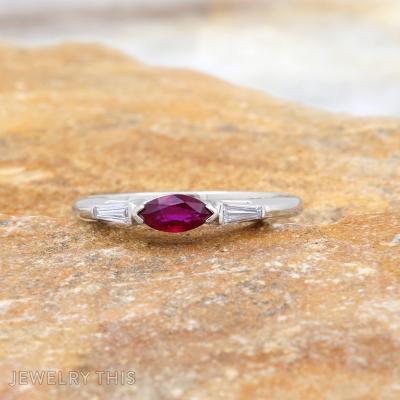
This platinum band recreates the style of a 1940s-era ring using the client’s own marquise ...

Celebrate timeless love with our meticulously recreated diamond band. This exquisite piece features a milgrain ...
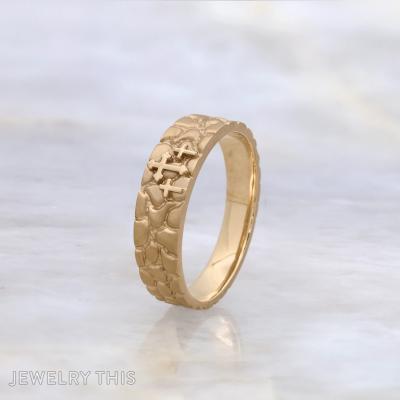
This wedding band was built around a specific request: a nugget-textured gold surface with three ...
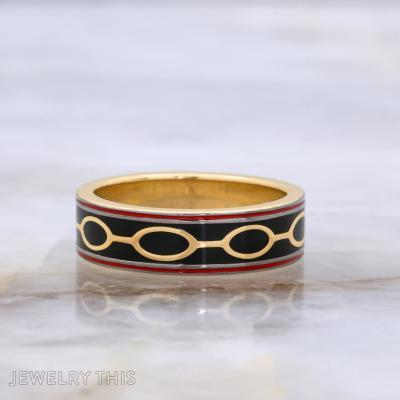
This wedding band pairs 14k yellow gold with black and red hot enamel to create ...
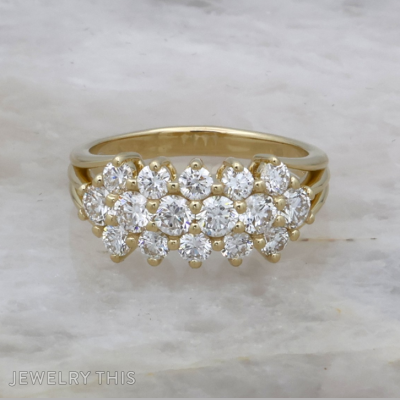
This 14k yellow gold ring recreates a wedding band that had been lost after years ...

This wedding band was thoughtfully designed to complement and enhance the beauty of an existing ...
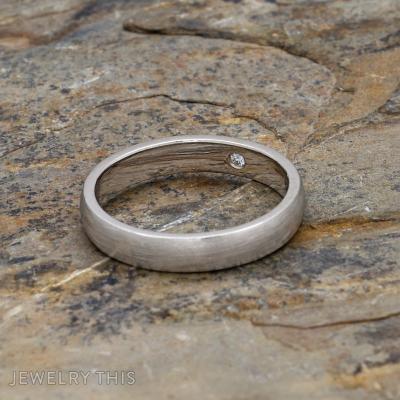
This thin men’s wedding band is crafted in 14k white gold with a soft matte ...

Two interlocking bands made of 14k white gold with channel set with VS1 diamonds in ...
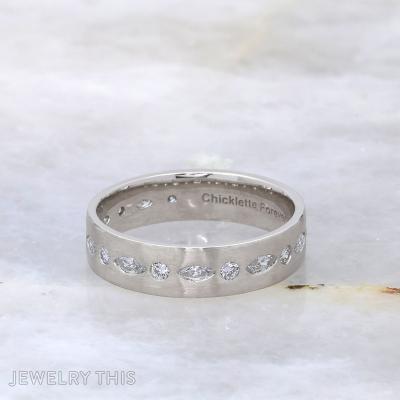
This men’s wedding band was built to mirror an existing engagement ring design, carrying the ...

Full eternity white diamond band set in a micro-pave setting style in 18k white gold. ...

This platinum band is the definition of timeless elegance. The band features a sleek flat ...

Matching wedding bands with a unique yin and yang design that includes white and black ...



