


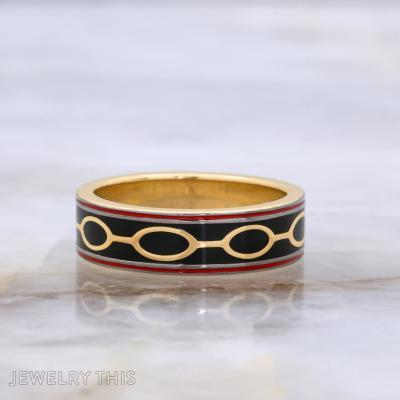


Black & Red Enamel Chain-Link Wedding Band in Gold
$$$
14k yellow gold, black rhodium plating, black enamel, red enamel
A.B. came to us to design two unmatched wedding bands — one for his fiancé and one for himself, each telling its own story. This one was designed for his partner, drawing on the color palette and pattern of a favorite creature design he loves, translated into a gold chain-link motif set against black and red enamel. The design went through several rounds of revision — stretching the pattern around the full band, adjusting the oval shapes, and solving how to keep the gold pattern flush with the enamel — before landing on a version they were both excited about.
'He is happy with the design! Please let us know what the next steps are.' — on design approval
Quick specs
Primary Metal
Primary Stone
Accent Stones
Design Complexity
Intent: Certainty
Size
Ring size 6.5 US. Band width 6mm.
How they made it distinctive
-
01
Chain-link pattern stretched to run the full circumference rather than leaving a visible gap, reworked over several rounds until the proportions felt right
-
02
Gold border lines kept in place around each enamel field out of structural necessity, then incorporated into the final look rather than treated as a flaw
-
03
Black enamel used as the recessed background instead of gold, keeping the raised chain pattern and red stripes at a consistent surface height without widening the band
-
04
Black rhodium plating added selectively to part of the outer edge for extra contrast, adjusted after casting when one edge wouldn't hold the plating
-
05
Two unmatched wedding bands designed as a pair, each with its own independent story rather than a coordinated his-and-his set
How you'd make it yours
Enamel colors: this piece uses black and red — a new commission could use any two-color combination that reads well in fused enamel
Metal: this piece is 14k yellow gold — the same enamel framing works in 18k yellow gold or could be adapted to white gold for a cooler contrast
Pattern: this piece uses a stretched oval chain-link motif — a new commission could translate a different personal reference into a similar raised linear pattern
Plating: this piece has partial black rhodium on the outer edge — a new piece could use full-edge plating, no plating, or a different plating color
Band width: this piece is 6mm — a wider band would allow a fully raised pattern without a recessed enamel background
One of a kind: this exact ring was designed for one client's partner and is not reproduced — a new commission is an original piece inspired by this one, not a copy
Design changes made
The chain pattern was stretched to run the full circumference instead of leaving a gap, and the flat gold border lines were kept (they turned out to be structurally necessary to hold the enamel) while the surrounding field was changed to black enamel instead of gold. Black rhodium plating was added to the outer edge late in the design phase, then scaled back after casting when the plating wouldn't adhere reliably to that specific edge.
Who this is for
This piece is for someone who wants a wedding band that reflects a specific personal interest rather than a conventional design — someone willing to go through a few rounds of back-and-forth to get proportions and structural details exactly right. It's especially right for a couple choosing two entirely different bands rather than a matching set, each ring speaking to its wearer individually.
How it's made
Once the final design was approved, the piece moved into design quality assurance before a wax model was 3D-printed and shared with the client as a resin preview. That wax model was attached to a tree, invested in plaster, and fired in a kiln to burn out the wax, leaving a hollow mold. Molten 14k yellow gold was then cast into the mold under pressure, producing the raw ring, which was cleaned, polished, and finished.
The band's enamel was applied in two colors — black in the recessed central channel and red in the twin stripes near each edge — with the raised gold chain-link pattern left exposed at the same height as the surrounding enamel. Gold border lines around each enamel field were left in place structurally, since they frame and hold the enamel during application. Black rhodium plating was applied afterward to part of the outer edge, though one specific edge did not hold the plating reliably during finishing and was left in gold instead.
Key note
The thin gold lines bordering each enamel field aren't a design choice but a structural necessity — they frame and contain the enamel during application and can't be removed without letting the colors bleed together.
Pricing guidance
A wide enamel wedding band with a raised metal pattern and multi-color detailing sits in the mid range for custom bands of this complexity. Hot enamel application and hand-finishing around a raised pattern are labor-intensive steps that drive most of the base cost, more so than the gold content itself at this width. Adding plating, adjusting the pattern density, or increasing the band width all shift the price from there.
Moves price up ↑
- ↑ Adding black rhodium plating across the full band rather than a partial edge
- ↑ Increasing the band width beyond 6mm to accommodate a raised, three-dimensional pattern
- ↑ Using additional enamel colors or more intricate multi-layer enamel work
- ↑ Upgrading from 14k to 18k yellow gold
- ↑ Adding more chain links or a denser repeating pattern around the band
Moves price down ↓
- ↓ Reducing to a single enamel color instead of two
- ↓ Narrowing the band width
- ↓ Skipping the black rhodium plating entirely and leaving the edges in polished gold
- ↓ Simplifying the chain-link pattern to fewer, larger elements
- ↓ Choosing a flat engraved pattern instead of a raised enamel-framed design
Questions people ask
Enamel is a fused glass coating that is more prone to wear over time than solid gold on its own, particularly with repeated impact or friction. It can be restored or redone by a jeweler if it chips or dulls with years of daily wear. Enamel is also sensitive to heat and movement, which makes resizing a ring with enamel details more difficult than resizing a plain band. Most enamel wedding bands hold up well for years of typical daily wear before any touch-up is needed.
Black rhodium is a plating applied over a base metal, in this case 14k yellow gold, to create a dark grey-black finish rather than a true black. It is not as durable as enamel and will gradually wear off with regular skin contact and friction, especially on edges that see the most contact. When it fades, it can be re-plated by a jeweler to restore the look. Some areas of a ring may hold plating better than others depending on shape and how much daily contact that area receives.
Yes, a raised metal pattern set into recessed enamel is achievable, though it requires enough band width to meet casting requirements. Making a central design sit above the surface without an enamel background typically requires widening the band so there's enough material thickness to support the raised detail plus the surrounding enamel channel. If the width needs to stay narrow, the raised pattern can instead sit flush with a recessed enamel field around it, which keeps the surface height consistent.
A wide enamel band with a raised chain-link style pattern and two enamel colors sits in the mid range for custom wedding bands of this complexity. The enamel application and hand-finishing around the raised pattern are the main cost drivers, more than the gold content at a 6mm width. Adding plating, more colors, or a wider band all increase the price from there, while simplifying the pattern or reducing colors brings it down.
The full process from design approval to a finished ring typically takes about five to six weeks. The first week or so covers the sketch and 3D render stage, where the client reviews and requests adjustments before anything is cast. Once the design is approved and paid for, production, enamel application, and finishing generally take four to five more weeks. Complex enamel work or plating adjustments discovered during production can occasionally add a bit of time.
Enamel is essentially colored glass fired onto metal, and it needs a physical barrier to keep different colors from touching and bleeding into each other during application. Thin raised metal lines act as that barrier, framing each enamel field and holding the material in place while it sets. Removing these borders entirely isn't possible without redesigning how the colors are separated. This is a structural requirement of enamel work, not a stylistic choice that can simply be dropped.
Resizing a ring with enamel is more difficult than resizing a plain metal band because the heat and pressure involved in resizing can crack or dislodge the enamel. It is not impossible, but it requires a jeweler experienced with enamel work and carries some risk to the finish. For this reason, it's especially important to confirm ring size carefully before production on an enamel piece. Minor resizing may be possible in some cases, but significant size changes are riskier than on an unadorned band.
Yellow gold is a common choice for enamel bands because its warm tone contrasts clearly against both black and red enamel fields. White gold or platinum would shift the look toward a cooler, more monochrome contrast with the red and black. The metal choice mainly affects the background tone rather than the enamel durability itself, since the enamel sits in its own recessed channel regardless of metal. 14k gold offers a practical balance of durability and cost for a band that will see daily wear.
Explore Similar Creations
Every masterpiece starts with a spark. Explore how our clients raw ideas - sketches, heirlooms, inspirations - were transformed into bespoke works of arts.
This mesmerizing White gold band features three enchanting rows of small round stones, creating a ...
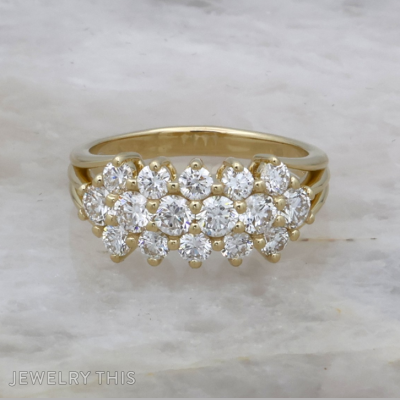
This 14k yellow gold ring recreates a wedding band that had been lost after years ...

Two interlocking bands made of 14k white gold with channel set with VS1 diamonds in ...

Matching wedding bands with a unique yin and yang design that includes white and black ...
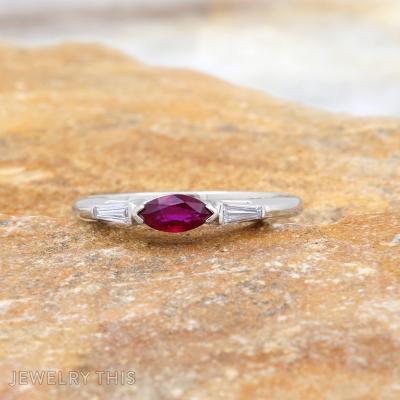
This platinum band recreates the style of a 1940s-era ring using the client’s own marquise ...
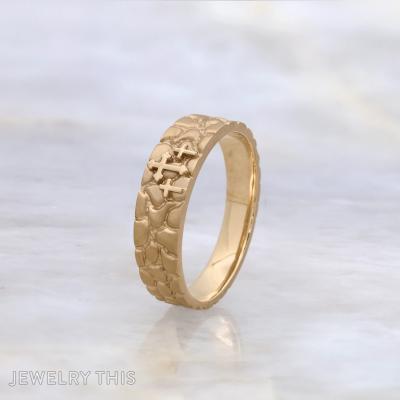
This wedding band was built around a specific request: a nugget-textured gold surface with three ...
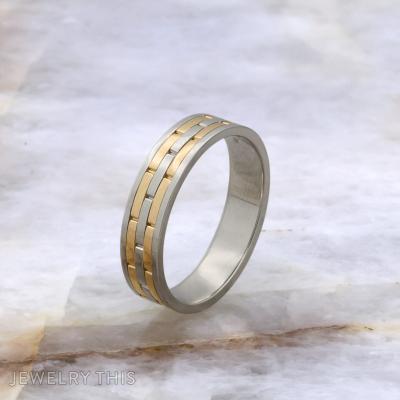
This wedding band recreates a ring lost in a lake after years of daily wear ...
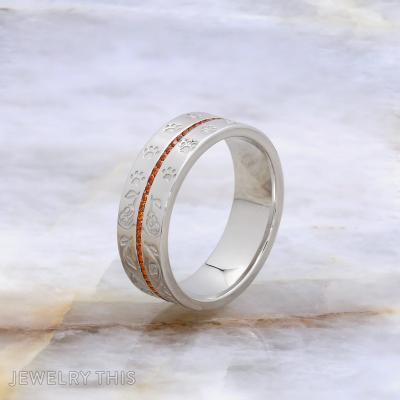
This wedding band pairs two engraved motifs on a wide sterling silver band, separated by ...

Full eternity white diamond band set in a micro-pave setting style in 18k white gold. ...
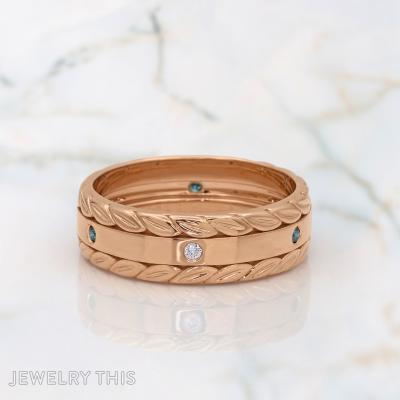
This wedding band was built around a design the client found and loved, then rebuilt ...

This platinum band is the definition of timeless elegance. The band features a sleek flat ...

This wedding band was thoughtfully designed to complement and enhance the beauty of an existing ...



