
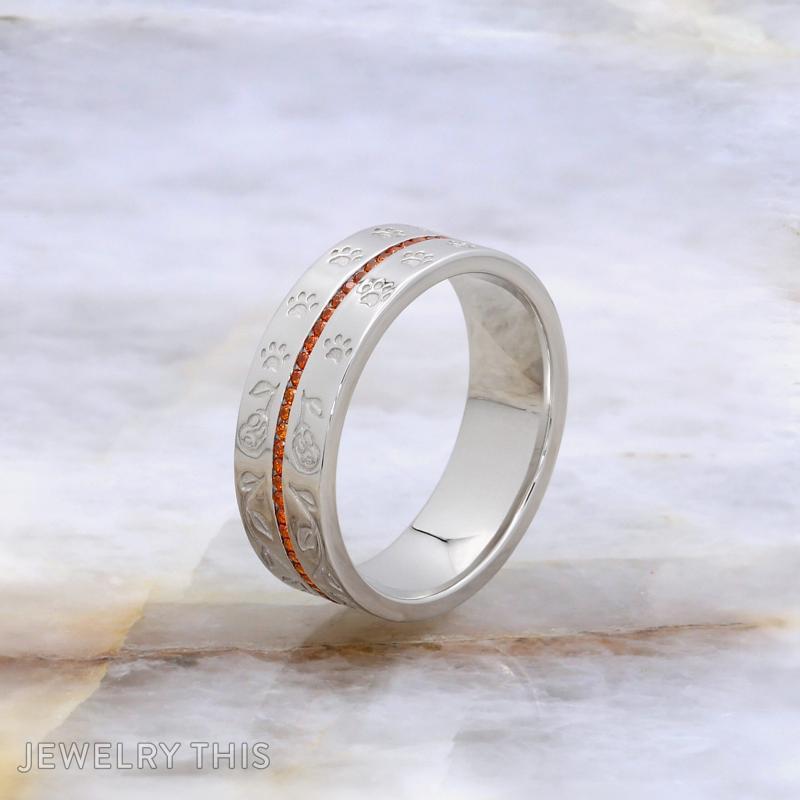
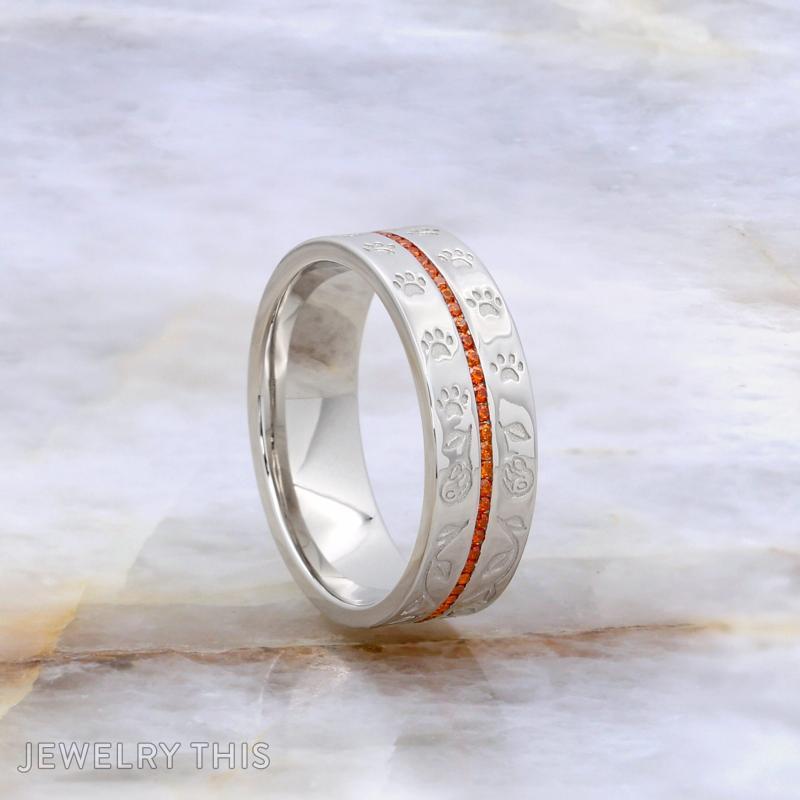
Paw Print & Rose Wedding Band with Orange Sapphires
$$
Sterling silver, lab-grown orange sapphires
A man designed his partner's wedding band around two things that define her: a horse she loved and lost, and her deep involvement in the world of dogs through her work and dog sports. He wanted her initials for both worlds engraved where they wouldn't scratch or catch on their kids, with a center row of orange stones because orange and sparkle are simply her. When the ring arrived, he wrote that she was thrilled with the results.
'That is beautiful!!! I look forward to seeing the model!' — on seeing the technical drawing
'The lab grown sapphires option is the way she wants to go! It looks fantastic and we love it!!' — on design approval
'She was super excited and thrilled and loved the results as did I!' — on delivery
Quick specs
Primary Metal
Shape / Cut
Primary Stone
Accent Stones
Style
Design Complexity
Intent: Certainty
Size
Ring size 9 US. Band width 7mm.
How they made it distinctive
-
01
Two distinct engraved motifs on one band — paw prints and leaves on one side, roses and leaves on the other — each representing a different part of the wearer's life
-
02
Engraving placed on the outer surface specifically so the raised pattern won't scratch or catch on children
-
03
Center channel set with lab-grown orange sapphires chosen to match the wearer's favorite color and love of sparkle
-
04
A small solid, stone-free section built into the design at the pattern transition point so the ring can be resized later without disturbing the stones
-
05
7mm width chosen specifically to give both engraved patterns enough surface to read clearly alongside the center stone channel
How you'd make it yours
Stone type: this piece uses lab-grown orange sapphires; a new commission could use natural sapphires, other colored stones, or return to an enamel inlay
Metal: this piece is sterling silver; the same engraved design language works in 14k or 18k gold for more durability
Motif: this piece pairs paw prints with roses; a new commission could reflect any two meaningful subjects, animals, symbols, or scenes
Band width: this piece is 7mm to hold two engraved motifs plus a stone channel; a narrower or wider band changes how much detail fits
One of a kind: this exact ring was designed for one couple's story and is not reproduced — a new commission is an original piece inspired by this one, not a copy
Design changes made
The center inlay changed from orange enamel to a row of small lab-grown orange sapphires after the client asked about adding sparkle, and a short stone-free section was added at the pattern transition point to allow for future resizing.
Who this is for
This is for someone who wants a wedding band that quietly carries two specific parts of a partner's identity rather than a plain or generic design. It fits someone drawn to engraved, tactile detail and a pop of color, and who wants a practical design choice, like outer-surface engraving, built in for a hands-on family life.
How it's made
Once the technical drawing and 3D render were approved, a wax model of the ring was 3D printed and shown to the client as a resin preview before casting. The wax was attached to a tree, invested in plaster, and burned out in a kiln to leave a hollow mold, into which molten sterling silver was poured to form the raw band.
After casting and cleanup, the two flanking bands were engraved on the outer surface with the paw-print-and-leaf pattern on one side and the rose-and-leaf pattern on the other, leaving the inner-facing metal smooth. The center channel was then set by hand with small round lab-grown orange sapphires in sequence, stopping short at one point to leave a small solid section for future resizing before final polishing.
Key note
The ring was recast entirely after a porosity defect (tiny internal air bubbles) was found during final polishing, since that flaw would have compromised the band's long-term strength.
Pricing guidance
A wide engraved sterling silver wedding band with a full stone-set center channel sits toward the higher end for silver custom work, mainly because of the labor split between two-sided engraving and hand-setting a continuous row of stones. Sterling silver keeps the material cost down relative to gold, so most of the price reflects the design's complexity rather than metal cost.
Moves price up ↑
- ↑ Switching from lab-grown to natural orange sapphires for the center row
- ↑ Upgrading the band metal from sterling silver to 14k or 18k gold
- ↑ Extending the stone row fully around the band with no resizing gap
- ↑ Adding a third engraved motif or extending the current engraving further around the band
- ↑ Increasing band width beyond 7mm to add more surface detail
Moves price down ↓
- ↓ Using orange enamel instead of set stones for the center inlay, as originally quoted
- ↓ Reducing the design to a single engraved motif instead of two
- ↓ Narrowing the band width, which reduces engraving surface and metal used
- ↓ Choosing a single continuous engraved pattern rather than two distinct motifs
- ↓ Using a lower stone count by widening the gaps between sapphires
Questions people ask
Yes, that's exactly how this band was built. The paw-print and leaf patterns are engraved into the outer surface rather than raised above it, so there's no sharp relief to catch on hair, clothing, or a child's hand. This is a common request for parents or anyone who works with their hands and wants texture without risk of snagging. The tradeoff is that engraved detail reads more subtly than a raised or 3D design.
Yes. Sapphire, whether natural or lab-grown, rates a 9 on the Mohs hardness scale, just below diamond, so it resists scratching extremely well for daily wear. Lab-grown sapphire is chemically identical to natural sapphire, just grown in a controlled environment rather than mined, so the durability is the same. The main reason to choose lab-grown is cost and easier availability in small, uniform sizes like the ones used in this center row.
Sterling silver is softer than gold or platinum, so it will pick up surface scratches and require occasional polishing over years of daily wear. It does not require rhodium plating and won't discolor from allergic reactions the way some base metals can. For a band with engraved detail like this one, the silver's softness actually makes it easier to engrave crisply. If long-term scratch resistance is the top priority, gold or platinum would hold up longer, but at a higher cost.
A wide sterling silver band with two-sided engraving and a full stone-set center channel typically falls in the low-to-mid range for custom bridal work. Most of the cost comes from labor: engraving two distinct patterns by hand and setting a continuous row of small stones one at a time. Choosing enamel instead of set stones, or simplifying to a single engraved motif, brings the cost down noticeably.
From design approval to shipping, a band like this typically takes around four to six weeks, though delays can occur if a casting defect is found during quality checks and the piece needs to be recast. The process starts with a technical drawing, then a 3D render for approval, then production: wax model, casting, engraving, and stone setting. Sourcing small uniform lab-grown stones can add a short amount of time if the exact size isn't already in stock.
It depends on how the stones are set. If stones run all the way around the band with no break, resizing is difficult without disturbing the setting. This band was intentionally designed with a small solid, stone-free section at one pattern transition point specifically so it can be resized in the future without touching the set stones.
Yes, a band can carry two distinct engraved motifs, one on each side of a center stone channel, as long as the band is wide enough to give each pattern room to read clearly. This band used a 7mm width to fit a paw-print-and-leaf design on one side and a rose-and-leaf design on the other. Wider bands generally handle multiple motifs better than narrow ones.
Enamel is a colored material fused into a recessed channel, giving a smooth, flat, uniformly colored surface at a lower cost. Set stones, like the small orange sapphires used here, catch light and sparkle individually, giving more dimension and brilliance but at a higher cost due to the hand-setting labor. Enamel is more budget-friendly and very durable, while set stones read as more dressy and can be swapped for different stone types.
Explore Similar Creations
Every masterpiece starts with a spark. Explore how our clients raw ideas - sketches, heirlooms, inspirations - were transformed into bespoke works of arts.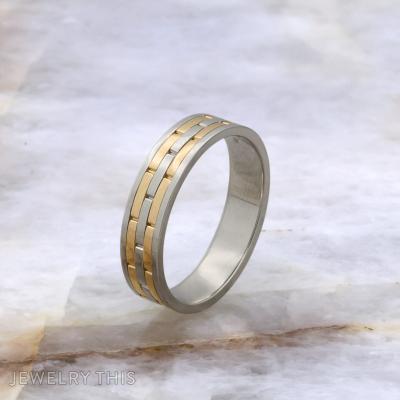
This wedding band recreates a ring lost in a lake after years of daily wear ...
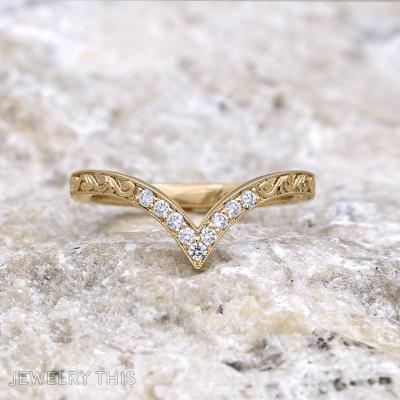
This wedding band was designed as a companion piece to an existing engagement ring, built ...
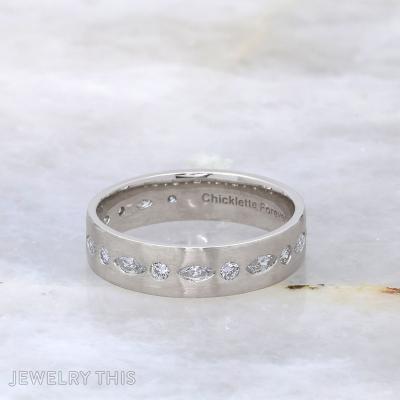
This men’s wedding band was built to mirror an existing engagement ring design, carrying the ...
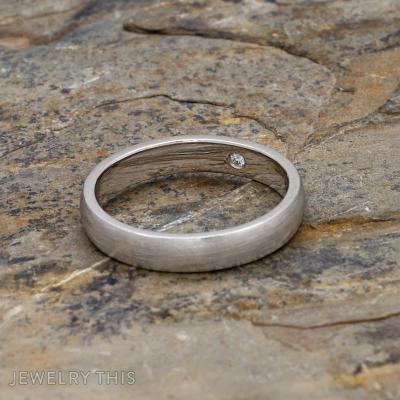
This thin men’s wedding band is crafted in 14k white gold with a soft matte ...

This mesmerizing White gold band features three enchanting rows of small round stones, creating a ...
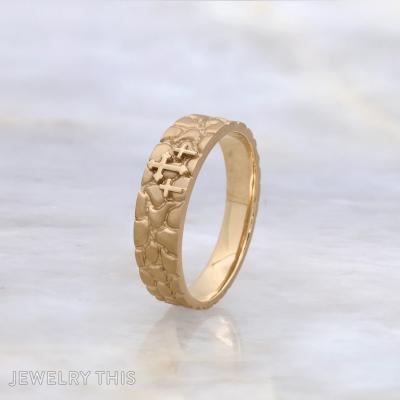
This wedding band was built around a specific request: a nugget-textured gold surface with three ...

This platinum band is the definition of timeless elegance. The band features a sleek flat ...

This wedding band pairs a straight, flat-profile shank with a graduated row of five prong-set ...

Two interlocking bands made of 14k white gold with channel set with VS1 diamonds in ...

This wedding band was thoughtfully designed to complement and enhance the beauty of an existing ...

This men’s wedding band was built around a channel of rectangular baguette diamonds running the ...

Matching wedding bands with a unique yin and yang design that includes white and black ...



