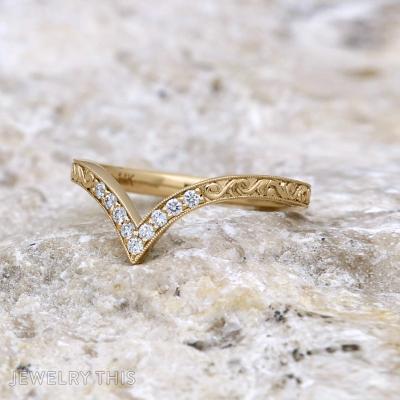
Contour Wedding Band with Filigree & Diamond Point
$$
14k yellow gold, lab-grown diamonds
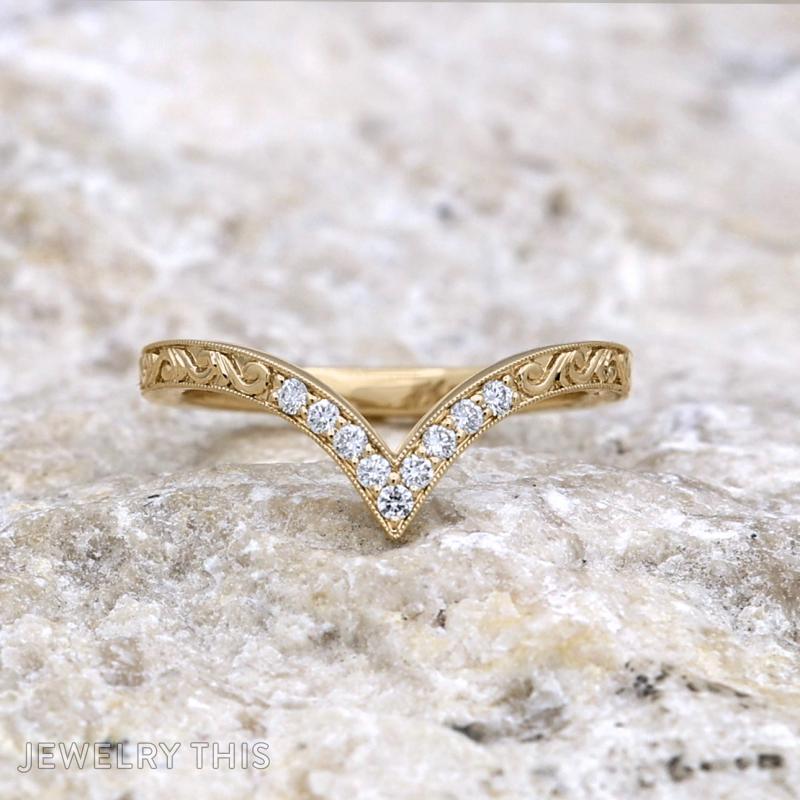
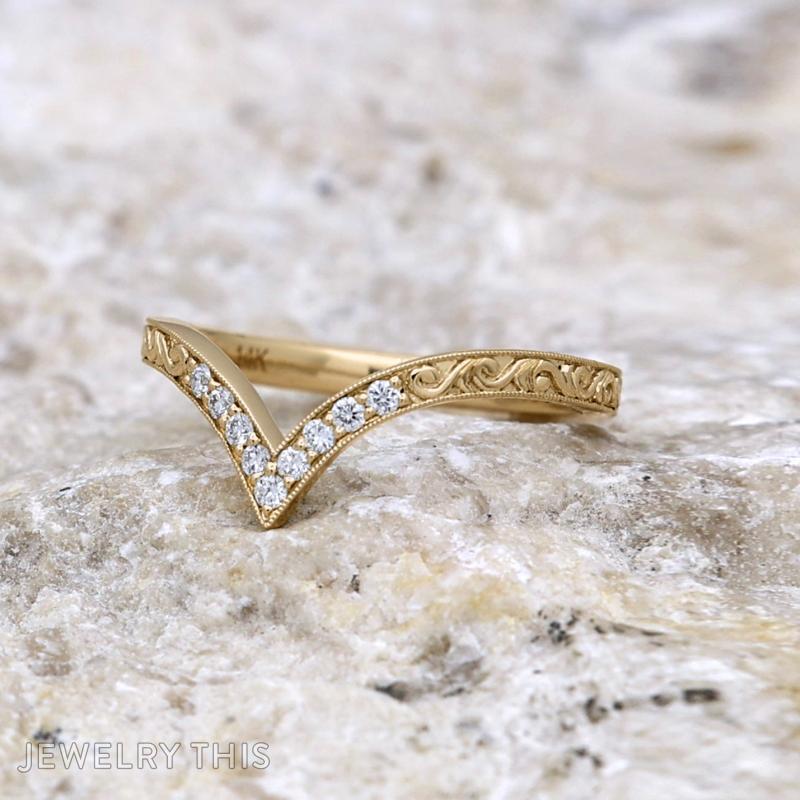
A.S. came back to the studio that made her engagement ring to design the wedding band to go with it, wanting the two to sit flush so they wouldn't rub over time. She asked for the same scroll filigree from her engagement band and, once she saw the render, asked for the pattern to be mirrored so the two rings would form a small heart shape where they met. When it arrived, she wrote: 'It fits perfectly with my engagement ring, and looks absolutely stunning.'
'Oh my goodness! I'm in tears! It's beautiful! I love it!' — on seeing the first render
'It fits perfectly with my engagement ring, and looks absolutely stunning.' — on delivery
Quick specs
Primary Metal
Shape / Cut
Primary Stone
Accent Stones
Design Complexity
Intent: Certainty
Size
Ring size 5.25 US (16.1mm). Band designed to sit flush against a contoured engagement ring, narrowing to a center point.
How they made it distinctive
-
01
Contoured shape engineered to sit flush against a specific engagement ring's halo, preventing long-term rubbing between the two bands
-
02
Filigree pattern mirrored from the engagement ring and flipped horizontally so the two rings form a small heart shape where they meet
-
03
Diamonds set only in a graduated cluster at the center point rather than along the full band, keeping the engraved pattern visible and the accent stones secondary to the engagement ring's center stone
-
04
Resin fit-test shipped to the client before casting so the fit against her engagement ring could be confirmed in person
-
05
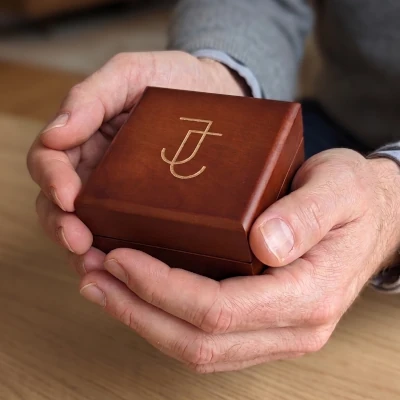
A private inside-band engraving added in italic script to keep the lettering legible at a small scale
How you'd make it yours
Stone type: this piece uses lab-grown diamonds — a new commission could use natural diamonds for the same look at a different cost
Metal: this piece is 14k yellow gold — the same filigree language works in 18k gold or rose gold
Filigree coverage: this piece has pattern flanking a center diamond cluster — a new piece could extend the engraving fully around the band
Engraving: the inside-band engraving on this piece can carry a new phrase or date on a fresh commission
One of a kind: this exact band was contoured to match one specific engagement ring and is not reproduced — a new commission is an original piece inspired by this one, not a copy
Design changes made
The client initially considered baguette diamonds set into the side walls, but this was ruled out because the band needed to stay slim enough to tuck under the engagement ring's frame — round diamonds were used instead. She also requested the filigree pattern be mirrored so the two bands would form a heart motif when worn together, and added a private engraving inside the band.
Who this is for
This is for someone who wants their wedding band to read as one design with their engagement ring, not a separate piece worn alongside it. It's especially right if you already love the design language of your engagement ring and want the band to echo it rather than introduce something new — and if a flush, non-rubbing fit matters to you for daily, long-term wear.
How it's made
Once the filigree pattern and stone layout were approved, the design was built as a 3D model and a resin sample was shipped to the client so she could confirm the fit against her engagement ring before any metal was cast. After that fit was confirmed, a wax tree was created and invested in plaster, then fired in a kiln to burn out the wax before molten 14k yellow gold was poured into the resulting mold.
After casting, the band was cleaned up and the scroll filigree pattern was hand-finished along both the top surface and the side profile to keep the engraved lines crisp. The graduated round lab-grown diamonds were then set by hand at the center point, and the piece was given a final polish to bring out the contrast between the engraved pattern and the smooth gold surface.
Key note
The resin fit-test happened before the wax model was ever cast, so the contour of the band against the engagement ring was verified while changes were still easy to make.
Pricing guidance
A contoured filigree wedding band designed to fit flush against an existing engagement ring sits in the mid range for custom bands of this complexity. Most of the cost comes from the hand-finishing required to keep an engraved pattern legible on a curved, low-profile band, plus the labor of matching its contour precisely to another ring. Diamond count and metal karat are the next biggest levers on price.
Moves price up ↑
- ↑ Extending the filigree engraving to run the full circumference of the band rather than just the visible portion
- ↑ Increasing the diamond count or upgrading from lab-grown to natural diamonds
- ↑ Using 18k gold instead of 14k
- ↑ Adding filigree or milgrain detail to the inner band surface as well
- ↑ Requesting multiple resin fit tests or design revisions beyond the standard round
Moves price down ↓
- ↓ Reducing the diamond cluster to a single stone or omitting stones entirely
- ↓ Simplifying the filigree pattern to a partial rather than continuous engraving
- ↓ Choosing a straight (non-contoured) band instead of one shaped to match another ring
- ↓ Using 10k gold in place of 14k
- ↓ Skipping the mirrored heart-motif detailing and using a standard single-direction pattern
Questions people ask
Yes. When a jeweler has the specifications or design files for the original engagement ring, a wedding band can be contoured to follow the exact shape of the ring's setting so the two sit together without a gap. This typically involves building a 3D model of both rings together and shipping a resin sample so the wearer can try the fit before any metal is cast. Contouring works especially well when the engagement ring has a distinct shape, like a curved halo or a pointed silhouette, since the band can be shaped to trace that line. This approach reduces rubbing and wear between the two rings over years of daily wear.
Lab-grown and natural diamonds have identical hardness, both ranking 10 on the Mohs scale, so there is no difference in day-to-day durability. The two are chemically and structurally identical; the only difference is origin. Lab-grown diamonds typically cost less than natural diamonds of comparable size, color, and clarity. For small accent stones like those used in a wedding band, this makes lab-grown a practical choice without any compromise in wear performance.
A contoured wedding band with hand-engraved filigree and a small diamond cluster generally sits in the mid range for custom band work. The main cost driver is labor: hand-engraving a scroll pattern on a curved, low-profile band takes considerably more time than a plain or machine-textured band. Diamond count, metal karat, and how much of the band surface carries the pattern all move the price from there. A simpler version with less engraving or fewer stones would fall toward the lower end of that range.
From design approval to delivery, a piece like this typically takes around five to six weeks. The first one to two weeks cover the 3D design and, when a precise fit against another ring is needed, a resin sample is shipped to the client to try on before casting begins. Once the fit is confirmed, casting and stone setting take roughly four to five weeks. Adding a fit-test step for a contoured band can add a few days versus a standard band that isn't shaped to match another ring.
Yes, filigree scrollwork can be engraved along the side profile of a band as well as the top surface, as long as the band has enough width and height to carry the detail clearly. This is different from setting stones into the side walls, which requires more metal thickness to have room for the settings. A purely engraved side pattern can be added to a slimmer band than one that also has side-set stones, since engraving doesn't require the same structural depth.
Yes. A common approach is to set a small cluster or a short row of round diamonds at one focal point of the band, flanked by the filigree pattern, rather than covering the entire surface with stones. This keeps the engraved detail legible and lets the diamonds act as a sparkle accent rather than the main feature. Round stones are typically used for this kind of setting because their shape is more forgiving in tight spaces than fancy cuts. This balance is especially important when the band is meant to complement a larger center stone on a paired ring.
Yes, inside-band engraving is a standard option on most rings, including contoured or shaped bands, as long as there is enough flat interior surface for the text. Because the lettering is small, ornate or highly decorative fonts can become illegible at that scale, so a simpler italic or block style is usually recommended over elaborate script. The engraving is applied after the ring is cast and finished. It's worth seeing a sample or model of the ring before finalizing font choice, since the actual scale of the lettering is hard to judge from a description alone.
A halo setting can shift or flatten slightly at a point if it takes a hard knock or sustained pressure against a hard surface, which can happen with normal daily wear over months or years. This is more likely on thinner or more delicate points of a halo shape than on a rounded outline. Most jewelers can assess and correct this kind of deformation once the piece is sent in for inspection, since a repair plan depends on seeing the actual damage in person. Routine wear-and-tear repairs like this are a normal part of long-term ring ownership and are not a sign of a manufacturing flaw.
Explore Similar Creations
Every masterpiece starts with a spark. Explore how our clients raw ideas - sketches, heirlooms, inspirations - were transformed into bespoke works of arts.
Two interlocking bands made of 14k white gold with channel set with VS1 diamonds in ...

This wedding band was designed to perfectly complement the client’s engagement ring. This band features ...

This platinum band is the definition of timeless elegance. The band features a sleek flat ...

Full eternity white diamond band set in a micro-pave setting style in 18k white gold. ...
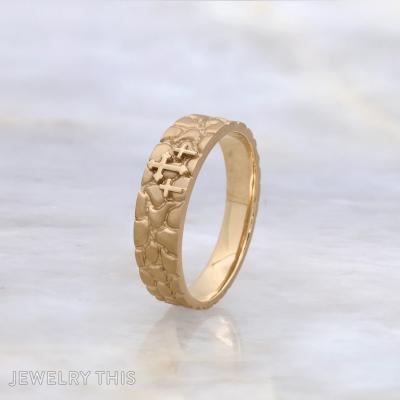
This wedding band was built around a specific request: a nugget-textured gold surface with three ...

This wedding band was thoughtfully designed to complement and enhance the beauty of an existing ...

Matching wedding bands with a unique yin and yang design that includes white and black ...
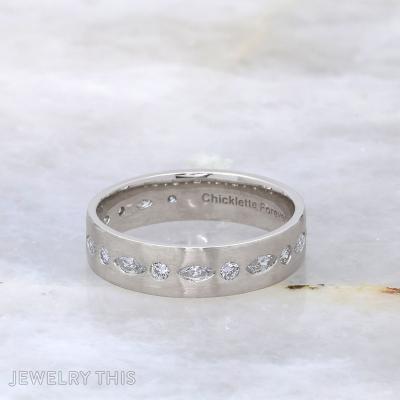
This men’s wedding band was built to mirror an existing engagement ring design, carrying the ...
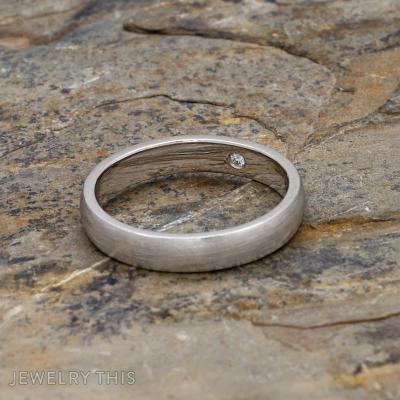
This thin men’s wedding band is crafted in 14k white gold with a soft matte ...

Celebrate timeless love with our meticulously recreated diamond band. This exquisite piece features a milgrain ...
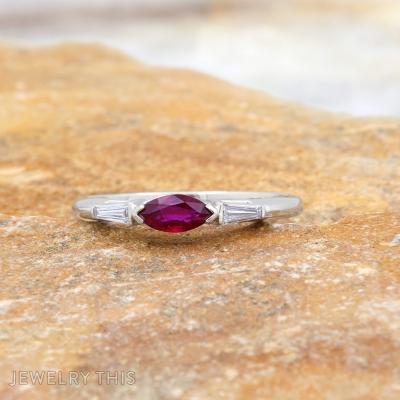
This platinum band recreates the style of a 1940s-era ring using the client’s own marquise ...

This mesmerizing White gold band features three enchanting rows of small round stones, creating a ...