

Recreated Engraved Gold Wedding Band With Diamonds
$$
14k yellow gold, natural diamonds
A client came to us hoping to recreate her husband's wedding band after it was lost years earlier and never found. All she had was one photo and an old purchase confirmation from a jeweler no longer in business. She wanted the recreated ring for their son to have one day. When it arrived, she wrote simply: 'Love it. Thank you all again.'
'Love it. Thank you all again.' — on delivery
Quick specs
Primary Metal
Shape / Cut
Primary Stone
Accent Stones
Design Complexity
Intent: Certainty
Size
Ring size 11 US (20.57mm).
How they made it distinctive
-
01
Hand-engraved scroll and leaf pattern wraps the entire band, rebuilt from a single photograph of the original ring
-
02
Twelve diamonds flush-set along both edges echo the original ring's diamond chips
-
03
Ridged border used around the engraving as a structural workaround after a true recessed lip wasn't possible with the diamond settings
-
04
Recreated without any paperwork or appraisal, using only a photo and an old purchase confirmation
-
05
14k yellow gold chosen to match the warmth and material of the original band
How you'd make it yours
Stone type: this piece uses natural diamonds; a new commission could use lab diamonds for the same look at lower cost
Engraving pattern: this piece uses a scroll-and-leaf motif; a new design could use a different repeating pattern
Metal: this piece is 14k yellow gold; the same engraved style works in 18k gold or rose gold
Stone count: this piece uses 12 diamonds; a new commission could use more or fewer depending on preference
One of a kind: this exact ring was recreated for one family and is not reproduced — a new commission is an original piece inspired by this one, not a copy
Design changes made
The client asked for a raised lip around the engraved pattern to make it look recessed, but the diamond-setting structure on the sides made that impossible; instead a ridged border was used to get as close as possible to the original look, which the client approved.
Who this is for
This piece is for someone trying to bring back a ring that mattered when the original is gone for good and there's little to work from — a photo, an old receipt, a memory. It's especially right if the goal is passing something forward, not just replacing what was lost.
How it's made
Once the design was approved, the ring was 3D printed in wax using the finalized digital model, then attached to a tree and invested in plaster. The flask was fired in a kiln to burn out the wax, leaving a hollow mold, and molten 14k yellow gold was cast into it under pressure. After cooling, the raw band was removed from the mold and prepared for cleaning, polishing, and finishing.
The hand-engraved scroll and leaf pattern was refined and sharpened after casting, since engraved detail reads softer straight out of the mold. Twelve round diamonds were then set flush along both edges of the band, within a narrow ridged border designed to echo the recessed look of the original ring without compromising the stone settings. The band was given an overall polish to complete the piece.
Key note
The ridged border around the engraving wasn't a stylistic choice but a structural workaround — the diamonds set into the band's sides made a true recessed lip impossible, so the ridge was the closest achievable match to the original ring's look.
Pricing guidance
A hand-engraved gold wedding band with a dozen small flush-set diamonds sits in the mid range for custom band work. The engraving is the main cost driver here, since the all-around scroll pattern requires significant hand-finishing time regardless of metal choice. Diamond count and gold karat are the next biggest levers on price.
Moves price up ↑
- ↑ Increasing the diamond count beyond 12 stones
- ↑ Upgrading from 14k to 18k gold
- ↑ Extending the engraving pattern to a more intricate or denser design
- ↑ Choosing larger diamonds instead of small flush-set chips
- ↑ Adding two-tone metal accents to highlight the engraved pattern
Moves price down ↓
- ↓ Switching from natural to lab-grown diamonds for the same look at lower cost
- ↓ Reducing the diamond count to fewer stones
- ↓ Simplifying the engraving to cover only part of the band
- ↓ Choosing 10k gold instead of 14k
- ↓ Narrowing the band width to reduce engraving surface area
Questions people ask
Yes, this band was rebuilt entirely from a single photograph and an old purchase confirmation email, with no physical ring or appraisal to reference. The process starts with turning that photo into a 3D digital model, which is then shared as a render for approval before anything is cast. Because the recreation comes from a photo rather than the physical piece, small details like exact engraving depth are approximated as closely as possible. Most clients find the render captures the spirit of the original even when minor adjustments are still needed.
On this particular design, diamonds are set into the sides of the band, and adding a raised lip around the engraved pattern would have compromised the structural integrity of those stone settings. Instead, a ridged border was used along the engraving to get as close as possible to a recessed look without risking the diamonds. This kind of trade-off is common in recreation work, where the original design sometimes has to be adapted slightly to work with modern stone-setting methods. The goal is always the closest achievable match, not a perfect physical duplicate.
Hand-engraved detail on 14k gold holds up well under normal daily wear because 14k gold is hard enough to resist most everyday scratching and denting. Over many years, engraving can soften slightly at the surface from repeated contact, similar to how any raised or recessed texture mellows with wear. Periodic polishing by a jeweler can help maintain the crispness of the lines without erasing the pattern. This is a normal part of owning an engraved piece and does not indicate a flaw in the work.
A hand-engraved gold wedding band with a dozen small diamonds falls in the mid range for custom band work, with engraving labor as the primary cost driver rather than the diamonds themselves. Diamond count, gold karat, and the complexity of the engraving pattern are what move the price up or down from there. A simpler engraving pattern or fewer stones brings the cost down, while a denser pattern or more diamonds raises it. Pricing is typically finalized only after the 3D design is approved, since the exact stone count and metal weight affect the final number.
The full process typically runs about five to seven weeks from first conversation to delivery. The design phase, including the 3D render and any requested adjustments, usually takes about a week. Once the design is approved, casting, stone setting, and finishing take another four to six weeks before the piece ships. Rings with especially detailed engraving or a higher stone count can sometimes take slightly longer at the production stage.
Yes, lab-grown diamonds are chemically and visually identical to natural diamonds and can be substituted in a design like this with no difference in appearance. For small flush-set stones like the ones on this band, the main difference between lab and natural is cost, with lab diamonds typically running lower for the same clarity and size. The choice comes down to personal preference and budget rather than any visible difference once set. Many recreation projects use lab diamonds specifically to keep the cost closer to what the original piece once cost new.
A fully engraved band like this can typically be resized within a small range, usually one size up or down, without significantly disrupting the engraving pattern. Larger resizing requests can be more difficult because stretching or compressing the metal can distort the engraved detail and stone spacing. It's best to confirm your size as accurately as possible before production begins, especially on a design with continuous engraving around the entire band. If a significant resize is needed later, a jeweler can advise on whether it's feasible without remaking the piece.
Yes, engraving patterns can be recreated from photographs even when the original jeweler or manufacturer is no longer in business. The design team studies the visible pattern in the photo and translates it into a repeating scroll, leaf, or geometric motif that wraps the band consistently. Because the original photo may not show every angle, some interpretation is sometimes needed to complete the pattern around the full circumference. The result is typically very close to the original, though exact replication of every detail isn't guaranteed without the physical piece or a professional appraisal.
Explore Similar Creations
Every masterpiece starts with a spark. Explore how our clients raw ideas - sketches, heirlooms, inspirations - were transformed into bespoke works of arts.
This wedding band was designed as a companion piece to an existing engagement ring, with ...

This 14k yellow gold stacking band takes its cue from a vine tattoo and a ...

Celebrate timeless love with our meticulously recreated diamond band. This exquisite piece features a milgrain ...

This men’s wedding band pairs a flat, low-profile white gold shank with a recessed, interlocking ...
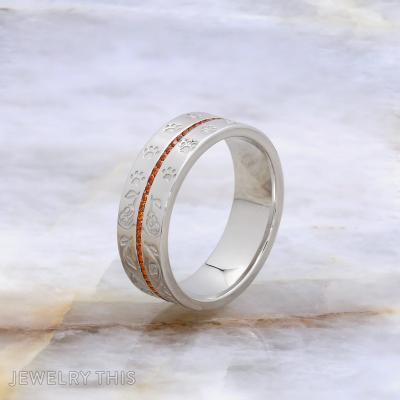
This wedding band pairs two engraved motifs on a wide sterling silver band, separated by ...

This men’s wedding band is built around a single-branch design, textured to read like real ...
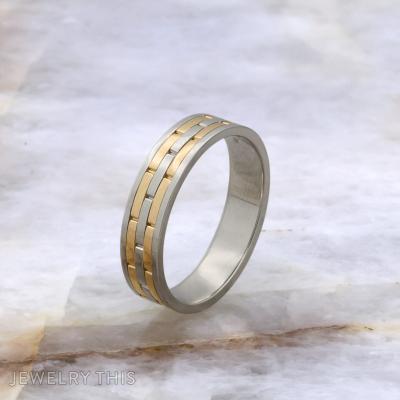
This wedding band recreates a ring lost in a lake after years of daily wear ...

This wedding band was rebuilt entirely from a client’s memory and description after the original ...

This wedding band recreates the look of an antique ring from around 1860, rebuilt in ...

This platinum wedding band was built as a companion piece to an existing engagement ring, ...

This wedding band was built around a single requirement: it had to be safe to ...

This mesmerizing White gold band features three enchanting rows of small round stones, creating a ...