


Men's Branch Wedding Band with Rose Gold Leaf Accent
$$
Platinum, rose gold accent
A couple came to us wanting a men's wedding band that would echo the branch-and-leaf design of the engagement ring already being made for the other partner. The design went through several rounds — from a cleaner branch sketch to a textured, more organic finish — before the client realized the simplest path was to ask for his band to directly mirror hers, right down to the overhanging leaf detail. The final version kept some of the natural curve of the branch while straightening the overall band, with branch ends worked into both sides to balance the design.
'We prefer the top one, option A.' — on initial design review
'We think this one is a lot better!' — on reviewing the muted-finish revision
Quick specs
Primary Metal
Secondary Metal
Primary Stone
Accent Stones
Design Complexity
Intent: Certainty
Size
Ring size 10.5 US (20.17mm). Band width 4mm.
How they made it distinctive
-
01
Branch texture with low-relief ends on both sides of the band, added specifically so the asymmetry felt balanced rather than one-sided
-
02
Rose gold leaf cluster cast separately and set to overhang the band edge, mirroring the leaf detail on the companion engagement ring
-
03
Matte, muted finish chosen over a high polish after the client shared a reference image, keeping the bark-like texture from looking too shiny
-
04
Platinum used as the primary metal for durability and a naturally white tone that won't fade over time
-
05
Band straightened from its original curve while deliberately retaining some asymmetry to preserve the branch-like feel
How you'd make it yours
Metal: this piece is platinum with a rose gold accent — the same design works in white gold or yellow gold with a contrasting accent metal
Texture density: this piece uses a moderate amount of branch-end detail — a new commission could use more or less texture
Finish: this piece has a matte, muted finish — a new piece could use a higher polish if a shinier look is preferred
Band width: this piece is 4mm wide — a new commission could be made narrower or wider
Leaf placement: the leaf overhang on this piece mirrors a companion ring — a standalone piece could have the leaf centered or sized differently
One of a kind: this exact band was designed to mirror a specific companion engagement ring and is not reproduced — a new commission is an original piece inspired by this one
Design changes made
The band moved from a smoother branch design with an optional high-polish finish to a muted, matte texture closer to a reference image the client provided, and ultimately was reworked to directly mirror the companion engagement ring's leaf and branch details rather than carry its own separate pattern. The band was also straightened somewhat from its original curve while keeping some branch-like asymmetry, and branch ends were added to both sides instead of just one.
Who this is for
This piece is for a partner who wants his wedding band to visibly connect to his partner's engagement ring without matching it metal-for-metal. It fits someone who prefers an organic, textured look over a smooth polished band, and who's comfortable going through a few rounds of revision to get the details exactly right.
How it's made
Once the final design was approved, a resin model was 3D printed as the first physical version of the ring, allowing the branch texture and leaf placement to be checked before any metal was committed. That model was used to create an investment mold, which was fired to remove the resin, leaving a cavity ready for casting. Molten platinum was then cast into the mold to form the textured band, with the rose gold leaf element cast separately to allow for the two-metal construction.
After casting, the platinum band was cleaned up and given a muted, matte finish across the branch texture rather than a high polish, preserving the look of real bark. The rose gold leaf cluster was then set into the band by hand and finished to sit flush with the overhanging edge, matching the proportions of the leaf on the companion engagement ring. The inside of the band was polished smooth for comfort despite the textured exterior.
Key note
The branch texture and rose gold leaf were cast as two separate metal components and joined during finishing, which is what allows the warm-toned leaf to stand out against the platinum band.
Pricing guidance
A textured platinum wedding band with a two-tone rose gold accent sits toward the higher end for men's wedding bands, largely because platinum itself carries a higher material cost than gold alloys and the hand-finishing needed for a realistic bark texture adds labor on top of that. Matching the design to a companion ring adds a layer of precision work as well, since both pieces need to read as a clear set.
Moves price up ↑
- ↑ Using platinum instead of a gold alloy for the full band
- ↑ Adding a two-tone metal accent that must be cast and set separately
- ↑ Increasing the density or complexity of the branch and knot texture
- ↑ Widening the band beyond 4mm, which increases material and finishing time
- ↑ Matching the design precisely to a companion ring, which adds extra design revision rounds
Moves price down ↓
- ↓ Switching from platinum to 14k or 18k white gold for a lower base metal cost
- ↓ Using a single metal throughout rather than a two-tone leaf accent
- ↓ Simplifying the texture to a lighter brushed finish rather than a full bark pattern
- ↓ Narrowing the band width slightly
- ↓ Reducing the number of branch-end details on the band
Questions people ask
Yes, platinum works well for a textured band because it is a dense, durable metal that holds fine surface detail without wearing down quickly. It is also naturally white and hypoallergenic, so it won't fade or require replating the way white gold sometimes does. The tradeoff is weight and cost — platinum is heavier and more expensive per gram than gold alloys of the same volume. For a textured organic design like a branch pattern, platinum's durability helps the detail stay crisp over years of daily wear.
The texture is built into the 3D design file and then printed as a resin model before casting, so the branch and bark pattern exists in the mold from the very beginning rather than being carved after the fact. Investment casting then transfers that same texture into the metal when it's poured. After casting, the surface can be left with a muted matte finish rather than polished smooth, which helps the texture read as organic rather than mechanical. Fine texture like this does take more hand-finishing time than a plain polished band.
Yes, two-tone pieces like this combine a primary metal, often platinum or white gold, with an accent in a contrasting metal such as rose gold, cast or set separately and then joined during finishing. This approach lets a men's band echo a design detail from a partner's engagement ring, such as a leaf or floral element, without changing the main metal of either piece. It does add a production step compared to a single-metal band, since the two metals are typically cast separately. The result is a pair of rings that clearly share a design language even though they serve different wearers.
A textured platinum band with a two-tone accent falls toward the higher end of the range for custom wedding bands, mainly because platinum costs more per gram than gold and the branch texture requires extra hand-finishing after casting. Matching the design closely to a companion ring can add a bit more cost, since it usually means additional design revisions to get both pieces looking cohesive. Simpler single-metal bands in gold alloys are generally the more cost-effective option if budget is the main driver.
A band like this typically takes around five to six weeks from final design approval to shipping, though a project involving multiple rounds of design revisions, like matching an existing companion ring, can run a bit longer during the design phase. Production itself, from resin model to finished cast piece, usually takes a few weeks once the design is locked in. Multiple pieces being finished together, like a matching set, are sometimes shipped as a single package once all pieces are complete.
Yes, platinum takes a matte or brushed finish well, and it's a common choice for organic or textured designs where a high polish would look too shiny or mechanical. The finish is applied after casting and cleanup, and it can be limited to specific areas of the ring while leaving others, like the inside of the band, polished smooth for comfort. A matte finish on platinum tends to hold up well over time since the metal itself is so durable, though it will gradually develop a soft patina with wear.
The branch-end details and bark texture are kept low-relief and smoothed during finishing specifically so they don't snag on clothing or gloves during normal daily activity. The design still reads as organic and dimensional, but the actual surface is not sharp or raised enough to catch on fabric. If daily hands-on work or frequent glove use is a concern, that's worth mentioning during design so the texture depth can be adjusted slightly.
Explore Similar Creations
Every masterpiece starts with a spark. Explore how our clients raw ideas - sketches, heirlooms, inspirations - were transformed into bespoke works of arts.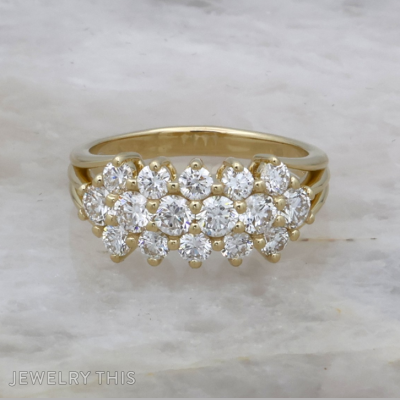
This 14k yellow gold ring recreates a wedding band that had been lost after years ...
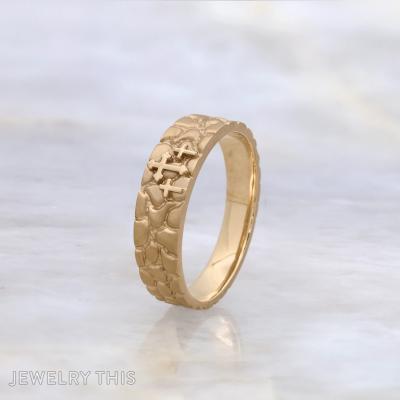
This wedding band was built around a specific request: a nugget-textured gold surface with three ...

This wedding band was rebuilt as a faithful recreation of a piece that had been ...

This wedding band pairs 14k rose gold with a central band of black enamel, creating ...

This platinum wedding band was built as a companion piece to an existing engagement ring, ...

This platinum band is the definition of timeless elegance. The band features a sleek flat ...

Matching wedding bands with a unique yin and yang design that includes white and black ...

This 14k yellow gold stacking band takes its cue from a vine tattoo and a ...

This wedding band pairs a straight, flat-profile shank with a graduated row of five prong-set ...

This wedding band uses a half-eternity layout, with marquise-cut moissanite stones set east-west along the ...

This wedding band was designed to perfectly complement the client’s engagement ring. This band features ...
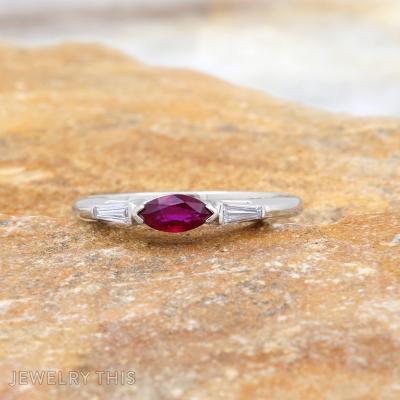
This platinum band recreates the style of a 1940s-era ring using the client’s own marquise ...



