

Emerald & Diamond Wedding Band — Curved to Fit Engagement Ring
$$
14k rose gold, lab-grown diamonds, lab-grown emeralds
A. came back to design a wedding band to pair with an engagement ring made earlier, carrying the same emerald-and-diamond combination into a five-stone row. Two sketches were reviewed — a straight band and a slightly curved one — and the curved version won for how closely it hugged the existing ring. On seeing the finished piece, A. wrote: 'It's beautiful!!!!!'
'I love it!!! So much!' — on seeing the final render
'It's beautiful!!!!!' — on delivery
Quick specs
Primary Metal
Shape / Cut
Primary Stone
Accent Stones
Style
Design Complexity
Intent: Certainty
Size
Ring size 9.5 US (19.35mm). Stones 3mm each.
How they made it distinctive
-
01
Five-stone graduated row of alternating emeralds and diamonds mirrors the exact stone combination used in the matching engagement ring
-
02
Curved profile chosen after direct comparison with a straight version, specifically to hug the engagement ring's setting
-
03
Flat, low-profile shank keeps the focus on the stone row rather than competing with the engagement ring
-
04
Lab-grown emeralds and diamonds selected to achieve the same look as natural stones at a different price point
How you'd make it yours
Stone type: this piece uses emeralds and diamonds — a new commission could use sapphires, rubies, or a single stone type
Metal: this piece is 14k rose gold — the same five-stone design works in yellow or white gold
Stone count: this piece uses five stones — a new piece could use three or seven depending on band width
Profile: this piece has a curved profile to hug a companion ring — a new commission could use a straight profile for standalone wear
One of a kind: this exact band was designed to pair with one specific engagement ring and is not reproduced — a new commission is an original piece inspired by this one
Design changes made
The band was changed from a straight profile to a slightly curved one after the client asked to compare both — the curve was chosen because it hugs the engagement ring more closely.
Who this is for
This is for someone who already has a ring they love and wants a wedding band that completes it rather than competes with it. It's especially right if you want the same stones and metal carried through in a slightly different arrangement, with a profile shaped to sit flush against what you already wear.
How it's made
Once the design was approved, a resin model was 3D-printed and shared with the client as a preview before casting. The resin was then attached to a wax tree, invested in plaster, and fired in a kiln to burn out the pattern, leaving a hollow mold. Molten 14k rose gold was cast into the mold under pressure, then the raw band was extracted, cleaned, and polished.
After casting, the band was finished to a mirror polish across its flat profile. The five stones — three round lab-grown emeralds alternating with two round lab-grown diamonds — were then prong-set in sequence along the top of the band, spaced evenly to read as a continuous graduated row when worn beside the engagement ring.
Key note
The band's flat, uncurved cross-section was a deliberate choice made specifically to sit flush against the engagement ring's setting rather than following a curved profile, which is usually reserved for rings with a more pronounced setting shape.
Pricing guidance
A five-stone wedding band in 14k gold with lab-grown emeralds and diamonds sits toward the lower-middle range for custom bands of moderate complexity. Most of the cost comes from the stone count and the prong-setting labor for five individually set stones rather than the metal itself. Choosing lab-grown stones over natural equivalents keeps the price toward the lower end of that range.
Moves price up ↑
- ↑ Switching to natural emeralds and natural diamonds instead of lab-grown
- ↑ Increasing stone size beyond 3mm across all five stones
- ↑ Upgrading from 14k to 18k rose gold
- ↑ Adding a curved or contoured profile with more intricate metalwork
- ↑ Extending the stone row further around the band
Moves price down ↓
- ↓ Reducing the stone count from five to three
- ↓ Using moissanite in place of lab diamonds
- ↓ Choosing a narrower band width
- ↓ Selecting a single stone type instead of alternating two
- ↓ Using 10k gold instead of 14k
Questions people ask
Yes, this is a common approach — a wedding band can be designed after the engagement ring using the same metal, stone types, and proportions so the two pieces read as a set. The key details to match are the metal color and karat, the stone type and size, and the general design language. Reviewing a sketch or render alongside a photo of the existing ring helps confirm the fit before production. A slightly curved profile is sometimes added specifically to hug the contour of the engagement ring's setting.
A straight band has a flat, even profile at the base that sits independently, while a curved band is shaped to follow the contour of an engagement ring's setting so the two sit flush together. Curved bands are typically recommended when the engagement ring has a raised or dramatic setting shape that a straight band would gap against. A flatter engagement ring setting often pairs well with either style, so the choice becomes largely aesthetic. Comparing sketches of both options side by side is the most reliable way to decide.
Lab-grown emeralds have the same chemical composition and hardness (about 7.5–8 on the Mohs scale) as natural emeralds, since they are grown from the same mineral structure rather than a simulant. Like natural emeralds, they can have some internal inclusions and benefit from being set with protective prongs rather than exposed edges. The main practical difference is cost, not durability or appearance. Daily wear care is the same for both — avoid ultrasonic cleaners and harsh impacts.
A band with five prong-set stones in 14k gold falls toward the lower-middle range for custom wedding bands, with lab-grown stones keeping the price below what natural emeralds and diamonds would cost for the same design. The main cost drivers are the number of stones being individually set and the labor for prong work, rather than the gold itself. Switching between lab and natural stones is the single biggest lever on price for a design like this. Band width and metal karat have a smaller but still noticeable effect.
A custom wedding band like this typically takes about one week for the design phase, including sketch review and a photorealistic render for approval, followed by approximately four weeks for production once the design is approved and paid. Production includes 3D printing a resin model, casting in metal, and hand-setting the stones. Some designs include a resin preview stage, where a 3D-printed model is shown before the final metal casting. Total turnaround from deposit to shipping is usually five to six weeks under standard scheduling.
Yes, a five-stone graduated band like this can be made entirely in diamonds, or with any single stone type instead of alternating two. Using one stone type simplifies sourcing since all five stones need to match in size and cut rather than needing two separate stone types to coordinate. This also tends to bring the price down slightly since sourcing is more straightforward. The prong-setting approach and spacing would remain the same regardless of stone choice.
Yes, a rose gold band without stones running the full circumference — like this one, where the stones sit only across the top — can typically be resized within a reasonable range using standard jewelry techniques. Because the decorative stone row occupies only the front portion of the band, the smooth back portion can be cut and adjusted without disturbing the setting. Larger resizes may require more significant rework depending on how far the size needs to move. It's best to have any resizing done by the original jeweler when possible to protect the stone settings.
Explore Similar Creations
Every masterpiece starts with a spark. Explore how our clients raw ideas - sketches, heirlooms, inspirations - were transformed into bespoke works of arts.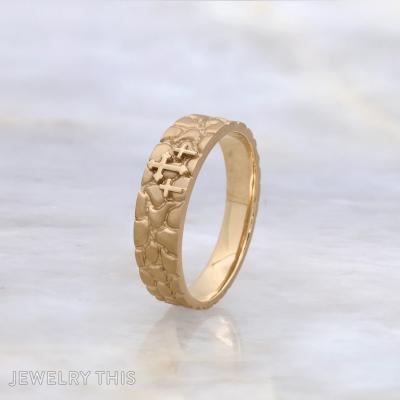
This wedding band was built around a specific request: a nugget-textured gold surface with three ...
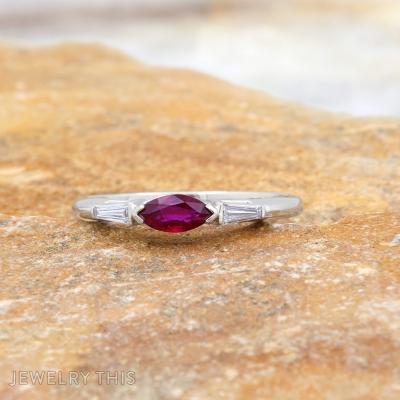
This platinum band recreates the style of a 1940s-era ring using the client’s own marquise ...
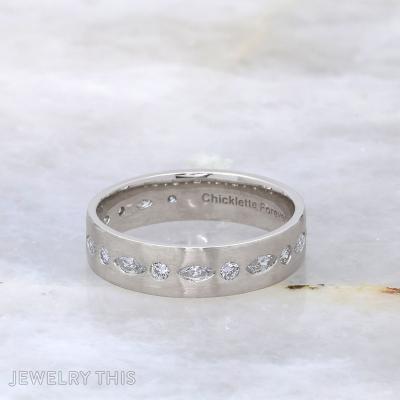
This men’s wedding band was built to mirror an existing engagement ring design, carrying the ...

This wedding band was thoughtfully designed to complement and enhance the beauty of an existing ...

Matching wedding bands with a unique yin and yang design that includes white and black ...
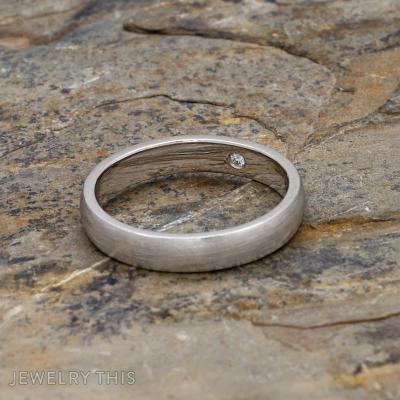
This thin men’s wedding band is crafted in 14k white gold with a soft matte ...
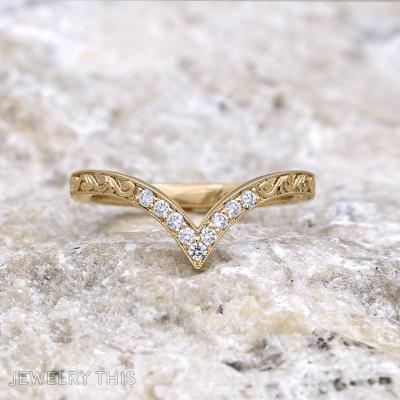
This wedding band was designed as a companion piece to an existing engagement ring, built ...

Celebrate timeless love with our meticulously recreated diamond band. This exquisite piece features a milgrain ...
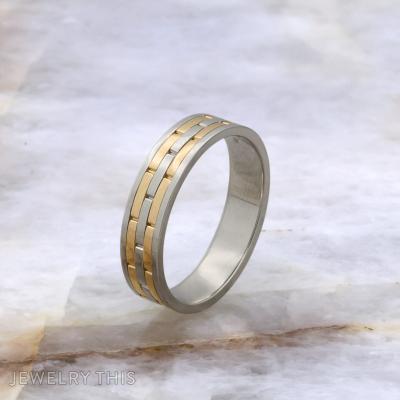
This wedding band recreates a ring lost in a lake after years of daily wear ...

Two interlocking bands made of 14k white gold with channel set with VS1 diamonds in ...

This mesmerizing White gold band features three enchanting rows of small round stones, creating a ...

This platinum band is the definition of timeless elegance. The band features a sleek flat ...



