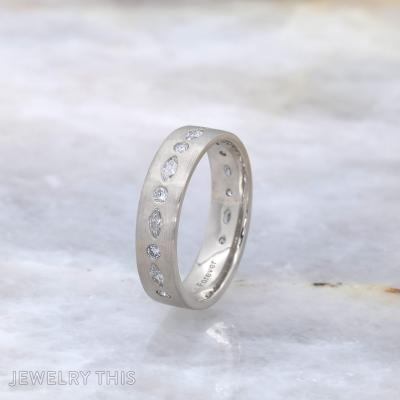
Men's Matching Wedding Band — Lab Diamonds, Satin Finish
$$$
14k white gold, lab diamonds
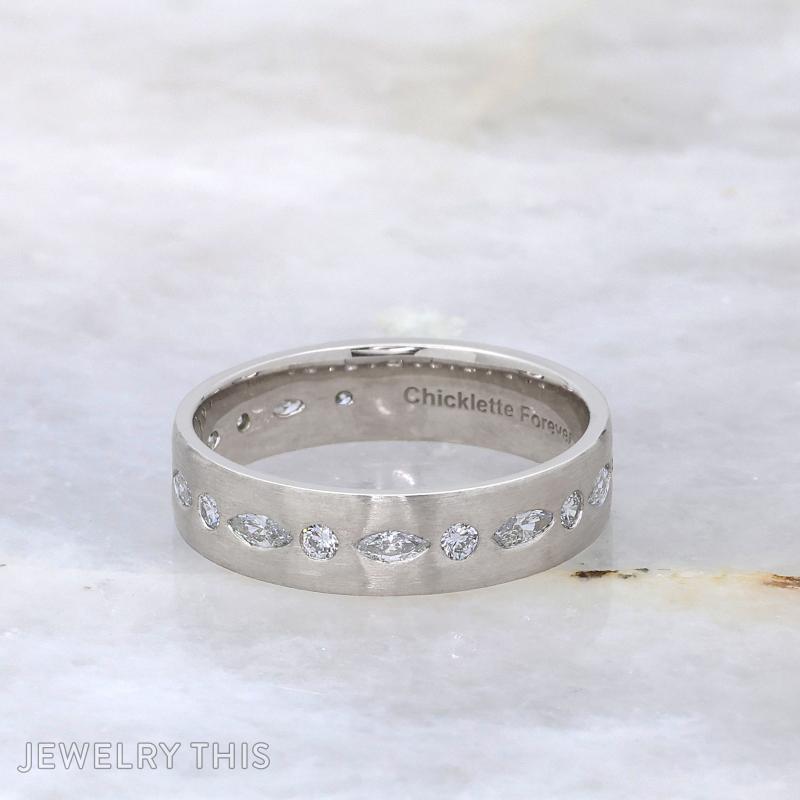
J. wanted a wedding band that mirrored his fiancée's engagement ring exactly — same stone shapes, same layout, same feel. He was precise about every detail, from diamond color-matching to comfort fit to finish, and the process required a full remake before the ring matched his expectations. When it arrived the second time, he wrote that the quality was so much better and that he liked it a lot more.
'Thank you for remaking my ring the quality is so much better as I like it a lot better.' — on delivery
Quick specs
Primary Metal
Shape / Cut
Primary Stone
Accent Stones
Style
Design Complexity
Intent: Certainty
Size
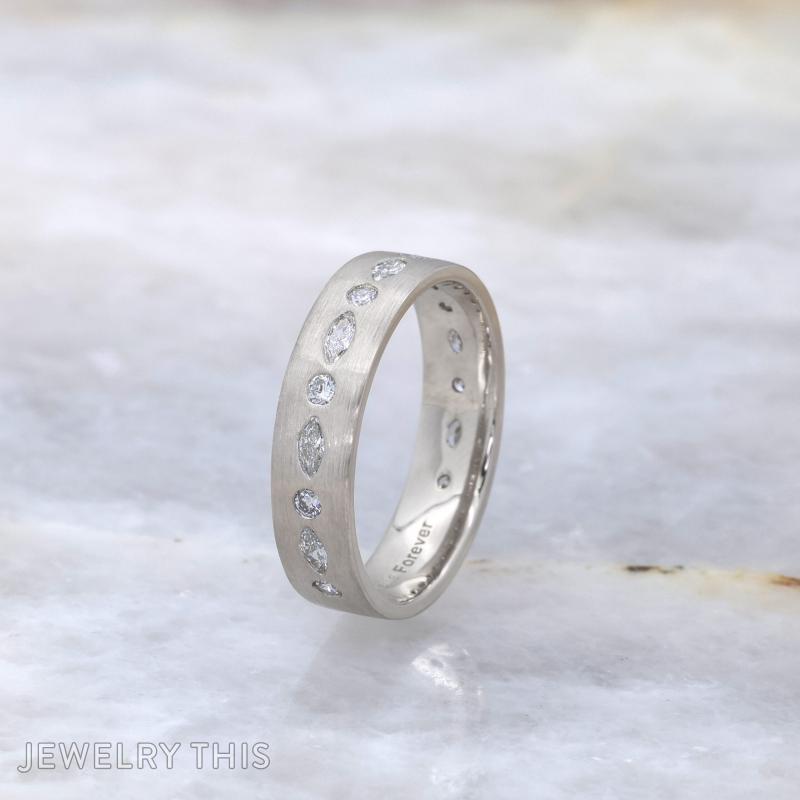
Ring size 9.75 US (19.56mm). Band width 6mm; thickness approximately 2.8mm (comfort fit). Eight 2mm round diamonds and seven 2mm x 4mm marquise diamonds.
How they made it distinctive
-
01
Diamond layout matches his fiancée's engagement ring exactly — alternating round and marquise stones set flush around the band
-
02
Marquise diamonds hand-selected to minimize the bow-tie effect for a cleaner look across each stone
-
03
Comfort-fit interior added after the initial design specifically for long-term daily wearability
-
04
All diamonds matched to a single color grade for visual consistency across thirteen stones
-
05
Interior engraved with a short personal phrase as a final touch
- 06
How you'd make it yours
Stone shapes: this piece alternates round and marquise — a new commission could use a single shape or a different combination
Metal: this piece is 14k white gold — the same layout works in 18k white gold, yellow gold, or platinum
Finish: this piece is high polish — a satin or brushed finish is equally achievable on the same design
Stone count: this piece uses thirteen diamonds — a new commission could use more or fewer depending on band width
Engraving: the interior can carry a new phrase, initials, or date on a fresh commission
One of a kind: this exact ring was made to match one specific engagement ring and is not reproduced — a new commission is an original piece inspired by this one
Design changes made
A comfort-fit interior profile was added after the initial render, requiring the band to be thickened slightly beyond the original 1.8mm spec — the modeling team achieved this without added cost. The finish was also changed from satin to high polish after the remake, based on the client's in-person research into finish types.
Who this is for
This piece is for someone who wants their wedding band to visibly coordinate with their partner's ring, down to the stone shapes and layout. It's especially right for someone who cares about precision and consistency in the details — matched stone color, a clean flush setting, a comfortable everyday fit — and is willing to see the process through until every detail is right.
How it's made
Once the design was approved, a wax model was 3D-printed and mounted to a tree for casting. The tree was invested in plaster and fired in a kiln to burn out the wax, leaving a hollow mold, and molten 14k white gold was cast into the mold under pressure to produce the raw ring. After cooling, the piece was cut from the tree and cleaned in preparation for finishing.
The band was finished to a high polish across the outer and inner surfaces, giving the comfort-fit interior a smooth, snag-free feel against the skin. The alternating round and marquise lab diamonds were then hand-set flush into the band so no edges caught on skin or clothing, with each stone selected for matching color grade and minimal bow-tie effect across the marquise cuts. The inside of the band was engraved with a short personal phrase as a final finishing step.
Key note
The ring was fully remade with an entirely new set of hand-picked diamonds after the first casting's finish and stone-matching did not meet the client's standard — the flush-set marquise and round diamonds you see were selected specifically to minimize the bow-tie effect common to marquise cuts.
Pricing guidance
A men's wedding band with flush-set alternating diamond shapes in 14k white gold sits in the mid range for custom bands of this complexity. The main cost drivers are the diamond count and the labor required to flush-set thirteen individually shaped stones with matched color grading. Comfort-fit shaping and finish type have a smaller but real effect on the final cost.
Moves price up ↑
- ↑ Increasing the total diamond count or upgrading to a higher clarity grade across all stones
- ↑ Matching diamonds more tightly for color (all D color, for example, versus a D-E range)
- ↑ Switching from lab-created to natural diamonds of the same size and cut
- ↑ Adding a wider band width, which increases both metal and stone-setting surface area
- ↑ Upgrading from 14k to 18k or platinum
Moves price down ↓
- ↓ Reducing the total number of stones set into the band
- ↓ Using a single stone shape (all round or all marquise) rather than alternating cuts
- ↓ Choosing a narrower band width
- ↓ Allowing a wider color-match range across the diamonds rather than a single grade
- ↓ Skipping the comfort-fit interior shaping in favor of a standard flat interior
Questions people ask
Yes. Lab diamonds are graded on the same color scale as natural diamonds, so a jeweler can select stones within a single grade, such as all D or all E color, to ensure visual consistency across multiple stones. This is especially important in a band with many small stones set close together, where even a slight color difference between neighbors is noticeable. Matching color across a full set does typically require more sourcing time than accepting a range of nearby grades. The visual payoff is a band where every stone reads as the same shade under normal lighting.
The bow-tie effect is a dark shadow that can appear across the center of elongated diamond cuts like marquise, oval, and pear, caused by the way light reflects through the stone's proportions. It varies significantly from stone to stone even within the same cut and carat weight. A jeweler can hand-select stones with minimal bow-tie effect by reviewing them individually rather than accepting whatever is readily available. This does add time to stone sourcing but produces a noticeably cleaner look across a row of marquise stones.
A men's band with thirteen or more flush-set diamonds in alternating shapes, in 14k white gold, typically falls in the mid range for custom wedding bands. The primary cost driver is the labor of setting many individual stones flush with the band surface rather than raised in prongs, combined with the sourcing time needed to match stone color. Band width, stone count, and metal karat are the main variables that move the price from there. Simpler bands with fewer or uniformly shaped stones cost less.
A comfort-fit band has a flat or slightly domed outer surface paired with a gently rounded interior, rather than a flat interior wall. The rounded inside reduces the surface area in contact with the finger, making the ring feel lighter and easier to slide on and off. It typically requires slightly more metal than a standard flat-inside band, which can add a small amount to the overall cost. For a ring intended to be worn every day for years, most wearers find the added comfort worthwhile.
A standard custom wedding band typically takes about one week for design and render approval, followed by three to four weeks of production once the design is approved. Bands involving hand-matched diamonds or remade stone sets can take longer, since sourcing well-matched stones takes additional time. If a piece requires a full remake due to quality concerns, that typically adds two to three more weeks. Rush timelines are possible when a specific delivery date is required.
Yes, a ring's outer finish can generally be changed after production, since it is a surface-level treatment rather than a structural feature. Satin finishes have visible fine texture, while high polish is smooth and reflective; converting from one to the other is a standard refinishing service most jewelers can perform. It's worth noting that satin finishes themselves vary — some have a subtle brushed line pattern, while others are smoother matte textures, so it helps to compare physical samples rather than photos. Changing the finish after delivery from a different jeweler can affect a manufacturer's warranty, so it's worth checking that first.
Yes, matching an existing ring's stone shapes, layout, and proportions is a common request, particularly for couples who want coordinated wedding bands. The jeweler needs the measurements and stone specs of the existing ring, or photos and a CAD reference, to replicate the pattern accurately in a new band. Small adjustments, like scaling the stone count or size for a different band width, are typically necessary since men's and women's bands differ in width and profile. The result is a set that reads as a matched pair without being identical pieces.
Yes, interior engraving is typically done as one of the final steps in production, after the band is cast, finished, and stone-set. Short phrases, initials, or dates are common choices, and the engraving depth and font are usually confirmed with a proof before it's applied permanently. Engraving does not affect the structural integrity of a properly sized band. It's a straightforward addition that doesn't significantly change production timelines under normal circumstances.
Explore Similar Creations
Every masterpiece starts with a spark. Explore how our clients raw ideas - sketches, heirlooms, inspirations - were transformed into bespoke works of arts.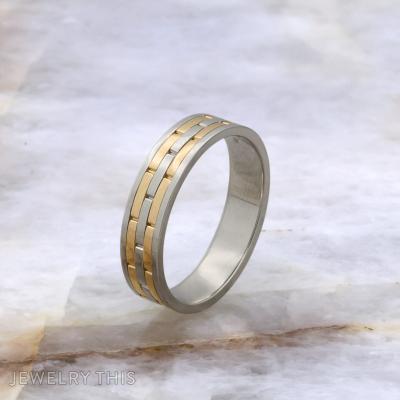
This wedding band recreates a ring lost in a lake after years of daily wear ...

Two interlocking bands made of 14k white gold with channel set with VS1 diamonds in ...

This mesmerizing White gold band features three enchanting rows of small round stones, creating a ...
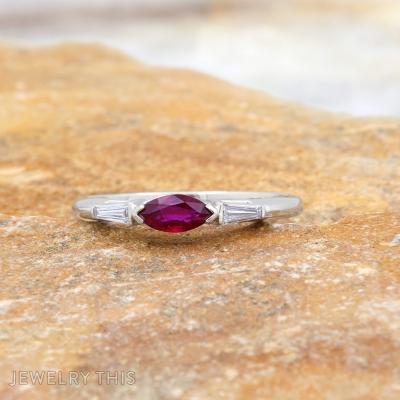
This platinum band recreates the style of a 1940s-era ring using the client’s own marquise ...

Matching wedding bands with a unique yin and yang design that includes white and black ...

This men’s wedding band was built around a channel of rectangular baguette diamonds running the ...

Celebrate timeless love with our meticulously recreated diamond band. This exquisite piece features a milgrain ...

This wedding band pairs a straight, flat-profile shank with a graduated row of five prong-set ...

This wedding band was designed to perfectly complement the client’s engagement ring. This band features ...
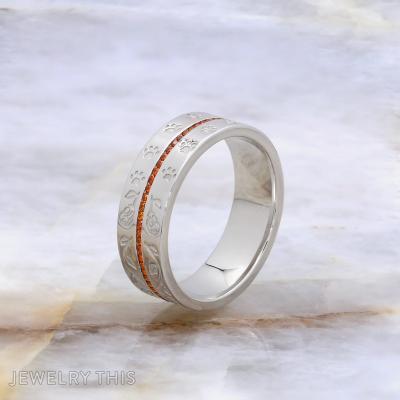
This wedding band pairs two engraved motifs on a wide sterling silver band, separated by ...

This wedding band was thoughtfully designed to complement and enhance the beauty of an existing ...

This platinum band is the definition of timeless elegance. The band features a sleek flat ...