


Curved Pear Diamond Wedding Band — Pairs With Engagement Ring
$$
14k white gold, lab-grown diamonds
J. came back to design a wedding band to pair with the engagement ring his fiancée already had. The design went through several rounds of changes — a resin model sent home so she could try it on with her engagement ring, then a final adjustment enlarging the center pear-shaped diamond for a more dramatic, graduated look. The finished band was built to curve against her engagement ring and nest flush against it.
Quick specs
Primary Metal
Shape / Cut
Primary Stone
Accent Stones
Style
Design Complexity
Intent: Certainty
Size
Ring size 8 US (18.14mm).
How they made it distinctive
-
01
Three graduated pear-shaped diamonds + the center stone was deliberately enlarged after an early version to create a more dramatic, gradient visual effect
-
02
Curved band shape + built specifically to nest flush against the matching engagement ring rather than a generic contour
-
03
Round diamond shoulder accents + added on each side to continue the line of the pear stones out along the band
-
04
Wax resin trial model + shipped to the client specifically so fit against the engagement ring could be confirmed before final casting
-
05
Lab-grown diamonds throughout + chosen to allow a larger center stone size within the project budget
How you'd make it yours
Stone shape: this piece uses three pear-shaped diamonds; a new commission could use round, oval, or marquise stones for a different silhouette
Stone size: this piece has a deliberately enlarged center stone; a new piece could use evenly sized stones for a more uniform look
Metal: this piece is 14k white gold; the same curved design works in 18k white gold, platinum, or yellow gold
Diamond type: this piece uses lab-grown diamonds; a new commission could use natural diamonds for the same look at a higher cost
Band curve: this piece is contoured to match a specific engagement ring; a new piece would need its own custom curve built around its own ring
One of a kind: this exact band was designed to pair with one specific engagement ring and is not reproduced — a new commission is an original piece inspired by this one, not a copy
Design changes made
The design shifted from a scroll/vintage-engraved band shape to a curved band with three pear-shaped diamonds and round accents, after the client requested something closer to a reference photo. The center pear diamond was later enlarged from roughly 3mm x 2mm to 5.5mm x 3.5mm for a more graduated, dramatic effect.
Who this is for
This is for someone who already has an engagement ring and wants a wedding band built specifically to sit flush against it, not just a generic curved band. It's especially right if you want the two rings to read as one continuous line when worn together, and you're willing to go through a few rounds of refinement — including trying on a trial model — to get the fit and stone proportions exactly right.
How it's made
Once the design was finalized, the piece was 3D printed in wax and attached to a wax tree inside a flask. The flask was placed in a kiln to burn out the wax, leaving a hollow mold shaped exactly like the approved design. Molten 14k white gold was then cast into that mold under heat and pressure, producing the raw metal band once cooled and removed.
After casting, the band was cleaned, polished, and finished to a bright white gold shine along its curved profile. The three pear-shaped lab-grown diamonds were set in a graduated arrangement across the top of the band, with the enlarged center stone flanked by two smaller pear stones, and round diamond accents were prong-set into the shoulders on either side to complete the curve.
Key note
A wax resin model was shipped to the client before casting specifically so the band could be tried on against the existing engagement ring to confirm fit before any metal was committed.
Pricing guidance
A curved wedding band with multiple graduated diamonds designed to pair with an existing engagement ring sits in the lower-to-mid range for custom bands of this complexity. The cost is driven primarily by the number of stones and the precision required to shape the band's curve to match a specific engagement ring. Stone size and metal choice are the next biggest variables.
Moves price up ↑
- ↑ Increasing the size of the center pear-shaped diamond further, or upgrading all three pear stones to a larger size
- ↑ Switching from lab-grown to natural diamonds across all stones
- ↑ Upgrading from 14k to 18k white gold or platinum
- ↑ Adding a fully matching halo around each pear stone rather than round accents on the shoulders only
- ↑ Building a custom curve to match a highly distinctive engagement ring shape
Moves price down ↓
- ↓ Reducing the number of pear-shaped stones from three to one
- ↓ Using smaller, uniform round diamonds instead of graduated pear shapes
- ↓ Choosing a straight band rather than one contoured to match an engagement ring
- ↓ Using moissanite in place of diamonds for the accent stones
- ↓ Simplifying the shoulder design to fewer accent stones
Questions people ask
Yes, a wedding band can be contoured to curve against a specific engagement ring so the two sit flush together when worn. The curve of the band and the placement of its stones are typically dictated by the shape of the engagement ring's setting. This usually requires a custom 3D model built specifically to match the engagement ring rather than a standard off-the-shelf curved band. A resin or wax model can be sent ahead of casting so the fit can be checked in person before the final metal piece is made.
Lab-grown and natural diamonds are chemically and optically identical — the same hardness, brilliance, and durability. The difference is origin: natural diamonds form underground over millions of years, while lab-grown diamonds are created in a controlled lab environment in weeks. For a multi-stone band like this, lab-grown diamonds typically cost significantly less than natural diamonds of comparable size and clarity. Many clients choose lab-grown specifically to afford a larger center stone within the same budget.
From design approval to completion, a custom wedding band like this typically takes a few weeks. The process starts with a 3D model and photorealistic render for approval, sometimes including a wax or resin trial model shipped to the client to confirm fit. Once the design and payment are finalized, the piece is cast, cleaned, polished, and stone-set, usually within two to three weeks of starting production. Total timeline can extend if multiple design revisions are needed before the final approval.
A curved band with three graduated pear-shaped diamonds and round diamond shoulder accents falls in the lower-to-mid price range for custom bands of this type. Lab-grown diamonds keep the cost down compared to natural stones of the same size. The main cost drivers are the number and size of the pear-shaped stones and the complexity of shaping the band's curve to match a specific engagement ring. Choosing natural diamonds or upgrading the metal to 18k gold or platinum would increase the cost from there.
Yes, this is a common design choice — the center stone can be sized noticeably larger than the two flanking stones to create a more dramatic, graduated look. On this band, the center pear-shaped diamond was enlarged from roughly 3mm by 2mm to 5.5mm by 3.5mm after the client reviewed an early version. This kind of adjustment can usually be made to an existing 3D model without starting the design over, as long as the stone's new proportions still fit the band's silhouette.
The photorealistic render is a close representation, but metal and gemstone colors can vary slightly between the digital render and the finished physical piece. Lighting, camera settings, and the physical properties of polished metal and faceted diamonds all affect how a piece appears in person versus on screen. Clients are generally advised of this before approving a design so there are no surprises upon delivery. Any significant difference in design elements, however, would reflect a genuine production error rather than normal rendering variance.
Most wedding bands with a continuous stone-free lower portion can be resized within a reasonable range after production, similar to a standard ring. Bands with stones set all the way around, or with a tightly curved profile built to match a specific engagement ring, have more limited resizing options since altering the band's circumference can distort the fitted curve. It's best to confirm ring size as precisely as possible before production on a contoured band like this. Any necessary resizing is generally handled as a separate service after delivery.
When a wedding band is designed to sit flush against an engagement ring, its curve has to mirror the negative space created by the engagement ring's setting and prongs. A more dramatic curve works for some engagement ring shapes but would leave gaps or an awkward fit with others. This is why wedding bands designed as companion pieces are typically custom-built around the specific engagement ring rather than chosen from a generic curved-band style. Changing the curve significantly usually means starting a new 3D model rather than adjusting the existing one.
Explore Similar Creations
Every masterpiece starts with a spark. Explore how our clients raw ideas - sketches, heirlooms, inspirations - were transformed into bespoke works of arts.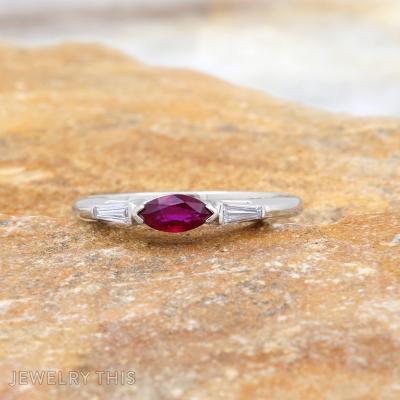
This platinum band recreates the style of a 1940s-era ring using the client’s own marquise ...

This wedding band was rebuilt entirely from a client’s memory and description after the original ...
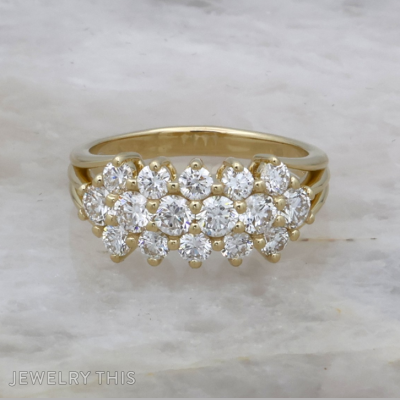
This 14k yellow gold ring recreates a wedding band that had been lost after years ...
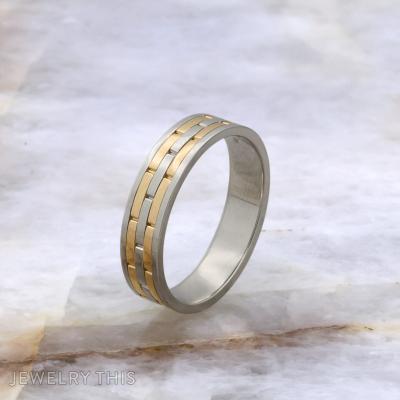
This wedding band recreates a ring lost in a lake after years of daily wear ...

This men’s wedding band was built around a channel of rectangular baguette diamonds running the ...

This 14k yellow gold stacking band takes its cue from a vine tattoo and a ...

This men’s wedding band is built around a single-branch design, textured to read like real ...
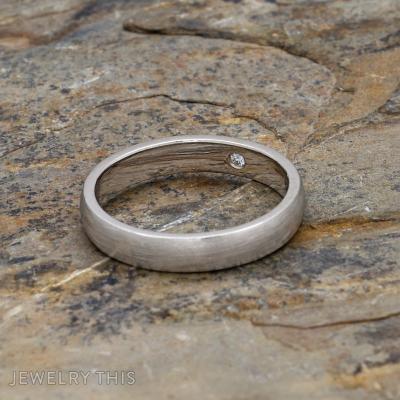
This thin men’s wedding band is crafted in 14k white gold with a soft matte ...

This wedding band pairs 14k rose gold with a central band of black enamel, creating ...

This wedding band was rebuilt as a faithful recreation of a piece that had been ...
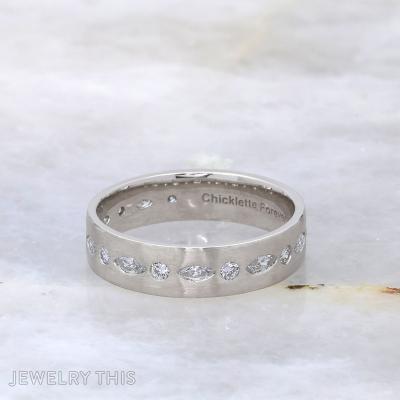
This men’s wedding band was built to mirror an existing engagement ring design, carrying the ...

This wedding band pairs a straight, flat-profile shank with a graduated row of five prong-set ...



