
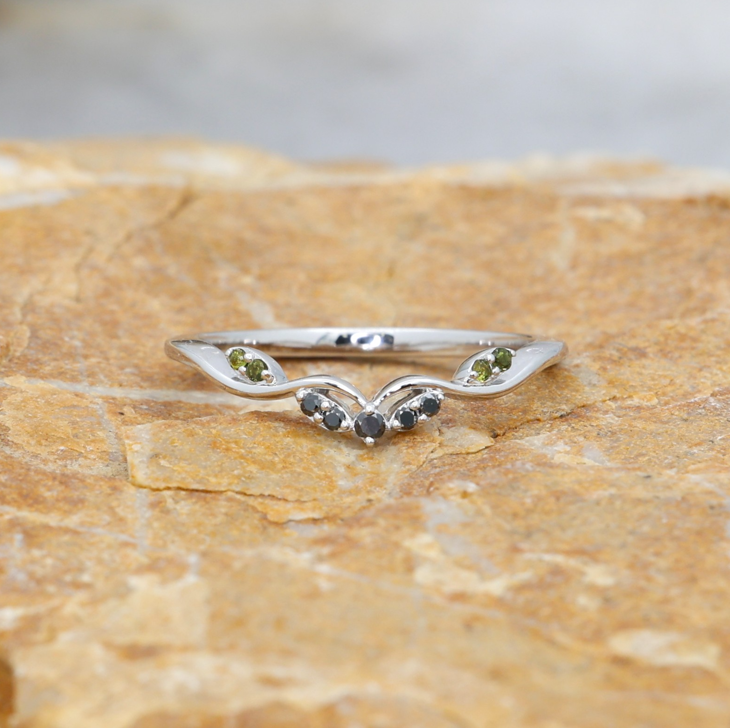
Curved White Gold Wedding Band with Black Diamonds & Garnet
$$
14k white gold, black diamonds, green garnet
A bride designed her wedding band to echo her fiance's own ring, pulling green and black stones into a curved white gold band that would nest against an engagement ring that had belonged to his grandmother. The design went through several rounds of adjustment — leaf-shaped stones swapped for round ones, a row of small diamonds removed to keep the profile delicate — before she tried the resin model on and confirmed it worked. After wearing the finished ring for a couple of months, she found the stones felt too small to really see, and reached back out to explore having a larger version made.
'Got it! You're totally right, as an actual ring it looks good. With the ring so zoomed in for the images it's easy to get hung up on tiny details and forget the ring itself is gonna be so tiny. I think it lays well against my engagement ring too.' — on trying the resin model
'Yeah it looks great! Thanks!' — on delivery
Quick specs
Primary Metal
Shape / Cut
Primary Stone
Accent Stones
Design Complexity
Intent: Certainty
Size
Ring size 6 US (16.51mm).
How they made it distinctive
-
01
Custom curve shaped specifically to nest against a family engagement ring that sits high and slightly outward on the finger
-
02
Black diamond and green garnet palette chosen to echo the stones already used in her partner's own wedding band
-
03
Green stones changed from a leaf cut to round after the leaf shape limited how the design could follow the band's curve
-
04
A row of small white diamonds was removed late in the design process specifically to keep the profile delicate and let the color stones stand out
-
05
Resin model mailed to the client so she could confirm fit against her actual engagement ring before casting
How you'd make it yours
Stone size: this piece uses small (1–1.5mm) accent stones; a new commission could use larger stones for more visible color at the cost of a slightly bolder profile
Stone type: this piece uses black diamonds and green garnet; a new commission could use moissanite or green tourmaline for a similar look
Metal: this piece is 14k white gold; the same curved design works in 18k white gold, yellow gold, or rose gold
Band curve: shaped to nest against this wearer's specific engagement ring; a new piece is curved to match its own companion ring
One of a kind: this exact band was designed around one client's engagement ring and is not reproduced — a new commission is an original piece inspired by this one, not a copy
Design changes made
The green stones shifted from a leaf shape to a round cut after the leaf shape limited how the design could flow with the curve of the band. A row of small white diamonds along the band was removed to reduce visual thickness and let the black and green stones stand out more.
Who this is for
This piece is for someone whose engagement ring has its own shape or history and wants a wedding band built specifically to work with it, not just sit next to it. It suits someone drawn to a delicate, low-profile look who still wants a pop of color and is willing to go through a few rounds of refinement to get proportions exactly right.
How it's made
Once the curved design was finalized in a 3D model, a wax version was 3D-printed and attached to a wax tree, which was invested in plaster and placed in a kiln to burn away the wax and leave a hollow mold. Molten 14k white gold was then cast into that mold, cooled, and extracted as the raw band. Before casting, a solid resin model was also printed and mailed to the client so she could try it on alongside her engagement ring and confirm the curve and fit in person.
After casting, the band was cleaned and polished to a smooth finish along its full curved profile, since the design uses one continuous finish rather than mixed matte and polished zones. The five round black diamonds were then hand-set in a clustered grouping at the lowest point of the band's center curve, and a single round green garnet was set near each upswept tip on either side.
Key note
The band was cast as one continuous curved piece rather than assembled from separate segments, which is why the stone groupings needed their spacing and angles finalized before the wax model was printed.
Pricing guidance
A curved wedding band designed to fit against an existing engagement ring, in 14k white gold with a small cluster of diamonds and colored stones, sits in the mid range for custom bands of moderate complexity. Most of the cost comes from the custom curve needed to match a specific engagement ring plus the hand-setting of several small stones. Stone count and metal choice are what move the price from there.
Moves price up ↑
- ↑ Increasing the black diamond count beyond five stones in the center cluster
- ↑ Using natural emeralds instead of green garnet, which requires more careful handling as a softer stone
- ↑ Upgrading from 14k to 18k white gold
- ↑ Adding a matching curve on both the top and bottom of the band rather than one side only
- ↑ Enlarging the stones for a bolder look, which increases setting labor and stone cost
Moves price down ↓
- ↓ Reducing the black diamond cluster to a single center stone instead of five
- ↓ Using lab-grown black diamonds or moissanite in place of natural black diamonds
- ↓ Choosing a straight band instead of a custom curve shaped to match an existing ring
- ↓ Simplifying to one stone color instead of two
- ↓ Selecting a lower karat gold such as 10k white gold
Questions people ask
Yes, this is a common request and is done by giving the wedding band a custom curve rather than keeping it straight. The jeweler typically asks for photos of the engagement ring from the front and the side to see how high the center stone sits and whether it angles outward. The curve is built into the 3D model before casting, and a resin test model can be mailed to the client to confirm the fit against the actual engagement ring before the final metal version is made. This avoids surprises after the piece is cast.
Black diamonds are true diamonds and share the same 10 rating on the Mohs hardness scale as colorless diamonds, making them one of the most durable stone choices for daily wear. Their dark color comes from dense internal inclusions rather than a coating, so the color will not wear off or fade over time. They resist scratching from nearly everything except another diamond. This makes them a practical choice for a band worn continuously, including during hands-on activities.
Green garnet and green tourmaline are both durable enough for daily wear, but they differ slightly in hardness and how they catch light. Garnet tends to have a more uniform, saturated green, while tourmaline can show more variation and depth of color depending on the stone. Both are commonly used as alternatives to emerald, which is a softer stone more prone to chipping in an everyday ring. The final color of either stone can look noticeably darker in person than it appears in a digital rendering.
A curved wedding band in 14k white gold with a small cluster of black diamonds and a couple of green accent stones typically falls in the mid range for custom bands. The main cost drivers are the custom curve required to fit a specific engagement ring and the hand-setting of the stone clusters. Choosing lab-grown stones, reducing stone count, or using a straight band instead of a curved one are the most effective ways to bring the price down. Metal karat also plays a role in the final cost.
The design phase for a curved custom band typically takes about a week to reach a first render, though bands with a shape needing to match an existing ring often go through additional rounds of adjustment before approval. Once the design is approved and paid to the required production threshold, casting and finishing generally take three to four weeks. A resin test model, if requested, adds a bit of time since it needs to be printed, mailed, tried on, and returned before final production begins. Total timelines of six to ten weeks are common when a fit-check step is included.
Yes, a solid resin model can be 3D-printed from the final approved design and shipped to the client to try on before the metal version is cast. This lets you check the fit against an existing ring, see how the curve sits on your hand, and confirm you're happy with the proportions in person rather than only in a digital render. The resin model does not contain any stones since it is only for checking fit and shape. This step is especially useful for bands designed to nest against another ring.
Ring spinning is common and usually happens because a ring is sized to clear the knuckle, which is wider than the base of the finger, leaving extra room once the ring is past the knuckle. Finger size also changes throughout the day and across seasons due to temperature, activity, and diet. When two rings are worn together, having them soldered to each other can reduce spinning since they act as a single wider unit. Small sizing beads can also be added to the inside of a band to take up extra space, though not everyone finds them comfortable.
Generally no — stones are selected and cut to fit a specific setting designed around their exact size, so enlarging them after the fact usually requires building an entirely new setting rather than modifying the existing one. If a client decides after wearing a finished ring that they want larger stones or bolder details, the typical path is a new version of the design with larger stones and adjusted proportions, with the original metal sometimes offered as a credit toward the new piece. The original stones usually cannot be reused if their size and cut were custom-selected for the first design. This is worth discussing before finalizing stone size on the first version.
Check what our clients say about us

Cassidee Gregory
1 year ago
So easy to work with them and I got the wedding ring of my dreams!
Explore Similar Creations
Every masterpiece starts with a spark. Explore how our clients raw ideas - sketches, heirlooms, inspirations - were transformed into bespoke works of arts.
This wedding band recreates a ring lost in a lake after years of daily wear ...

This men’s wedding band was built around a channel of rectangular baguette diamonds running the ...

Celebrate timeless love with our meticulously recreated diamond band. This exquisite piece features a milgrain ...

This wedding band pairs a straight, flat-profile shank with a graduated row of five prong-set ...

Matching wedding bands with a unique yin and yang design that includes white and black ...

Full eternity white diamond band set in a micro-pave setting style in 18k white gold. ...

This platinum band is the definition of timeless elegance. The band features a sleek flat ...
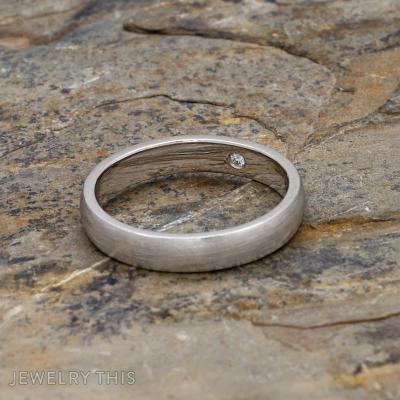
This thin men’s wedding band is crafted in 14k white gold with a soft matte ...
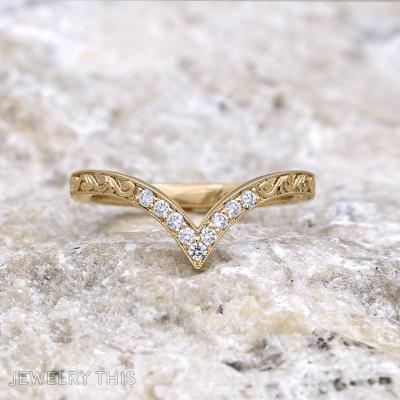
This wedding band was designed as a companion piece to an existing engagement ring, built ...
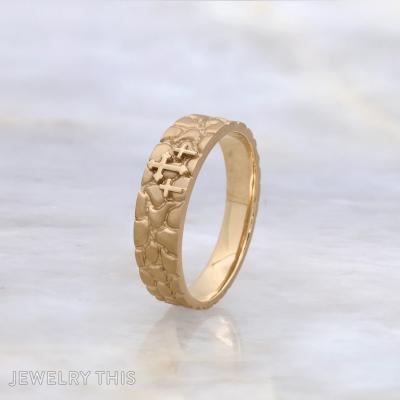
This wedding band was built around a specific request: a nugget-textured gold surface with three ...
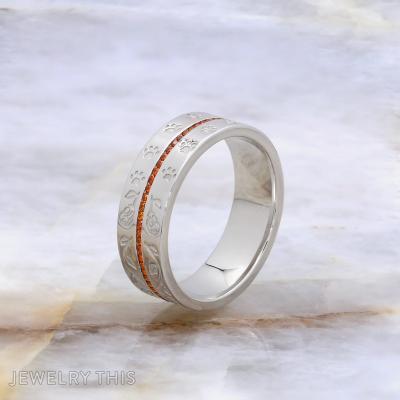
This wedding band pairs two engraved motifs on a wide sterling silver band, separated by ...

This wedding band was thoughtfully designed to complement and enhance the beauty of an existing ...



