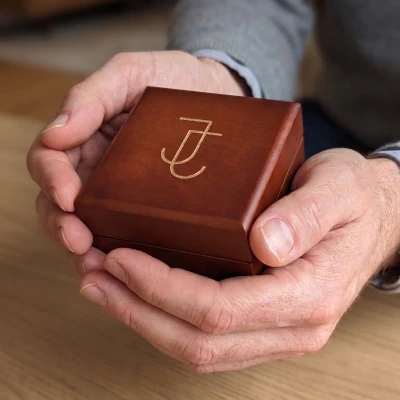


Recreated Wave Wedding Band with Diamond Accents
$
10k yellow gold, moissanite
A client wanted to recreate her partner's great-grandfather's wedding ring — a piece he had worn daily on a necklace until he lost it on a job site. Working from a single photo and her memory of the original, she asked for the lower band to taper the way the original had worn down over time. When the final render matched what she remembered, she wrote that she couldn't believe how closely it had been recreated.
'Wow! It's honestly so awesome how you guys are able to recreate these from images... I do love it so much already and I hope he does as well.' — on seeing the first render
Quick specs
Primary Metal
Shape / Cut
Primary Stone
Accent Stones
Design Complexity
Intent: Certainty
Size
Ring size 8¾ US (18.75mm).
How they made it distinctive
-
01
Diagonal wave of six moissanites across the top of the band, rather than a straight row, to echo the original ring's organic character
-
02
Lower shank deliberately tapered thinner — not a styling choice but a recreation of exactly where the original ring had worn down and been damaged
-
03
Rebuilt from a single photograph and the client's memory, with no physical original to reference
-
04
10k yellow gold chosen for durability suited to daily wear on a job site
-
05
Designed as an anniversary gift to restore a piece the recipient had worn constantly before losing it
How you'd make it yours
Stone type: this piece uses moissanite; a new commission could use lab diamonds or natural diamonds along the same wave
Metal: this piece is 10k yellow gold; the same wave design works in 14k or 18k gold for a richer tone
Taper detail: the thinned lower shank is specific to this recreation; a new piece could keep a uniform band width instead
Stone placement: the wave currently carries a single diagonal row; a new commission could extend stones further around the band
One of a kind: this exact ring was designed for one recipient and is not reproduced — a new commission is an original piece inspired by this one, not a copy
Design changes made
The lower portion of the band was tapered narrower after the first render, matching how the original ring had worn down and been damaged where it was mostly plain metal. This was the only adjustment requested before approval.
Who this is for
This piece is for someone trying to bring back a ring that mattered to someone else, usually with very little to go on beyond a photo and a memory. It's especially right for a partner who wants to give back something that was worn every day and never meant to be lost, in a version built to be worn just as constantly going forward.
How it's made
Once the tapered design was approved, a digital model was used to produce a wax pattern, which was invested in plaster and burned out to leave a hollow mold. Molten 10k yellow gold was then cast into the mold under pressure, producing the raw band in its final tapered profile.
After casting, the ring was cleaned up and polished to a mirror finish across the entire surface, including the diagonal wave detail on the top of the band. The six round moissanites were then set by hand along the wave, following its diagonal path from one side of the band to the other. The tapered lower shank was finished last, smoothed so the thinner profile reads cleanly against the fuller upper portion of the band.
Key note
The taper at the base of the band isn't a stylistic choice — it was built to echo exactly where the original ring had worn thin and become damaged over years of daily wear.
Pricing guidance
A yellow gold men's band with a diagonal stone-set wave sits toward the lower end of custom ring pricing. Most of the cost comes from the gold content and the hand-finishing needed to carve and polish the wave detail cleanly, rather than from the stones themselves. Moving between moissanite, lab diamond, or natural diamond at this stone size has a modest effect on the overall price.
Moves price up ↑
- ↑ Upgrading from 10k to 14k or 18k gold for a richer color and higher gold content
- ↑ Switching from moissanite to natural diamonds along the wave
- ↑ Adding stones to both sides of the wave rather than one diagonal row
- ↑ Increasing band width, which uses more metal and more finishing time
- ↑ Requesting a hand-carved wax model instead of a standard digital pattern
Moves price down ↓
- ↓ Choosing gold-plated sterling silver instead of solid 10k gold
- ↓ Reducing the stone count along the wave
- ↓ Leaving the wave detail unset, as a purely sculptural line with no stones
- ↓ Choosing a narrower band width
- ↓ Simplifying the taper to a straight uniform band without the thinning detail
Questions people ask
Yes, a single clear photo combined with a detailed description is often enough to produce a close recreation. The process starts with a 3D render based on that reference, which the client reviews and can request changes to before anything is cast. In this case, the only photo available was used alongside the client's memory of specific wear details, like a thinner spot at the base of the band, and the design was adjusted once to capture that. The result won't be a pixel-perfect match to the original, but it can be very close.
Moissanite and lab diamond are different materials with different optical properties. Moissanite is harder to scratch in everyday terms but has more fire, or rainbow flash, than a diamond, which some wearers notice more under certain lighting. Lab diamonds are chemically identical to natural diamonds and have a more neutral brilliance. For small accent stones in a band like this, both hold up well to daily wear, and the practical difference is mostly cost, with moissanite typically being the lower-cost option.
A band like this, in 10k yellow gold with a handful of small accent stones along a carved design, falls toward the lower end of custom ring pricing. The gold content and the labor to hand-finish the carved detail are the main cost drivers, more so than the stones themselves. Moving to a higher karat gold or upgrading the stone type will shift the price up, while a gold-plated option brings it down.
Most gold bands can be resized up or down within about one to two sizes without affecting the design, since there is enough metal in the shank to work with. A band with a tapered or thinned section, like this one, has less metal to adjust in that area, so a jeweler needs to confirm the resize carefully to avoid disturbing the taper. Larger size changes may require additional work to preserve the design's proportions. It's always worth having a jeweler inspect the specific piece before committing to a resize.
Yes, 10k gold is actually more durable than higher karats like 18k because it contains a higher percentage of alloy metals, which makes it more resistant to scratching and denting. It has a slightly paler yellow color than 14k or 18k gold, which some wearers prefer and others don't. For a ring meant to be worn every day without much special handling, 10k is a practical and common choice.
Yes, specific wear details like a thinned or tapered section can be deliberately built into a new design rather than left to develop naturally over years. This is done by describing the wear pattern to the design team during the render review stage, so it can be incorporated before anything is cast. It's a common request in recreation projects where the original piece can't be physically referenced.
Moissanite is a very hard stone, close to diamond on the hardness scale, so it resists scratching well under normal daily wear. It can be cleaned the same way as a diamond, with warm water, mild soap, and a soft brush, or an ultrasonic cleaner if the setting allows it. It doesn't require any special maintenance beyond what you'd do for a diamond ring. Regular rinsing to remove soap buildup will keep it looking bright.
Explore Similar Creations
Every masterpiece starts with a spark. Explore how our clients raw ideas - sketches, heirlooms, inspirations - were transformed into bespoke works of arts.
This men’s wedding band is built around a single-branch design, textured to read like real ...

This wedding band pairs a rose gold, bark-textured wishbone shank with a white gold upper ...

This wedding band was built to visually pair with an existing engagement ring rather than ...

This wedding band pairs a straight, flat-profile shank with a graduated row of five prong-set ...

This wedding band recreates the look of an antique ring from around 1860, rebuilt in ...

This wedding band was designed to perfectly complement the client’s engagement ring. This band features ...
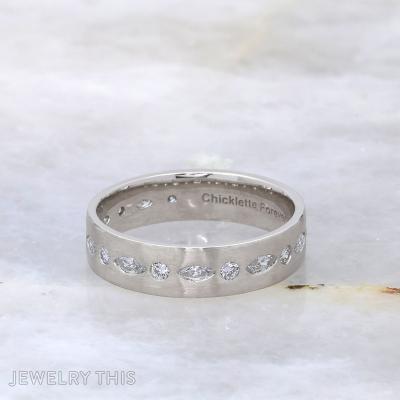
This men’s wedding band was built to mirror an existing engagement ring design, carrying the ...
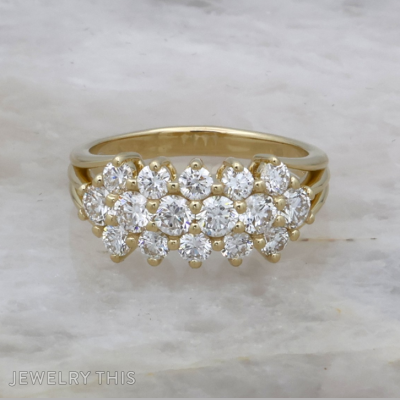
This 14k yellow gold ring recreates a wedding band that had been lost after years ...

This wedding band was rebuilt from a single surviving photograph and an old order confirmation ...

Celebrate timeless love with our meticulously recreated diamond band. This exquisite piece features a milgrain ...

This wedding band pairs 14k rose gold with a central band of black enamel, creating ...
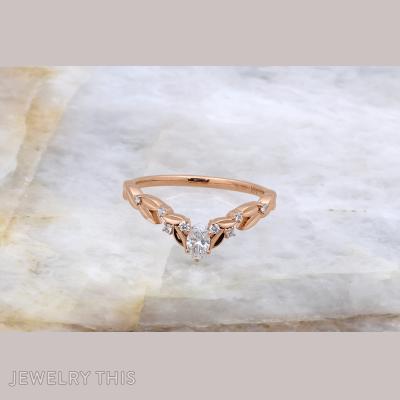
This wedding band was designed as a companion piece to an existing engagement ring, continuing ...