


Mountain-Inspired Triangle Diamond Stud Earrings
$$$
14k white gold, natural diamonds
K. wanted a small pair of studs for a second piercing inspired by a turquoise mountain-shaped earring she'd seen, but reimagined in white gold and diamonds. She pushed back when the first render came across as a plain triangle rather than a mountain peak, asking to see other directions. When it arrived, she wrote simply: 'They are beautiful!'
'They are beautiful!' — on seeing the revised render
Quick specs
Design type
Primary Metal
Shape / Cut
Primary Stone
Accent Stones
Style
Design Complexity
Intent: Certainty
Size
Stud, approximately 0.25 carat triangle stones each. Screw-back post and backing.
How they made it distinctive
-
01
Asymmetric triangle shape with one side wall wider than the other, designed to evoke a mountain peak rather than a plain geometric triangle
-
02
Natural trillion diamonds used instead of lab-grown after lab-grown stones proved to have curved side walls that couldn't achieve the straight lines the design needed
-
03
Threaded screw-back posts specified for security, chosen after a previous earring was lost pulling off a ski helmet
-
04
Bezel setting keeps the stone protected and flush, well suited to an active, second-piercing placement
-
05
Scaled down specifically for a second piercing rather than a primary lobe
How you'd make it yours
Stone type: this piece uses natural diamonds — a new commission could use lab-grown diamonds if a cut with straight side walls is available, or moissanite for a similar look
Metal: this piece is 14k white gold — the same asymmetric triangle design works in yellow or rose gold
Stone size: this piece uses approximately .25 carat stones each — a new commission could use larger or smaller stones depending on desired scale
Closure: this piece uses a threaded screw-back post — a new commission could use a standard push-back if security is less of a priority
One of a kind: this exact pair was designed for one client's second piercing and is not reproduced — a new commission is an original piece inspired by this one, not a copy
Design changes made
The design was revised after the first render read as a plain triangle rather than a mountain silhouette — the asymmetric side-wall detail was clarified and emphasized. The stone type also changed from lab-grown to natural diamonds after it became clear lab-grown trillions had curved side walls that couldn't achieve the straight, peak-like lines the design needed.
Who this is for
This piece is for someone who wants a small, everyday stud with a specific personal meaning behind its shape, not just a generic geometric shape. It especially suits an active lifestyle — someone who has lost an earring before to equipment like a helmet and wants a backing they can trust to stay put.
How it's made
Once the design was finalized, the earrings were 3D printed in wax and attached to a wax tree inside a flask. The flask was placed in a kiln to burn out the wax, leaving a hollow mold, and molten 14k white gold was cast into that cavity under pressure to form the raw earrings before cooling and release from the mold.
After casting, the earrings were cleaned, polished, and rhodium-plated for a bright white finish. The two natural trillion-cut diamonds were bezel-set into the triangular frames, with the metal rim secured flush around each stone's girdle. Threaded screw-back posts were then fitted to each earring for a locking closure.
Key note
The straight-sided look of the mountain silhouette required switching from lab-grown to natural trillion diamonds, since the lab-grown stones available had a subtle curve along their side walls that couldn't be masked in the bezel setting.
Pricing guidance
A pair of simple bezel-set triangular stud earrings in 14k white gold sits toward the lower end of the price range for custom earrings, though the choice of natural versus lab-grown stones has an outsized effect here. Labor is modest since the design is minimal, so the stones are the dominant cost driver. Moving between lab-grown and natural diamonds of the same size can shift the price substantially even though the design itself doesn't change.
Moves price up ↑
- ↑ Using natural mined diamonds instead of lab-grown diamonds of the same size
- ↑ Increasing the carat weight of each stone beyond .25 carats
- ↑ Upgrading from 14k to 18k white gold
- ↑ Adding stone accents along the bezel frame
- ↑ Choosing platinum instead of white gold for the setting
Moves price down ↓
- ↓ Switching to lab-grown diamonds where the cut allows a clean straight-sided bezel
- ↓ Reducing stone size slightly below .25 carats each
- ↓ Using a simpler push-back post instead of a threaded screw-back
- ↓ Choosing sterling silver instead of 14k white gold
- ↓ Using moissanite instead of diamond for a similar look at lower cost
Questions people ask
It depends on the specific stones available at the time of sourcing. Trillion and triangle-cut lab-grown diamonds often have a subtle curve along their side walls rather than perfectly straight edges, which can be a problem when a design calls for crisp geometric lines. Natural mined diamonds in triangle cuts are more likely to be found with straight side walls because there's a wider pool of cut stones to choose from. If straight sides are essential to the design, it's worth asking your jeweler to confirm the actual stone shape before finalizing, since renders don't always capture this detail clearly.
A bezel setting surrounds the stone with a continuous rim of metal that holds it in place without any prongs, while a prong setting uses small metal claws to grip the stone at a few points. Bezel settings offer more protection for the stone's edges and are generally more secure for active wear, since there's no prong to bend or catch. They also give a cleaner, more geometric look, which works well for shaped stones like triangles or trillions. The tradeoff is that a bezel setting shows slightly less of the stone from the side compared to an open prong setting.
A simple pair of bezel-set stud earrings in 14k white gold with small diamonds falls in the mid range for custom earrings, with the stone choice being the biggest factor in final cost. Lab-grown diamonds are typically more affordable than natural diamonds of the same size and clarity, so switching between the two can shift the price considerably even when the design stays identical. Labor costs stay relatively low for a simple geometric design like this since there's minimal detail work beyond the setting itself. The metal choice and stone size are the other two variables that move the price most.
Yes, threaded screw-back posts are generally considered one of the more secure earring closures available, since the back threads onto the post rather than simply friction-fitting like a standard push back. This makes them a popular choice for people with an active lifestyle or anyone who has lost an earring before from a backing coming loose. They take a bit more time to put on and take off since you have to twist the backing rather than just push it on. For earrings meant for daily or active wear, the added security is usually worth the small tradeoff in convenience.
The full process from approved design to finished earrings typically takes around four to five weeks total. The first week or so is spent on the 3D design and render, which you review and can request changes to before anything is cast. Once the design is approved, production including wax printing, casting, polishing, and stone setting takes another three to four weeks. Sourcing a specific stone cut, like finding natural diamonds with straight-sided walls, can add extra time if the first option doesn't work out.
Yes, stud earrings can be scaled down significantly for a second or higher piercing, where a smaller, less prominent design is usually preferred over a larger statement piece. A small triangular or geometric stud with a modest stone size, such as a quarter carat, works well for this placement without feeling heavy or oversized. The setting style matters too: a flush bezel setting sits closer to the ear and is less likely to snag on clothing, hair, or hats than a raised prong setting. It's worth discussing placement and scale with your jeweler up front since a design proportioned for a primary lobe piercing may look too large on a second piercing.
Natural and lab-grown diamonds are chemically and optically identical — both are crystallized carbon with the same hardness, brilliance, and durability. The difference lies entirely in origin: natural diamonds form underground over millions of years, while lab-grown diamonds are created in a controlled environment in a matter of weeks. Lab-grown diamonds are generally less expensive than natural diamonds of comparable size and quality, though the actual cut and shape available can vary between the two, as was the case here when the needed straight-sided triangle cut wasn't available in lab-grown form. Both are considered real diamonds, not imitations like cubic zirconia or moissanite.
Yes, a triangular silhouette with an intentionally asymmetric shape — one side wall wider than the other — can effectively suggest a mountain peak without being a literal, detailed landscape. This kind of abstract geometric interpretation tends to translate better into small-scale jewelry than a literal mountain range would, since fine detail gets lost at earring scale. Communicating the exact asymmetry needed can be tricky through a 3D render alone, so it often takes a round of revisions to get the proportions reading correctly. A bezel-set stone within the triangle adds structure and holds the shape crisply once cast in metal.
Explore Similar Creations
Every masterpiece starts with a spark. Explore how our clients raw ideas - sketches, heirlooms, inspirations - were transformed into bespoke works of arts.
This pair of round brilliant diamond stud earrings began as a single earring from an ...

These stud earrings translate a personal logo into a small, wearable abstract form — an ...
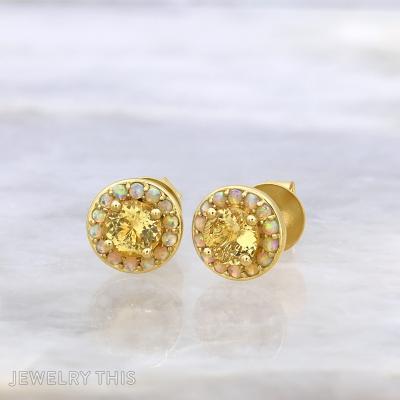
These stud earrings were designed around a round yellow topaz center stone, approximately 5.5mm, surrounded ...

This pair of oval ruby and diamond halo stud earrings was built to replace an ...

These rose gold stud earrings were designed around an oval center stone, flanked by two ...

These stud earrings take the form of the jackal-headed god Anubis, rendered in dimensional relief ...

A pair of stud earrings built around elongated kite-shaped lab-grown alexandrite, each stone framed in ...

This pair of halo stud earrings was built to recreate an original pair the client ...

These daisy-shaped stud earrings turn a name into the petals of a flower. Each petal ...



