

Anubis Stud Earrings in Black Rhodium with Garnets
$$$
14k white gold, black rhodium plating, garnet
A. came to us wanting a pair of earrings built entirely around the imagery of Anubis, with black gold styling and red garnet accents in the eyes, forehead, and neck. After confirming black rhodium plating could achieve the look he wanted, he paused the project for several weeks before returning to move forward. When the finished pair arrived, he wrote simply: 'They look great.'
'Oh I'm sorry, my message must not have sent. But yes, I love the design, they look amazing.' — on seeing the first render
'They look great' — on delivery
Quick specs
Design type
Primary Metal
Shape / Cut
Primary Stone
Accent Stones
Style
Design Complexity
Intent: Certainty
Size
Approximately 0.5–0.75 inch stud earrings.
How they made it distinctive
-
01
Anubis head rendered in full dimensional relief rather than a flat silhouette, with fine linear texture running down the headdress
-
02
Three red garnets placed specifically in the eyes, forehead, and neck to mirror traditional Egyptian iconography
-
03
Black rhodium plating chosen to achieve a 'black gold' look the client requested, applied over 14k white gold
-
04
Compact 0.5–0.75 inch scale keeps a highly detailed figural design wearable as an everyday stud
-
05
Garnet selected over ruby for a reliably saturated red at small stone sizes
How you'd make it yours
Stone type: this piece uses garnet — a new commission could use ruby, sapphire, or a lab-created stone for a different color or budget point
Metal: this piece is black rhodium-plated 14k white gold — the same design works in solid yellow, white, or rose gold without plating
Stone placement: the eyes, forehead, and neck accents could be adjusted or expanded to a different number of stones on a new piece
Size: this piece is sized at roughly 0.5–0.75 inch — a new commission could be scaled larger or smaller
One of a kind: this exact pair was designed for one client and is not reproduced — a new commission is an original piece inspired by this one, not a copy
Design changes made
Design matched the initial brief without major changes. The main technical decision was translating the client's request for "black gold" into black rhodium plating over white gold, which was confirmed and approved before production began.
Who this is for
This piece is for someone drawn to mythology, ancient symbolism, or cultural iconography who wants it rendered as a wearable, everyday detail rather than an oversized statement. It suits someone who likes a dark, modern metal finish paired with historical imagery, and who wants a stud earring with real sculptural depth rather than a flat engraved design.
How it's made
Once the design was approved, the piece was 3D printed in wax and attached to a tree inside a flask. The flask was fired in a kiln to burn out the wax, leaving a hollow mold, and molten 14k white gold was cast into that mold under pressure to form the raw earrings. After cooling, the earrings were removed from the mold and prepared for finishing.
The cast pieces were cleaned and polished before the linear texture on the headdress was refined to read clearly at this small scale. Three round garnets were then hand-set into each earring at the eyes, forehead, and neck, and the entire surface was plated in black rhodium last, since the plating must go on after all mechanical polishing is complete to avoid being abraded away.
Key note
The black rhodium plating is applied only after the garnets are set and the metal is fully polished, since the plating layer is too delicate to survive any further mechanical finishing.
Pricing guidance
A pair of dimensional, sculptural stud earrings with this level of surface detail sits in the mid range for custom earring work. Most of the cost comes from the labor of modeling a small, highly detailed figural design and hand-setting multiple stones at a compact scale, rather than from the stones themselves. Metal plating and stone count are the main variables that shift the price from there.
Moves price up ↑
- ↑ Increasing the number of garnets or adding stones to additional design areas
- ↑ Upgrading from white gold to solid 14k or 18k yellow or rose gold without plating
- ↑ Enlarging the earrings beyond 3/4 inch, which increases modeling and casting complexity
- ↑ Adding more intricate surface texture or additional figural elements to the design
- ↑ Switching from garnet to a harder or rarer colored stone
Moves price down ↓
- ↓ Simplifying the design to a flatter, less dimensional silhouette
- ↓ Reducing the stone count from three per earring to one or two
- ↓ Using sterling silver with black rhodium plating instead of white gold
- ↓ Choosing a smaller overall earring size to reduce modeling and casting time
- ↓ Omitting the gemstone accents entirely for a plain metal finish
Questions people ask
Black rhodium is a surface plating applied over a base metal, in this case 14k white gold, and it is not a permanent color change. With regular wear, the plating will gradually fade, especially on edges and high-contact points, typically over one to two years before it needs attention. Re-plating is a standard jewelry service that most jewelers, including the original studio, can perform to restore the black finish. The underlying white gold structure is unaffected by plating wear, so the earrings remain structurally sound even if the color fades.
Yes, the accent stones used here are garnets, chosen for their deep red color and reliable durability for everyday wear. Garnet rates around 6.5 to 7.5 on the Mohs hardness scale, which makes it a solid choice for small stones set into stud earrings that see regular handling. Garnet is also a practical substitute for ruby when a true, saturated red is desired at a smaller size, since small rubies can sometimes read pink rather than red. These stones are set securely into the eyes, forehead, and neck areas of the design.
Yes, figural and symbolic stud earrings like this are a common custom request, whether the subject is a cultural or mythological figure, an animal, or a personal symbol. The process starts with a sketch or digital render based on your description, which is refined until the proportions and detail read clearly at stud-earring scale. Fine linear or textured detail, like the striping seen here, can be added to almost any figural design. The main design constraint is keeping enough separation between small details so they don't blur together once cast at a small size.
A pair of dimensional stud earrings with this much surface detail and multiple hand-set stones falls in the mid range for custom earring work. The primary cost driver is the labor involved in modeling a small, intricate figural design and setting stones precisely at that scale, rather than the metal or stone cost itself. Plating choice, stone count, and overall earring size are the factors that move the price up or down from a baseline design like this one. Simpler, flatter designs with fewer stones cost less than a fully dimensional piece like this.
The full process from design approval to delivery typically runs six to eight weeks. The first stage covers sketching and a 3D render, which the client reviews and approves before any metal work begins. Once approved, the piece is 3D printed in wax, cast in metal, and then goes through cleaning, stone setting, and plating, which together make up the bulk of the production timeline. A resin preview of the printed wax model is often shared partway through so the client can see the piece take shape before it's cast in metal.
Yes, a design like this can be cast in solid 14k or 18k yellow, white, or rose gold without any black rhodium plating if a client prefers a traditional gold finish over the darker look. The tradeoff is that a dark, black finish specifically requires either rhodium plating over a white metal base or an oxidized silver treatment, since gold itself cannot be permanently turned black. Solid gold without plating also removes any future need for re-plating maintenance. The choice mostly comes down to whether the client wants the matte-black aesthetic or a classic gold appearance.
Properly set stones in a well-made setting are designed to hold securely through normal daily wear, and garnets at this size are a common, well-tested choice for small stud settings. That said, any set stone can loosen over years of wear if a prong or bezel edge wears down, so periodic visual checks are a good habit for any stone-set jewelry. If a stone ever feels loose, it should be brought to a jeweler for re-securing before it is worn further. This is standard advice for any small stone-set earring, not specific to garnets.
Yes, a figural design like this can typically be adapted across jewelry categories, including a pendant or a ring, while keeping the same visual language and detailing. The scale adjustment from a stud earring to a larger pendant often allows for even more surface detail or additional stone placements. Each piece would be designed and produced as its own project, so the companion piece would be sized and detailed appropriately for its category. This is a common way clients build out a themed set over multiple orders.
Explore Similar Creations
Every masterpiece starts with a spark. Explore how our clients raw ideas - sketches, heirlooms, inspirations - were transformed into bespoke works of arts.
A pair of stud earrings built around elongated kite-shaped lab-grown alexandrite, each stone framed in ...

This pair of oval ruby and diamond halo stud earrings was built to replace an ...
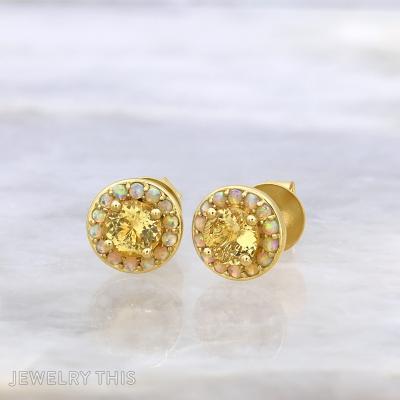
These stud earrings were designed around a round yellow topaz center stone, approximately 5.5mm, surrounded ...

This pair of round brilliant diamond stud earrings began as a single earring from an ...

This pair of halo stud earrings was built to recreate an original pair the client ...

These daisy-shaped stud earrings turn a name into the petals of a flower. Each petal ...



