

Ruby & Diamond Starburst Halo Stud Earrings Remade in White Gold
$$$
18k white gold, natural ruby, natural diamonds
R. lost one earring from a ruby and diamond pair and came to us hoping to replace just the missing half. Once the original ruby was examined, it turned out to have been cut and matched as a pair from the start, making a true single-stone match unlikely — so instead a new pair was built from scratch, reusing the diamonds from the surviving earring and sourcing a freshly matched pair of rubies, with the original ruby returned to him afterward. On approving the render he wrote: 'The rendering looks good, go ahead with the process.'
'The rendering looks good, go ahead with the process.' — on design approval
Quick specs
Design type
Primary Metal
Shape / Cut
Primary Stone
Accent Stones
Design Complexity
Intent
Intent: Certainty
Size
Center stone approximately 7x5mm oval per original setting. 12 round diamond halo per earring.
How they made it distinctive
-
01
Rebuilt as a full matched pair rather than a single earring, after the original ruby proved too difficult to match alone
-
02
Diamonds reused from the surviving original earring, carrying forward part of the original piece into the new one
-
03
New ruby pair specifically sourced and video-reviewed together to ensure a close color and clarity match between the two stones
-
04
Halo structure and oval stone orientation closely mirror the original earring's design
-
05
Original center ruby returned to the client rather than discarded, preserving the option to use it in a future piece
How you'd make it yours
Stone type: this piece uses natural ruby centers; a new commission could use lab-created ruby for the same look at lower cost
Metal: this piece is 18k white gold; the same halo design works well in platinum or yellow gold
Halo size: this piece uses a 12-diamond halo; a new design could use a larger or smaller halo count
Stone type for accents: this piece uses natural diamonds in the halo; lab diamonds are a visually identical alternative
One of a kind: this exact pair was built to match one client's original earring and is not reproduced — a new commission is an original piece inspired by this one, not a copy
Design changes made
The plan shifted from replacing a single earring to remaking the full pair after the original ruby proved too difficult to match on its own — the surviving diamonds were reused and a new matched ruby pair was sourced, keeping the design as close to the original as possible.
Who this is for
This is for someone who already owns a piece they love and wants that exact look preserved, even when circumstances mean the original materials can't all carry forward. It's especially right if you're facing the frustrating reality that a lost stone can't simply be replaced one-for-one, and you'd rather have a true matched pair than a mismatched fix.
How it's made
Once the new ruby pair was sourced and the design approved from the 3D render, the earring settings were modeled and cast in 18k white gold using the lost-wax casting method. The design intentionally mirrored the halo structure and proportions of the original earring, reusing the diamonds recovered from the surviving piece alongside the newly matched rubies.
After casting, each setting was cleaned up and polished to a bright finish typical of fine white gold jewelry. The oval ruby was set first into its prong setting at the center of each earring, followed by the twelve round diamonds set individually around the halo. The original ruby from the surviving earring was not reused in this piece and was returned to the client separately.
Key note
The new pair was built around the diamonds recovered from the surviving original earring, rather than sourcing all-new stones, so part of the original piece lives on in the replacement.
Pricing guidance
A ruby and diamond halo stud earring pair in 18k white gold sits toward the higher end for earrings of this style, largely because of the cost of sourcing a well-matched pair of center rubies. Diamond halos of this size add meaningfully to the labor and stone cost, and rebuilding a full pair rather than a single earring roughly doubles the stone-sourcing and setting work.
Moves price up ↑
- ↑ Sourcing a larger or higher-clarity matched ruby pair
- ↑ Increasing the diamond halo count or upgrading to larger accent diamonds
- ↑ Using platinum instead of 18k white gold for the setting
- ↑ Choosing natural, unheated rubies over standard heat-treated stones
Moves price down ↓
- ↓ Using lab-created rubies instead of natural stones
- ↓ Reducing the halo to fewer, smaller accent diamonds
- ↓ Choosing 14k white gold instead of 18k
- ↓ Using lab diamonds instead of natural diamonds for the halo
Questions people ask
It depends on how the original stones were sourced. If the center stones were cut and matched together as a pair from the start, as was the case here, it can be very difficult to find a true match for just one — color, clarity, and cut all have to align closely. In cases like this, the better solution is usually to remake the full pair, reusing elements like the diamonds from the surviving earring and sourcing a freshly matched pair of center stones. This approach generally gives a more consistent, higher-quality result than trying to pair a single new stone with an old one.
Ruby rates a 9 on the Mohs hardness scale, just below diamond, which makes it one of the more durable gemstones used in fine jewelry. It resists scratching extremely well and holds up to daily wear better than softer stones like opal or moonstone. The main thing to watch for in earrings is impact rather than surface wear, since a hard knock can still chip a stone regardless of hardness. With normal care, a ruby earring like this should hold up for decades.
Pricing for a pair like this sits toward the higher end for stud earrings, mainly driven by the cost of sourcing a well-matched pair of center rubies rather than the setting itself. Diamond halos add labor and stone cost on top of that, since each stone is set individually. The specific combination of ruby quality, diamond count, and metal karat is what moves the final number most within that range.
Yes, reusing stones from an existing piece is a common part of custom work, especially when a piece is damaged or incomplete. In this case, the diamonds from a surviving earring were carried over into a brand new matching pair, while the original center stone was returned to the client rather than being reused. The key step is having the original piece in hand so the stones can be measured and assessed before the new design is finalized.
Once the original piece is received and reviewed, it typically takes a week or two to finalize the design and get a render ready for approval. After the design is approved and production begins, casting, stone sourcing, and setting usually take around four to five weeks. If a stone match proves difficult, as happened here, there can be some added time while a new sourcing plan is worked out before production starts.
Natural and lab-grown rubies share the same chemical composition and physical properties, including hardness and color, but natural rubies are mined from the earth while lab-grown rubies are grown in a controlled setting. The visual difference to the naked eye is typically negligible. The main practical difference is cost, with lab-grown rubies generally priced lower than natural stones of comparable size and quality, and natural unheated rubies in larger sizes commanding a significant premium.
Yes, when the original piece or detailed photos are available, a jeweler can closely replicate the proportions, prong style, and stone arrangement of an existing design. In this case the halo structure and oval center stone orientation were built to mirror the original earring as closely as possible. Small differences are still possible since a remake is a new piece built from a render rather than a direct copy, but the overall look and feel can be matched closely.
Explore Similar Creations
Every masterpiece starts with a spark. Explore how our clients raw ideas - sketches, heirlooms, inspirations - were transformed into bespoke works of arts.
These daisy-shaped stud earrings turn a name into the petals of a flower. Each petal ...

This pair of halo stud earrings was built to recreate an original pair the client ...
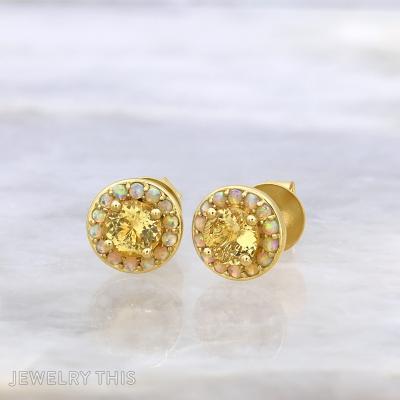
These stud earrings were designed around a round yellow topaz center stone, approximately 5.5mm, surrounded ...

A pair of stud earrings built around elongated kite-shaped lab-grown alexandrite, each stone framed in ...

This pair of round brilliant diamond stud earrings began as a single earring from an ...



