


Matched Diamond Stud Earrings in 14k White Gold
$$$
14k white gold, natural diamonds
A client came to us with one remaining earring from a pair she had bought during a sale — she only needed a replacement for its missing match. After her jeweler recommended rebuilding both settings as a new pair instead of modifying just one, she agreed, and her original stone was reset alongside a newly sourced diamond chosen specifically to match it in cut, color, and clarity. Both earrings were finished with screw backs for a more secure everyday fit.
Quick specs
Design type
Primary Metal
Shape / Cut
Primary Stone
Accent Stones
Design Complexity
Intent
Intent: Certainty
Size
Stud diameter approximately 5.7mm per earring; screw-back posts on both earrings.
How they made it distinctive
-
01
Built as a full matched pair rather than a single modified earring, so prong height and profile are identical across both earrings
-
02
Original diamond preserved and reset into one of the two new settings rather than replaced
-
03
Matching diamond sourced specifically against the original stone's cut, color, and clarity rather than pulled from standard inventory
-
04
Both posts converted from smooth to threaded screw backs for a more secure daily hold
How you'd make it yours
Stone: this piece uses a natural diamond match — a new commission could use lab diamonds for the same look at lower cost
Metal: this piece is 14k white gold — the same setting style works in 18k white gold or platinum
Setting: this piece uses a simple four-prong solitaire — a new commission could use a halo or six-prong basket for a different look
Post type: this piece uses threaded screw backs — a new commission could use standard push backs or lever backs depending on preference
One of a kind: this exact pair was built around one client's original diamond and is not reproduced — a new commission is an original piece inspired by this one, not a copy
Design changes made
The brief started as a single replacement earring, but the design shifted to a full matched pair after the jeweler explained that building both settings fresh would produce a closer match for a similar cost. The client also requested both posts be converted to threaded screw backs rather than the original smooth posts.
Who this is for
This piece is for someone who already owns a beloved pair of stud earrings and lost or damaged one, and wants the replacement to look original rather than mismatched. It's especially right if you're comfortable sending in your existing piece so the match can be built around its exact measurements and quality.
How it's made
Once the client's earring was received and the matching diamond was sourced, the approved design was 3D printed in wax and attached to a wax tree inside a flask. The flask was placed in a kiln to burn out the wax, leaving a hollow mold, and molten 14k white gold was cast into that mold to produce the raw settings for both earrings. After cooling, the castings were removed from their molds and prepared for finishing.
Both settings were cleaned, polished, and finished to a matched bright white gold surface. The client's original diamond was removed from its old setting and reset into one of the new four-prong mountings, while the newly sourced matching diamond was set into the other. Threaded screw-back posts were fitted to both earrings in place of the original smooth posts, for a more secure daily hold.
Key note
Rebuilding both settings from scratch, rather than only fabricating the missing earring, allowed the jeweler to match prong height and profile exactly between the two so the pair reads as a single original set rather than a repair.
Pricing guidance
A pair of round diamond stud earrings in 14k white gold, rebuilding a setting around a client-provided stone and a newly matched diamond, sits toward the mid-to-upper range for stud earrings of this carat weight. Diamond sourcing is the dominant cost driver here, since the matching stone must be selected for close agreement in cut, color, and clarity rather than pulled from standard inventory. Setting style and post type make a smaller but still real difference.
Moves price up ↑
- ↑ Sourcing a higher color and clarity matching diamond (e.g. moving from I1 clarity to VS or higher)
- ↑ Increasing total carat weight per earring beyond the original stone size
- ↑ Adding a halo or double-prong setting rather than a simple four-prong solitaire
- ↑ Upgrading to platinum rather than 14k white gold
- ↑ Choosing a rarer cut (such as cushion or radiance) that is harder to match
Moves price down ↓
- ↓ Using lab-grown diamonds instead of natural for the matching stone
- ↓ Keeping the original smooth posts rather than converting to threaded screw backs
- ↓ Matching to a lower clarity grade with more visible inclusions
- ↓ Choosing a six-prong basket setting made from less material
- ↓ Opting for a single replacement earring modification rather than a full new pair
Questions people ask
Yes, this is a common request. The process starts with sending in the earring you have so the jeweler can measure the stone precisely and assess its cut quality, color, and clarity. From there, a matching diamond is sourced that aligns as closely as possible on those same measurements. In many cases it makes sense to rebuild both settings as a fresh pair rather than only fabricating the missing one, since this produces a closer visual match for a similar overall cost.
It depends on the stone's size, cut, and grade, but a close match is usually achievable. Diamonds of the same carat weight can still have different millimeter diameters depending on how they were cut, so the jeweler compares actual measurements and visual quality side by side rather than relying on carat weight alone. For a .70 to .75 carat round brilliant in the I1 clarity, G-H color range, a close match is a realistic outcome. The final match is typically shown to the client for approval before the diamond is purchased.
The cost for a piece like this falls in the mid-to-upper range for stud earrings of this size, and is driven mainly by the sourcing of the matching diamond rather than the metal setting itself. A newly sourced matching stone in the three-quarter carat range typically represents the majority of the total cost, with the 14k white gold setting work making up a smaller portion. Pricing is confirmed only after the original stone has been measured and a specific matching diamond has been located.
Yes, converting from a smooth friction post to a threaded screw-back post is a straightforward request and is often done at the same time as other setting work. Screw backs thread onto the post and are considered more secure than standard push backs, which rely on friction alone. This is a common upgrade for earrings that will be worn daily or that the owner wants extra security for. It can be done whether the setting itself is new or being modified.
Once the original earring has been received and inspected, the design and diamond sourcing typically takes one to two weeks, depending on how quickly a close-matching stone can be located from cutters. After the design and stone are approved, production of the settings generally takes another two to three weeks, including casting, finishing, and stone setting. Sourcing a specific matching diamond can occasionally extend the timeline if it coincides with industry trade shows or supplier closures. Total turnaround from received earring to shipped pair is typically around five to six weeks.
Both are viable options, but natural diamond is generally recommended when matching an existing natural stone, since the two will share similar optical characteristics and inclusion patterns at comparable grades. Lab-grown diamonds are chemically identical to natural diamonds and can also be matched closely by cut and clarity, typically at a lower cost. The choice mostly comes down to whether the client wants the new stone to share the exact same origin type as the original, or is comfortable mixing a lab stone with a natural one since the visual difference is not detectable to the eye.
When only one earring needs to be replaced, rebuilding just that single setting can still leave small differences in prong height, profile, or finish between the old and new piece. Rebuilding both settings from scratch, using the original stone in one and the matching stone in the other, allows the jeweler to control for an identical setting style on both earrings. The price difference between making one new setting and a full new pair is often minor, since most of the added cost is the matching diamond, not the second setting. This approach is typically offered as an option, not a requirement.
Yes, this is standard practice when matching a lost or incomplete pair. The original diamond is removed from its old setting and reset into the new mounting alongside the newly sourced matching stone, so the finished pair uses one original stone and one new stone. This preserves the value and history of the original diamond while completing the pair. The stone is inspected for condition during the setting process to confirm it is secure before the earring is finished.
Explore Similar Creations
Every masterpiece starts with a spark. Explore how our clients raw ideas - sketches, heirlooms, inspirations - were transformed into bespoke works of arts.
A pair of stud earrings built around elongated kite-shaped lab-grown alexandrite, each stone framed in ...

This pair of oval ruby and diamond halo stud earrings was built to replace an ...

This pair of halo stud earrings was built to recreate an original pair the client ...

These daisy-shaped stud earrings turn a name into the petals of a flower. Each petal ...
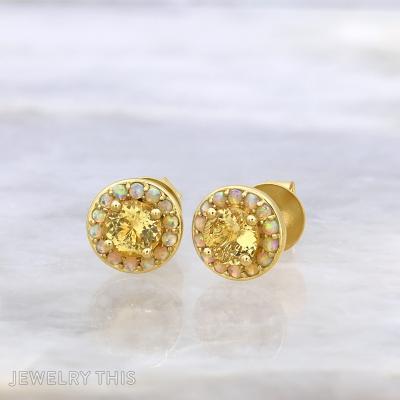
These stud earrings were designed around a round yellow topaz center stone, approximately 5.5mm, surrounded ...



