
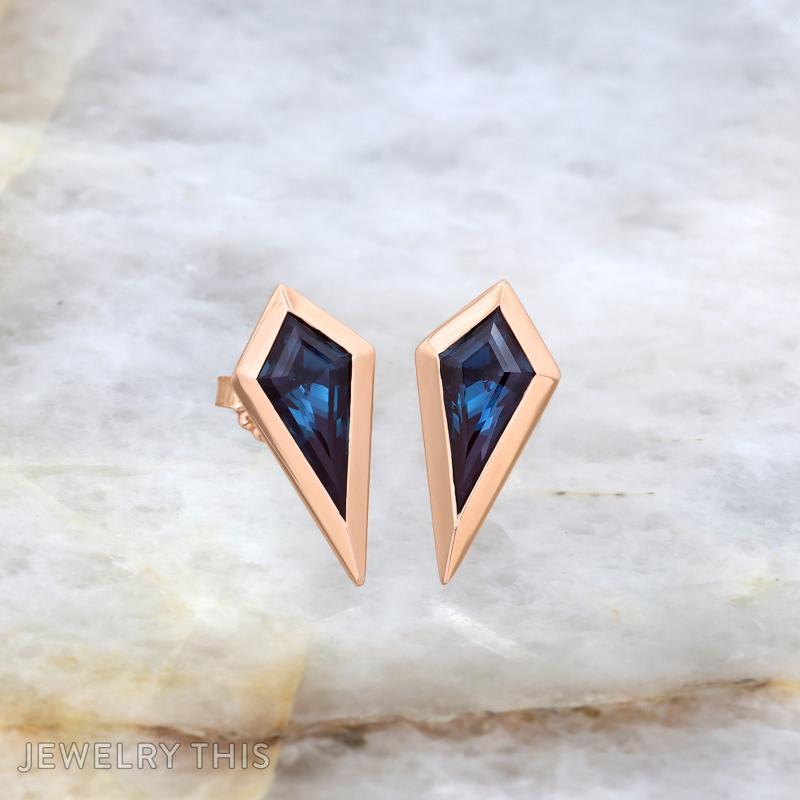
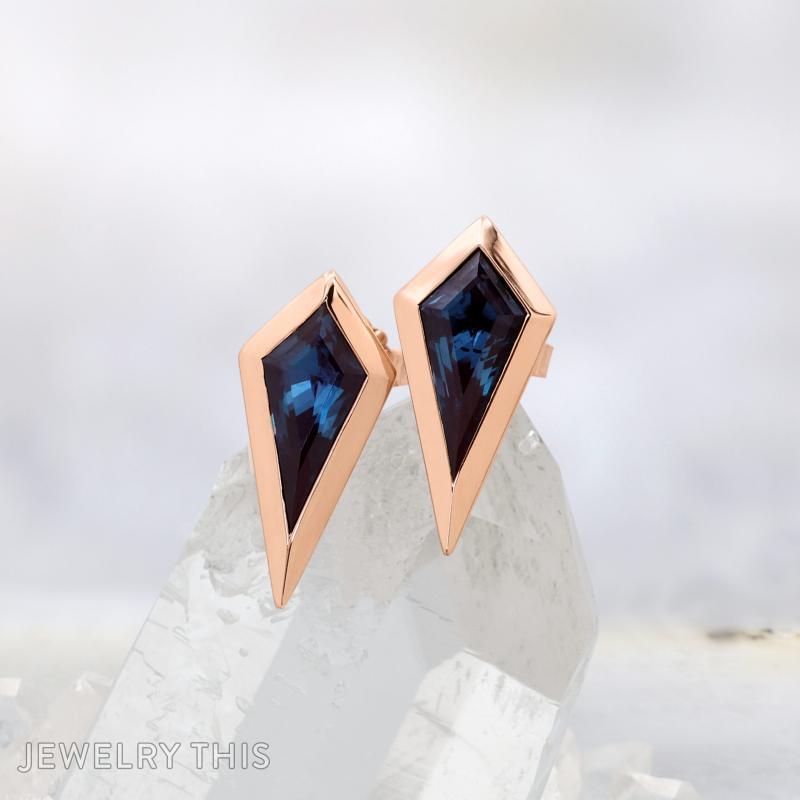
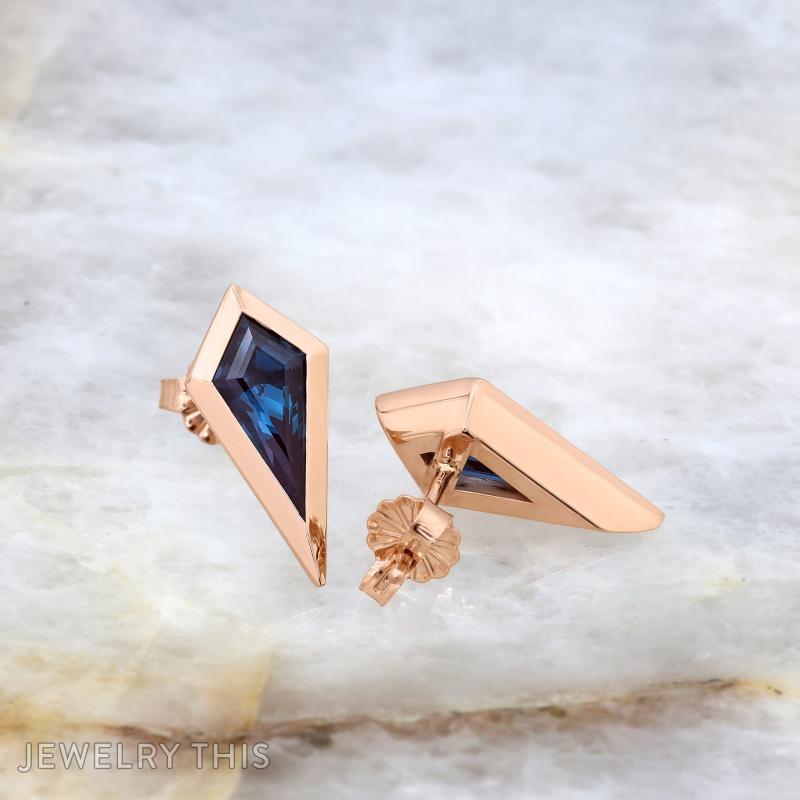
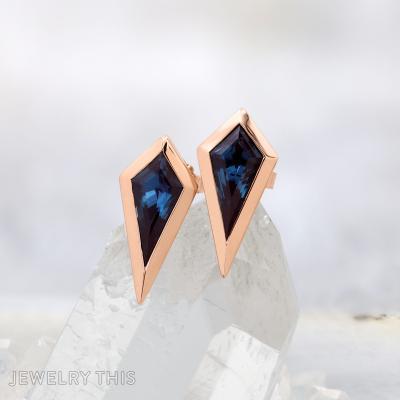
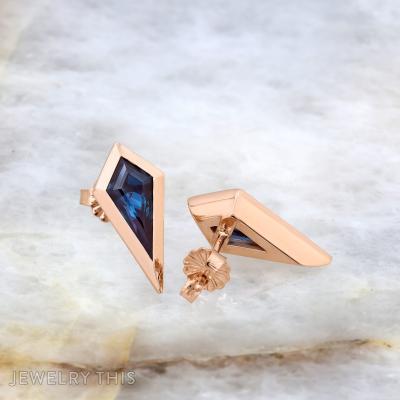
Framed Kite Alexandrite Stud Earrings in Rose Gold
$$
14k rose gold, lab-grown alexandrite
A client wanted a distinctive pair of stud earrings for his wife, drawn to the color-changing character of alexandrite over a more common stone. The design shifted from an exposed-prong kite setting to a fully framed bezel after the team flagged that the pointed tips would otherwise be left sharp and vulnerable to chipping. When they arrived, he wrote: 'Thank you very much! My wife loves them!!'
'Wow they look great! So excited!' — on seeing photos of the finished stones
'Hi Carrie! They look amazing!' — on seeing the finished earrings
'Thank you very much! My wife loves them!!' — on delivery
Quick specs
Design type
Primary Metal
Shape / Cut
Primary Stone
Accent Stones
Design Complexity
Intent: Certainty
Size
Stud earrings, elongated kite-shaped stones approximately 12mm x 5.5mm each.
How they made it distinctive
-
01
Custom-cut elongated kite shape chosen over standard calibrated shapes for a distinctive silhouette
-
02
Frame/bezel setting selected specifically to protect the four vulnerable points of the kite shape
-
03
Lab-grown alexandrite chosen for its color-changing effect at a lower cost than natural material
-
04
Stud orientation deliberately set with the long axis running up the earlobe rather than toward the face
-
05
Smooth enclosed setting chosen so nothing catches on hair, addressing a concern raised early in the design
How you'd make it yours
Stone: this piece uses lab-grown alexandrite; a new commission could use a sapphire, tourmaline, or other kite-cut colored stone
Metal: this piece is 14k rose gold; the same frame design works well in white gold or yellow gold
Setting style: this piece uses a fully framed bezel; a new commission with a less pointed stone shape could use a lower-profile prong setting
Stone shape: this piece uses an elongated kite cut; a new piece could use a symmetrical kite, shield, or other geometric calibrated shape
One of a kind: this exact pair was designed and cut for one client and is not reproduced — a new commission is an original piece inspired by this one, not a copy
Design changes made
The kite-shaped stones were originally going to be set with prongs at each point, but the design shifted to a fully framed bezel setting after the client's own suggested exposed-tip layout was flagged as leaving sharp, vulnerable corners. The framed version also eliminated any risk of hair catching on the setting.
Who this is for
This piece is for someone who wants a distinctive stone shape without sacrificing everyday durability, especially if small children are around to tug at jewelry. It's especially fitting for someone drawn to a stone with genuine character, like a color-changing gem, but who wants the practical peace of mind of a fully enclosed, catch-free setting.
How it's made
Once the custom-cut stones arrived from the cutter, the design team built a 3D model of the earring settings for review, including two stud orientation options to show how the kite shape would sit on the earlobe. After the client approved the framed setting and metal color, the model moved to casting in 14k rose gold, producing the raw earring settings ready for finishing.
Each setting was cleaned up and polished to a smooth finish, since the frame style leaves no prongs or texture to differentiate — the entire surface reads as one continuous polished edge. The elongated kite-shaped alexandrite stones were then set into their frames, with the bezel fully enclosing each stone's edges and pointed corners for protection. The stud posts were positioned so the longer axis of each stone runs up the earlobe.
Key note
The frame setting was chosen specifically because a kite shape has four vulnerable points instead of the usual two or four rounded corners — a prong at every point would have been structurally weaker than a continuous bezel.
Pricing guidance
Stud earrings with a custom-cut colored center stone and a fully framed bezel setting sit in the mid range for custom earring work. Most of the added cost over a standard stud comes from the custom stone cutting to a specific calibrated shape, plus the hand-fitting required for a frame that fully encloses an unusual outline. Metal karat and stone treatment are the next biggest levers on price.
Moves price up ↑
- ↑ Choosing natural alexandrite instead of lab-grown, which is significantly rarer and more expensive at this size
- ↑ Increasing the stone size beyond the calibrated 12mm x 5.5mm dimensions, requiring an even more custom cut
- ↑ Adding accent diamonds or melee stones around the frame
- ↑ Upgrading from 14k to 18k rose gold
- ↑ Rushing the custom stone-cutting timeline to meet a tighter deadline
Moves price down ↓
- ↓ Choosing a standard calibrated shape (round, oval, pear) instead of a custom-cut kite, avoiding custom cutting fees
- ↓ Selecting a more readily available stone such as lab moissanite or a colored topaz
- ↓ Using a simpler prong setting instead of a fully framed bezel
- ↓ Reducing the stone size to a smaller standard calibration
- ↓ Choosing sterling silver or gold-plated silver instead of solid 14k rose gold
Questions people ask
Lab-grown and natural alexandrite are chemically identical, both showing the mineral's signature color-change effect between different lighting conditions. Natural alexandrite is extremely rare and commands a much higher price, especially at larger sizes. Lab-grown versions are widely available in calibrated sizes and shapes, though the color shift is sometimes less dramatic than in the finest natural stones. For most buyers, lab-grown offers the same visual character at a fraction of the cost.
A kite shape has sharp points at all four corners, and each point is a vulnerable spot where a stone can chip if struck or dropped. A traditional prong setting only grips the stone at a few contact points, leaving the tips exposed. A continuous frame, or bezel, setting encloses the entire outline of the stone, protecting every corner while also removing any raised metal that could catch on hair or clothing.
Alexandrite rates around 8.5 on the Mohs hardness scale, making it quite durable for everyday jewelry, comparable to sapphire. The main vulnerability isn't the material itself but the cut: pointed shapes like a kite have corners that can chip on impact regardless of the stone's hardness. A protective setting like a full frame addresses that specific risk rather than the stone's overall durability.
Earrings built around a custom-cut colored stone in an unusual shape like a kite sit in the mid range for custom earring work, largely because the stones must be cut to order rather than pulled from standard inventory. A frame or bezel setting that fully encloses the stone's outline adds hand-finishing time compared to a simple prong setting. Metal choice and stone size are the two biggest additional cost factors from there.
Custom-cut calibrated stones typically take a few weeks from order to delivery, though this can extend if a cutter is dealing with high seasonal demand or if a stone needs to be re-cut due to a flaw discovered during faceting. Once the stones are in hand, the setting itself, from 3D model to finished casting and stone-setting, generally takes another few weeks. Total timelines for a custom stone plus setting project often run longer than a stock-stone design because of this sequential dependency.
Yes, alexandrite works well in either white or rose gold, since the metal tone doesn't compete with the stone's own color-changing effect. White gold gives a cooler, more neutral frame around the stone, while rose gold adds warmth that can complement a purplish or reddish color shift. The choice comes down entirely to personal preference and doesn't affect the stone's performance or durability.
Stud-style earrings that sit flat against the earlobe, rather than dangling, are much harder for small hands to grab compared to drop or chandelier styles. A smooth frame setting with no exposed prongs also reduces anything a child's fingers could catch on. This combination of a close-fitting stud with a fully enclosed setting is a common request from parents of young children.



