


Recreated Daisy Ring — Two-Tone Gold with Sapphire Center
$$
14k yellow gold, 14k white gold, natural sapphire
K. came to us trying to recreate a daisy ring that had belonged to her mother and that she had since lost, with no photos to work from after a long search through old pictures. Over several rounds of sketches and renders, she refined the petal shape, the flower size, and the curve of the band from memory alone, scaling the flower down twice until it matched how small and delicate the original had been. When it arrived, she wrote: 'I do love it, and am wearing it as we speak! I've hardly taken it off since I received it.'
'So beautiful!! I can't wait to see it in person. Thank you so much for working with me on this special project!' — on seeing the finished piece photo before shipping
'I do love it, and am wearing it as we speak! I've hardly taken it off since I received it.' — on delivery
Quick specs
Design type
Primary Metal
Secondary Metal
Shape / Cut
Primary Stone
Accent Stones
Design Complexity
Intent: Certainty
Size
Ring size 6.5 US (16.92mm). Flower diameter 10mm. Band width approximately 1.5mm at narrowest point.
How they made it distinctive
-
01
Six petals fold back toward the shank rather than standing upright, keeping the profile low and snag-free
-
02
Dark, nearly-black sapphire chosen and hand-selected from a sourced parcel to match the client's memory of the original stone's color
-
03
Flower scaled down twice to 10mm after the client clarified the original was small enough to show her finger on either side
-
04
Prong setting chosen over bezel specifically to match the way the original ring held its center stone
-
05
Shank designed with a shallow groove that tapers from deep near the flower to smooth further around the band, mirroring a detail from the lost original
How you'd make it yours
Stone: this piece uses a dark, nearly-black natural sapphire; a new commission could use a lighter blue sapphire, a lab sapphire, or a different center stone entirely
Metal: this piece is two-tone 14k yellow and white gold; the same floral design works in a single tone or in 18k gold
Petal count: this piece has six petals; a new commission could use four, five, or eight for a different flower character
Flower scale: this piece's flower is 10mm; a new piece could be sized larger or smaller depending on the wearer's preference
Band detail: the tapering groove near the flower is a design choice that could be omitted for a plain rounded shank on a new piece
One of a kind: this exact ring was designed to match one client's memory of her mother's ring and is not reproduced — a new commission is an original piece inspired by this one, not a copy
Design changes made
The flower was scaled down twice, from an initial 15mm to 10mm, after the client clarified the original was small enough that her finger showed on either side of it. The petal shape was also softened to remove some of the ridging, and the center stone setting was changed from a bezel to simple prongs to match the client's memory.
Who this is for
This piece is for someone who remembers a specific piece of jewelry in detail and wants that memory rebuilt, even without a single photo to work from. It's especially right for anyone who values a low, soft, wearable floral design over a bold or raised one, and who is comfortable working through several rounds of sketches and renders to get small details like scale and petal shape exactly right.
How it's made
Once the final design was approved, the piece was built first as a wax model using a 3D printer, then attached to a wax tree and invested in plaster before the wax was burned out in a kiln to leave a hollow mold. Molten 14k gold was then cast into the mold, producing the raw two-tone ring with its white gold flower and yellow gold band in one casting.
After casting, the ring was cleaned and hand-polished, smoothing the ridges in the petals so they read as soft rather than sharply faceted. The shank was finished with a shallow groove running from the base of the flower, deepest near the petals and tapering out a few millimeters before giving way to a smooth, rounded band. The sourced dark sapphire was then set into simple prong mounts at the center of the flower.
Key note
The band's groove detail had to taper into a smooth profile within a few millimeters of the flower because the shank, at its narrowest point of about 1.5mm, was already at the minimum thickness the casting process could reliably hold.
Pricing guidance
A two-tone floral ring with a sculpted, multi-petal flower and a center stone sits toward the lower-to-mid end for custom rings of this complexity. Most of the cost comes from the hand-finishing needed to soften a multi-petal design and the casting precision required for a narrow bypass band. Stone choice and metal karat are the biggest levers from there.
Moves price up ↑
- ↑ Using a larger or higher-grade sapphire, or switching to a natural fine sapphire with strong color saturation
- ↑ Upgrading from 14k to 18k gold in either the band or the flower
- ↑ Adding diamond accents along the petals or band
- ↑ Increasing the flower size, which requires more metal and more hand-finishing per petal
- ↑ Choosing a fully bezel-set stone, which requires more metalwork than simple prongs
Moves price down ↓
- ↓ Using a lab sapphire or a lab-created alternative stone instead of a natural sapphire
- ↓ Simplifying the petal count from six to four or five
- ↓ Choosing a single metal tone instead of a two-tone build
- ↓ Reducing the flower diameter below 10mm, using less metal overall
- ↓ Omitting the shank groove detail for a plain rounded band
Questions people ask
Yes, this ring was rebuilt entirely from written description and a handful of inspiration photos the client found online, since no photo of the original ring existed. The process usually starts with a technical sketch based on your description, which is refined through a few rounds of feedback before it becomes a 3D render. It can take longer than recreating from a photo because small details like petal count, curve, and scale have to be worked out through back-and-forth conversation. Most clients find that two to three rounds of sketch revisions gets the design very close to what they remember.
Sapphire is rated 9 on the Mohs hardness scale, just below diamond, which makes it one of the most durable gemstones available for daily wear. It resists scratching extremely well and holds up to normal daily activities like washing hands or light physical work. A small center stone set in simple prongs, as in this design, is also easier to keep secure over time than a larger or more exposed stone. Dark or nearly-black sapphires are typically natural color variations and do not require different care than lighter blue sapphires.
A two-tone ring with a sculpted multi-petal flower and a center stone generally falls toward the lower-to-mid range for custom work of this complexity. The main cost driver is the hand-finishing required to soften the petal detail and the precision casting needed for a narrow band, rather than the metal itself. Stone selection and metal karat are what move the price most from a baseline design like this.
The full process from first sketch to finished ring typically runs several weeks to a couple of months, depending on how much back-and-forth is needed on the design. In this case, the sketch and render phase took several weeks because the flower size and petal shape needed multiple rounds of adjustment. Once a design is approved, production including wax modeling, casting, finishing, and stone setting generally takes three to five weeks. A resin or wax preview is sometimes shared partway through so the client can see the piece before it's cast in metal.
Yes, within limits set by the casting process. In this design the band was narrowed to approximately 1.5mm at its thinnest point, which is close to the minimum width that can reliably hold a decorative groove detail without failing during casting. Going thinner than that risks the piece not passing casting tolerances, so there is a practical floor to how slim a band can be made. A jeweler can tell you the minimum safe width for your specific design during the 3D modeling stage.
Yes, petals can be designed to fold back toward the band rather than standing upright, which keeps the profile low and reduces snagging on clothing, hair, or gloves. This design choice does change the sculptural look of the flower somewhat, trading height and drama for a flatter, more wearable silhouette. It's a common request for flower rings intended for daily wear rather than special-occasion use. The setting for any center stone can also be kept low-profile with simple prongs rather than a raised or elaborate mounting.
Yes, two-tone construction combining white gold and yellow gold in the same piece is a standard technique, most often used so one metal highlights a specific design element like a flower or setting while the other forms the body of the ring. Both metals are cast together or joined during production so the final piece is a single solid ring, not two pieces attached after casting. This approach is common in floral and nature-inspired designs where the contrast helps a decorative element stand out against a plainer band.
A bezel setting surrounds the stone with a continuous rim of metal, fully enclosing its edge, while a prong setting uses a small number of metal claws to hold the stone in place with more of it exposed. Prongs generally show more of the stone's surface and give a lighter, less bulky look, which matters in a small-scale design like a flower center. Bezels offer slightly more protection for the stone's edge but add visual weight. The choice is largely aesthetic for a small, well-protected stone like the one in this design, though prongs were specifically chosen here to match the original ring's appearance.
Check what our clients say about us

Katie Schenkkan
3 years ago
Absolutely fantastic experience. Contacted them to try and remake a lost ring I was absolutely devastated about…they usually work from photos, but after combing through 10+ years’ worth of iPhone pics, I couldn’t find one, despite how often I used to wear it. Nevertheless, after many rounds of conversation, sharing of photos, and even my completely inept sketches, they made me a ring that’s probably 90% of the way there to the exact item I lost. It’s incredible. And it’s also a very high quality piece of jewelry on its own! They even sourced a center stone for me and showed me a dozen options to choose from, so my type A micromanager self was thrilled. Couldn’t recommend more!
Explore Similar Creations
Every masterpiece starts with a spark. Explore how our clients raw ideas - sketches, heirlooms, inspirations - were transformed into bespoke works of arts.
This 14k yellow gold ring was built from an existing design the client admired, with ...

This elegant 14 karat white gold mother’s ring features an array of birthstones alternating between ...

This platinum engagement ring set began as a single, structurally compromised ring — a thin ...

This ring began as a glimpse of someone else’s jewelry — a chance sighting that ...

This ring is built from two separate bands that interlock and roll against each other ...


Elevate connection with our matching Anam Cara soulmate bands, crafted in 14kt yellow gold with ...
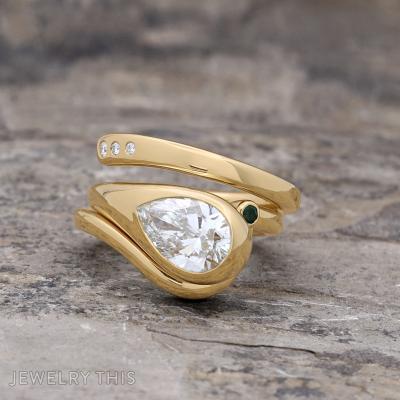
This breathtaking yellow gold wedding set is a masterclass in organic, bypass-style design. The engagement ...

This wide gold engagement ring is a captivating work of art, showcasing an extraordinary amorphous ...

This men’s wedding band was built around a channel of rectangular baguette diamonds running the ...

This engagement ring is crafted with white gold, featuring an emerald-cut moissanite center stone and ...

This custom 14k yellow gold wedding band is a meaningful recreation of the client’s father’s ...



