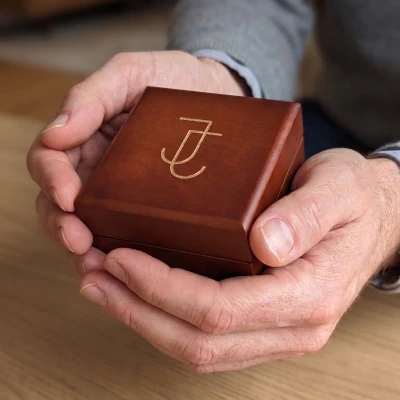


Ruby Pavé Eternity Band in White Gold with Engraving
$$
14k white gold, natural rubies
A. returned to recreate a band she already loved in a new color, choosing deep red rubies in place of the aquamarines from a previous piece. She asked for a private inside engraving to mark it as this ring's own. When it first arrived without the engraving, she sent it back, and it came back finished exactly as planned.
Quick specs
Design type
Primary Metal
Shape / Cut
Primary Stone
Accent Stones
Design Complexity
Intent: Certainty
Size
Ring size 7½ US (17.73mm). 21 round 2mm rubies set along the band.
How they made it distinctive
-
01
Rubies chosen in a deliberately darker, richer tone to distinguish this band from a prior aquamarine version
-
02
Pave setting with shared prongs keeps the profile slim enough to stack with other bands
-
03
Private inside engraving added specifically to personalize this piece from its companion rings
-
04
Built from an existing approved model, keeping the design consistent across a growing set of bands
How you'd make it yours
Stone: this piece uses rubies; a new commission could use sapphires, emeralds, or other colored stones for the same pave look
Metal: this piece is 14k white gold; the same design works in yellow or rose gold
Coverage: this piece covers roughly two-thirds of the band; a new piece could go full eternity or partial in either direction
Engraving: the inside of the band can carry a new name, date, or short phrase
One of a kind: this exact ring was made for one client and is not reproduced — a new commission is an original piece inspired by this one
Design changes made
Design matched the initial brief without major changes — the only addition was the inside engraving, agreed before production began.
Who this is for
This is for someone building a personal collection of matching stacking bands, each one marking something different through color and a private engraving. It suits someone who likes repeating a design they already trust rather than starting over with something new each time.
How it's made
Because this band repeated an existing model, production moved directly into the casting phase once the deposit was received. The approved digital model was updated with the engraving text, then used to cast the band in 14k white gold. The rubies were sourced separately and confirmed for fit against the setting before the ring was finished.
After casting, the band was cleaned up and polished to a bright finish. The 21 round rubies were set by hand along the top of the band in a shared-prong pave arrangement, each stone secured individually. The inside engraving was completed as a separate step after the ring's first return, using the same model reference to place the text accurately inside the band.
Key note
The engraving was added after casting and polishing were complete, since engraving a finished band risks less distortion to the metal than engraving before the stones are set.
Pricing guidance
A slim pave ruby eternity-style band in 14k white gold sits toward the lower end of the mid range for custom stacking bands. Much of the cost comes from the number of small stones set individually rather than the metal itself. Stone color grade and band coverage are what move the price most from there.
Moves price up ↑
- ↑ Extending the pave rubies to go fully around the band rather than partway
- ↑ Using larger stones than 2mm
- ↑ Upgrading to 18k gold instead of 14k
- ↑ Choosing natural rubies with a premium color grade over standard commercial-grade stones
Moves price down ↓
- ↓ Reducing the stone count by covering less of the band
- ↓ Switching to lab-created rubies instead of natural
- ↓ Using a lower karat gold such as 10k
- ↓ Leaving the band unengraved
Questions people ask
This depends on what was sourced for the specific piece, but both options are available for a pave ruby band like this. Lab-created rubies are chemically identical to natural rubies, just grown in a controlled setting rather than mined, and they typically cost less for the same color and clarity. Natural rubies carry a premium, especially in a deep, richly saturated red. Either option holds up well in a pave setting like this one.
Rubies rank 9 on the Mohs hardness scale, second only to diamond, which makes them one of the most durable gemstones available for daily wear. They resist scratching extremely well, which matters in a pave setting where many small stones sit close to the surface. The main risk to a pave band over time is wear on the prongs holding each stone, not damage to the rubies themselves. Periodic prong checks are a good idea for any pave ring worn daily.
A slim pave band set with around 20 small rubies in 14k white gold falls toward the lower end of the mid-range for custom stacking bands. The main cost driver is the labor of setting each small stone individually rather than the gold itself. Choosing lab-created rubies instead of natural, or reducing stone coverage, brings the cost down further.
Yes, this is a common request — the same pave design can be repeated in different gemstones to build a coordinated stack. Each band uses the identical setting style and stone size, so only the gem color changes between pieces. This approach lets someone build a personal set one ring at a time rather than committing to all of them at once.
When the design already exists, production can move directly to casting and stone-setting, which typically takes around four weeks from deposit to completion. A brand-new pave design from scratch usually takes a bit longer because of the initial design and render phase. Adding engraving after the ring is cast can extend the timeline slightly since it requires a separate shipping step.
Yes, the inside of a pave band can be engraved with a name, date, or short phrase as long as the band has enough flat interior surface for legible text. Engraving is typically done after the band is cast and polished, since engraving into a fully finished surface produces a cleaner result than engraving before the piece is complete. Short engravings like a name and date fit comfortably on most standard band widths.
A pave setting uses small shared prongs between each stone, so the stones sit close together with minimal visible metal, giving a continuous sparkle along the band. A channel setting holds stones between two metal walls with no visible prongs, which protects the stones more but gives a slightly different, smoother look. Pave is generally preferred for a lighter, more delicate stacking band like this one.
Pave bands can typically be resized within a limited range, usually one size up or down, without disturbing the stones. Larger resizes are riskier because stretching or compressing the band can loosen the prongs holding the pave stones. If a significant resize is needed, it's worth checking with a jeweler experienced in pave settings specifically, rather than a general resize service.
Explore Similar Creations
Every masterpiece starts with a spark. Explore how our clients raw ideas - sketches, heirlooms, inspirations - were transformed into bespoke works of arts.
This eternity-style band was recreated from a single aged photograph of a ring that had ...

This eternity band pairs a full circumference of pavé-set round lab diamonds with a distinctive ...

This eternity band pairs two December birthstones — faceted blue topaz and cabochon-cut turquoise — ...
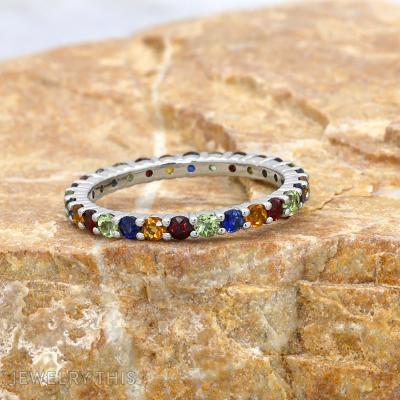
This 14k white gold eternity band was designed to be worn every day without feeling ...

Experience timeless elegance with this exquisite custom eternity ring crafted in luxurious 14K yellow gold. ...

This curved eternity-style band was built to solve a specific stacking problem: finding a colored-stone ...
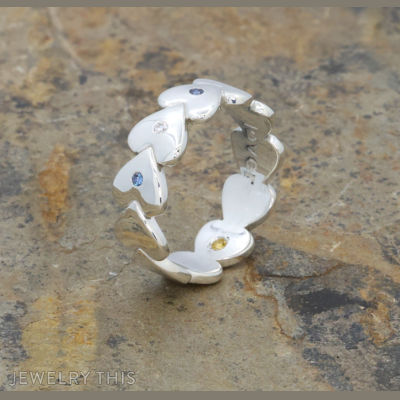
This eternity-style band is built from a continuous run of heart-shaped links, each face polished ...
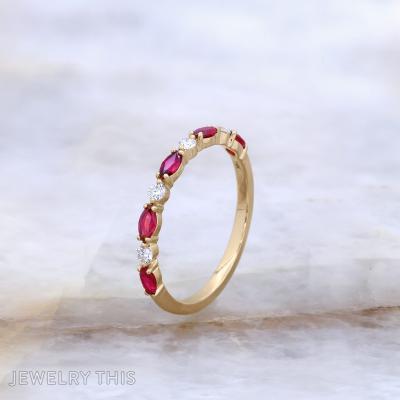
This 14k yellow gold band alternates five marquise-cut natural rubies with four round natural diamonds, ...

This wedding band was built to complete a set, matched in metal, stone grade, and ...

This 14k yellow gold band was built around an open, branch-like leaf pattern that runs ...