

Full Eternity Wedding Band in 18k White Gold Pave Diamonds
$$$
18k white gold, natural diamonds
A client returning to the same studio that made his fiancée's engagement ring wanted a wedding band that would feel like part of the same set rather than a separate piece. The design started as a simple matching band and became a full eternity design partway through, once he decided he wanted diamonds continuing all the way around rather than stopping halfway. He wrote afterward that everything had worked out well.
'All worked out great.' — on delivery
Quick specs
Design type
Primary Metal
Shape / Cut
Primary Stone
Accent Stones
Design Complexity
Intent: Certainty
Size
Ring size 8.5 US (18.54mm).
How they made it distinctive
-
01
Designed specifically to pair with and match an existing engagement ring's metal, stone grade, and setting style rather than as a standalone piece
-
02
Changed mid-design from a half-pave matching band to a full eternity setting at the client's request for a fuller look
-
03
Diamonds set continuously around the entire band rather than only across the visible top portion
-
04
Interior engraving uses the same font as the engagement ring to visually connect the two pieces
-
05
Ring size confirmed using mailed ring sizers rather than an estimate, to avoid a repeat resize
How you'd make it yours
Stone type: this piece uses natural diamonds — a new commission could use lab diamonds for the same look at lower cost
Coverage: this piece is a full eternity design — a new commission could use a half-eternity band for a similar look with fewer stones
Metal: this piece is 18k white gold — the same pave style works in yellow gold or rose gold
Engraving: the inside of a new band can carry its own inscription, matched or unmatched to a companion ring
One of a kind: this exact band was designed to match one specific engagement ring and is not reproduced — a new commission is an original piece inspired by this one, not a copy
Design changes made
The band was changed from a half-pave design matching only the top of the engagement ring to a full eternity band with diamonds continuing all the way around, after the client decided mid-process that he wanted the fuller look.
Who this is for
This is for someone building a wedding set who wants the wedding band to feel inseparable from the engagement ring, even though the two pieces are never physically joined. It's especially right if you already have a ring whose specs can be matched, and you want diamonds that wrap the entire band rather than stopping partway around.
How it's made
Once the full eternity design was approved, the ring was 3D modeled and printed in wax using a 3D printer. The wax model was attached to a tree and invested in plaster, then fired in a kiln to burn out the wax and leave a hollow mold. Molten 18k white gold was then cast into the mold under pressure and allowed to cool before the raw band was removed and prepared for finishing. Before committing to metal, a resin model was sent to the client to confirm fit and style against the engagement ring.
After casting, the band was cleaned, polished, and finished to match the engagement ring's white gold surface. Round diamonds were then pave-set continuously around the full circumference of the band in the same setting style as the engagement ring, rather than only partway around. The inside of the band was engraved with a personal inscription in the same font used on the engagement ring, tying the two pieces together visually from the inside.
Key note
The band was deliberately built as a full eternity design rather than a half-pave match so it could be worn comfortably even without being soldered to the engagement ring, since the two rings move independently on the finger.
Pricing guidance
A full eternity band in 18k white gold with natural diamonds set continuously around the band sits toward the higher end for wedding bands of this type. Most of the added cost over a half-pave or plain band comes from the stone count and the labor of setting diamonds evenly around the entire circumference. Matching an existing engagement ring's stone grade and metal also adds a sourcing step that a standalone band wouldn't require.
Moves price up ↑
- ↑ Increasing from a half-pave to a full eternity setting, which roughly doubles the number of stones set
- ↑ Matching a specific existing stone grade and color to pair with another piece, which narrows sourcing options
- ↑ Upgrading diamond clarity or color grade beyond what is used here
- ↑ Adding a resin fit-check step before casting for a guaranteed match in profile and sizing
- ↑ Custom engraving in a specific matched font rather than a standard font choice
Moves price down ↓
- ↓ Switching from a full eternity to a half-pave design, using fewer stones
- ↓ Using lab-grown diamonds instead of natural diamonds for the same look at lower cost
- ↓ Reducing stone size slightly across the band
- ↓ Choosing a lower clarity/color grade than top color/quality
- ↓ Skipping the custom engraving
Questions people ask
Yes. When a wedding band is designed to match an existing engagement ring, the jeweler needs the original specs — metal type, stone color and clarity grade, and setting style — to source matching materials. This band was matched to an 18k white gold engagement ring using the same F/G color, VS clarity diamonds and the same pave setting style. The result is a band that reads as part of a set rather than a separate piece, even though the two rings are not physically joined.
A full eternity band has stones set continuously all the way around the entire band, 360 degrees, while a half-eternity band only has stones across the top portion that's visible when worn. Full eternity bands typically use significantly more stones and more setting labor since the stones continue around the base of the finger as well. Some people choose half-eternity for comfort or cost reasons, since the back portion isn't usually visible anyway. The choice is purely aesthetic and budget-driven, not a durability difference.
Not always. When an engagement ring has a large center stone, the prongs or claws supporting it are often placed lower on the band for structural support, which can prevent a straight wedding band from sitting perfectly flush against it. A jeweler can design around this with adjustments to the wedding band's profile, but some gap or shift between the two rings is common with larger center stones. The two rings will typically move independently unless they are soldered together after the wedding.
Pave-set diamonds are individually secured with small prongs or beads of metal, and a well-made full eternity band in 18k gold should hold up well to daily wear. The main long-term consideration is that stones set all the way around the band, including the underside, will see more contact with hard surfaces than a half-eternity design. Regular inspection by a jeweler every year or two is a good practice to check that no prongs have worn thin. Natural diamonds rated VS clarity or better are durable enough for everyday wear.
A full eternity band in 18k white gold with natural diamonds set continuously around the band falls toward the higher end for wedding bands, largely because of the stone count and the labor required to set diamonds evenly around the full circumference. Matching the diamonds to an existing piece's color and clarity grade can add a sourcing step as well. Choosing lab-grown diamonds, a half-eternity design, or a lower stone grade are the most direct ways to reduce the cost while keeping a similar look.
Yes. White gold jewelry is typically plated with rhodium to give it a bright white finish, and that plating wears off gradually with polishing and everyday wear, which can reveal a warmer, more yellow tone underneath. This is a normal characteristic of white gold, not a defect, and it's usually fixed with a simple re-plating service at most jewelers. If a ring is professionally cleaned or polished without re-plating afterward, the rhodium layer can be thinned or lifted, making the yellow tone more noticeable sooner. Periodic rhodium replating, roughly every one to two years depending on wear, keeps the bright white look consistent.
Resizing a full eternity band is more difficult than resizing a plain band because diamonds are set all the way around, including at the point where metal would normally be added or removed. Some full eternity bands can only be resized within a very limited range, if at all, without disturbing the stone setting. This is why confirming the exact ring size before production, often using ring sizers mailed to the client, is especially important for this style. A half-eternity band is generally easier to resize since the back portion has no stones.
Yes. Interior engraving is a common way to tie a wedding band to a matching engagement ring, and the font style can be matched between the two pieces for visual consistency. Common choices include a name, a date, or a short phrase, placed on the inside of the band where it stays private during wear. Engraving is typically finalized after the ring's design and metal work are approved, since it's one of the last steps before production begins. It does not affect the durability or fit of the ring.
Explore Similar Creations
Every masterpiece starts with a spark. Explore how our clients raw ideas - sketches, heirlooms, inspirations - were transformed into bespoke works of arts.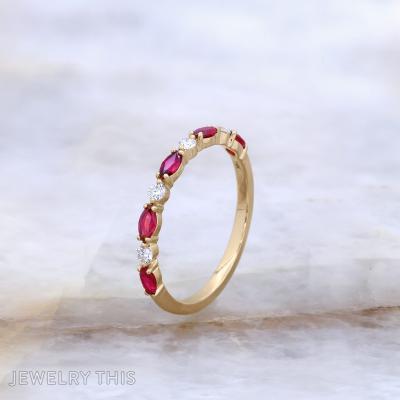
This 14k yellow gold band alternates five marquise-cut natural rubies with four round natural diamonds, ...

This 14k yellow gold band was built around an open, branch-like leaf pattern that runs ...

This eternity band pairs a full circumference of pavé-set round lab diamonds with a distinctive ...

This eternity band pairs two December birthstones — faceted blue topaz and cabochon-cut turquoise — ...

Experience timeless elegance with this exquisite custom eternity ring crafted in luxurious 14K yellow gold. ...

This 14k white gold eternity band was designed to be worn every day without feeling ...

This curved eternity-style band was built to solve a specific stacking problem: finding a colored-stone ...

This eternity-style band is built from a continuous run of heart-shaped links, each face polished ...

This eternity-style band was recreated from a single aged photograph of a ring that had ...



