


Branch & Leaf Eternity Band — Heirloom-Inspired Design
$$
14k yellow gold, blue sapphires
A couple designed this ring to echo a wedding ring worn for decades on a chain by the client's partner's grandfather. They wanted a version they could wear as a ring or a pendant for their commitment ceremony, blending the coral-like pattern of the original with a more branch-like feel of the client's own engagement ring. After receiving the piece, an early stone color didn't read as intended, and the team replaced the accent stones once more: 'It's perfect. Thank you so much.'
'Wow!! This is very very very cool. Thank you so much. We love it. It's gorgeous and so perfectly matched.' — on seeing the first render
'It's perfect. Thank you so much.' — on delivery
Quick specs
Design type
Primary Metal
Shape / Cut
Primary Stone
Accent Stones
Design Complexity
Intent: Certainty
Size
Ring size 11.25 US. Band width 4-5mm, slight taper on inside.
How they made it distinctive
-
01
Pattern directly references a family ring worn as a necklace for decades, blended with the branch style of the client's own engagement ring
-
02
Open branch design chosen so the ring reads clearly whether worn on the finger or turned sideways as a pendant
-
03
Slight inside taper added for comfort since the piece is worn both as a ring and on a chain
-
04
A dedicated solid section was engineered into the open pattern purely to hold a hidden inscription
-
05
Purple sapphires were swapped for blue after delivery when the color did not read as intended in the finished piece
How you'd make it yours
Stone type: this piece uses small blue sapphires; a new commission could use amethyst, purple sapphire, or a different birthstone color
Metal: this piece is 14k yellow gold; the same branch design works in white or rose gold
Band width: this piece is 4-5mm; a new piece could run narrower or wider depending on preference
Engraving: a solid interior section can be built into a new design to hold a private inscription
One of a kind: this exact ring was designed for one couple's commitment ceremony and is not reproduced — a new commission is an original piece inspired by this one, not a copy
Design changes made
The client compared amethyst and sapphire options and settled on stones after learning sapphire offers more durability and brilliance at a small size; the ring size was also adjusted twice using resin fit models before the final size was confirmed.
Who this is for
This piece is for someone who wants one object that moves between two forms of meaning — worn as a ring some days and as a pendant on others. It's especially right for anyone blending two different design references into one piece, or who wants a family connection reflected in something built fresh rather than copied exactly.
How it's made
Once the design was approved, a 3D wax model was printed and attached to a wax tree, which was invested in plaster and placed in a kiln to burn away the wax and leave a hollow mold. Molten 14k yellow gold was then cast into the mold, cooled, and the raw ring was extracted for cleanup and finishing.
After casting, the open branch pattern was cleaned and polished to a bright finish across the leaf and vine surfaces, with the small round accent stones set by hand into several of the leaf tips. A solid interior section was reserved during modeling specifically to hold a hidden engraving, since the open branch pattern elsewhere in the design does not have enough solid surface to carry text.
Key note
A dedicated solid section was built into the interior of the band specifically to carry the engraving, because the open branch pattern used everywhere else on the ring has no continuous surface that could hold engraved text.
Pricing guidance
A wide eternity-style band with an open branch pattern and small accent stones running continuously around the ring sits in the mid range for custom bands of this complexity. Most of the cost comes from the hand-finishing needed to clean up an open, organic pattern and from setting several small stones individually rather than in one continuous row. Stone type and band width are the biggest levers on price from there.
Moves price up ↑
- ↑ Using natural sapphires instead of lab-grown stones of the same size and color
- ↑ Increasing the number of accent stones set into the pattern
- ↑ Widening the band beyond 4-5mm, which adds more surface area to finish by hand
- ↑ Adding a fully solid inner band instead of a small engraving section, which increases metal weight and finishing time
- ↑ Upgrading from 14k to 18k gold
Moves price down ↓
- ↓ Reducing the number of accent stones
- ↓ Choosing a lab-created stone over a natural one
- ↓ Narrowing the band width
- ↓ Simplifying the branch pattern to fewer leaf clusters
- ↓ Omitting the interior engraving detail, avoiding the need for a solid section
Questions people ask
Yes, a band designed with a continuous pattern and no protruding prongs can usually be worn on a chain as a pendant as well as on the finger. The main design consideration is making sure the pattern still reads clearly when the ring is turned sideways on a chain. This dual-wear approach works especially well with open, textured patterns like a branch or vine motif. It does not require any special hardware since the ring itself becomes the pendant.
Yes, lab-grown sapphires are chemically, physically, and optically identical to natural sapphires — the only difference is where they were formed. Sapphire ranks 9 on the Mohs hardness scale, just below diamond, so both lab and natural versions hold up very well to daily wear. For small accent stones especially, lab-grown sapphires often show richer, more consistent color than natural stones of the same size. The practical difference for most buyers comes down to cost and color consistency rather than durability.
Sapphire is significantly harder than amethyst — a 9 versus a 7 on the Mohs hardness scale — which matters most for small stones set at the edges of an open, textured design where they see more daily contact. Amethyst can look great in a larger, more protected setting but is more prone to chipping in small, exposed accent stones. Sapphire also naturally has more brilliance due to its crystal structure and how it is cut, so a small sapphire will often appear brighter than a same-sized amethyst. Purple sapphire specifically gives a similar color family to amethyst with added durability and sparkle.
A branch-pattern eternity band in 14k gold with a handful of small accent stones typically falls in the mid range for custom ring work. The price is driven mainly by the hand-finishing required on an open, organic pattern and by the labor of setting multiple small stones individually. Choosing a narrower band, fewer stones, or a lab-created stone instead of a natural one are the main ways to bring the cost down from there.
The full process from approved design to finished ring typically runs several weeks. After the design is approved and a deposit is made toward production, casting and stone setting generally take about four to five weeks. If a resin size-check model is requested before casting, that step can add a week or two to confirm fit before any metal is committed.
It depends on how open the pattern is. If the design is fully open with no solid interior surface, one small section usually needs to be built as a solid area specifically to hold the engraving, which will be visible as a slightly different section from the top. This is a common solution for open branch, vine, or filigree patterns that otherwise have nowhere flat enough to engrave. The tradeoff is a small visible break in the pattern in exchange for a legible inscription.
For a wider or more organic band shape, a plastic ring sizer can sometimes give a slightly different read than the actual finished metal ring, especially at sizes between standard increments. Many jewelers will send a 3D-printed resin model of the exact ring shape so you can try on the true fit before the piece is cast in metal. This step is especially useful for larger or in-between sizes, or for anyone whose finger size changes with temperature or activity. It adds some time to the process but significantly reduces the chance of a resize after casting.
Yes, accent stones can be placed within specific design elements — like leaf tips or branch nodes — rather than in a strict evenly-spaced pattern, which often looks more organic and intentional on nature-inspired designs. This approach usually uses fewer stones than a fully eternity-set band, which can also help keep the cost more moderate. The placement is typically finalized during the 3D render stage so it can be adjusted before casting. It works particularly well on branch, vine, or floral motifs where symmetry isn't the goal.
Check what our clients say about us

Jessye Kass
2 years ago
Amazing customer service. Phenomenal ring. We are so grateful. Came out perfectly and is a beautiful wedding band to match an old heirloom. :)
Explore Similar Creations
Every masterpiece starts with a spark. Explore how our clients raw ideas - sketches, heirlooms, inspirations - were transformed into bespoke works of arts.
Experience timeless elegance with this exquisite custom eternity ring crafted in luxurious 14K yellow gold. ...

This eternity-style band is built from a continuous run of heart-shaped links, each face polished ...
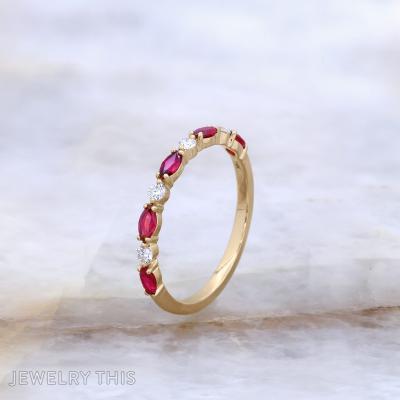
This 14k yellow gold band alternates five marquise-cut natural rubies with four round natural diamonds, ...

This 14k white gold eternity band was designed to be worn every day without feeling ...

This eternity band pairs two December birthstones — faceted blue topaz and cabochon-cut turquoise — ...



