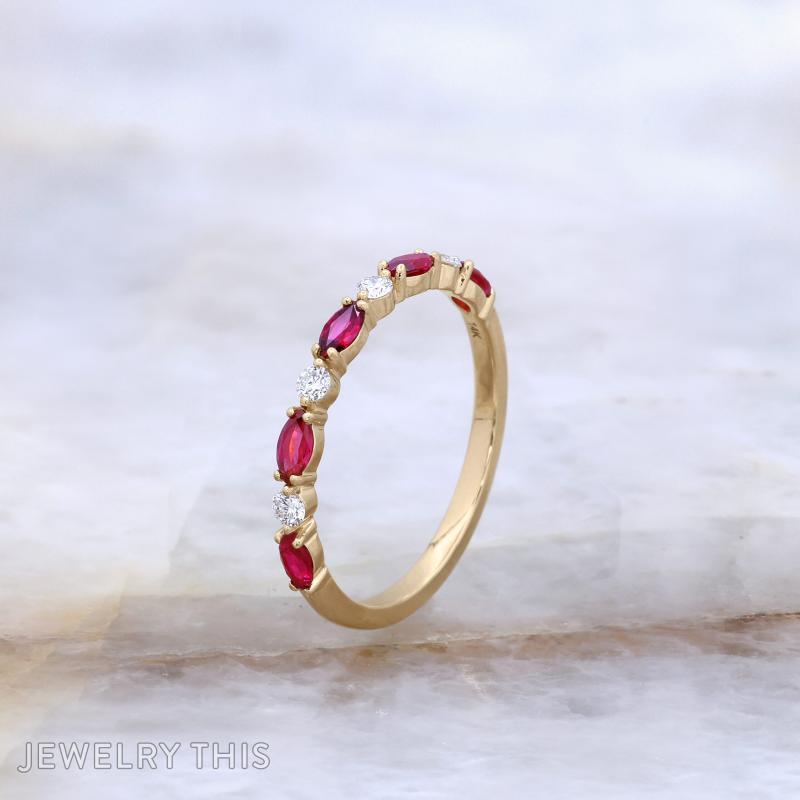
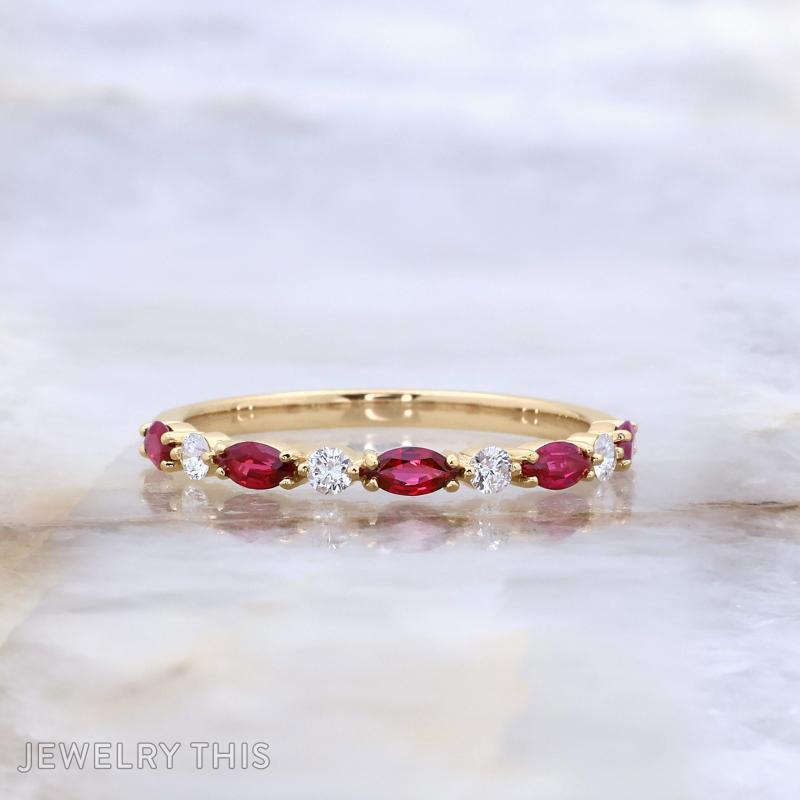
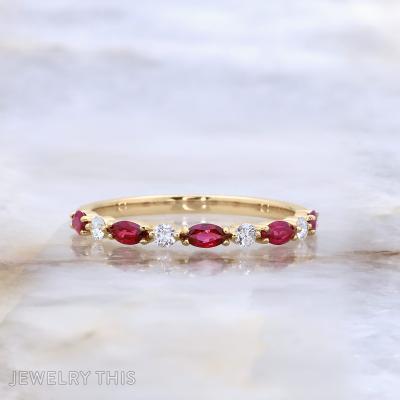
Recreated Ruby & Diamond Heirloom Band in Gold
$$$
14k yellow gold, natural diamonds, natural rubies
A client's great aunt's ring was passed to her grandmother, then given to her as a college graduation gift. She wore it once to watch the sunset at the beach and lost it in the sand, searching for hours before giving up. She had it recreated from memory and a comparison photo, matching the ruby shape and thin gold band as closely as possible. When it arrived, she wrote: 'I did get the ring and it looks really great. Thank you so much for your help in recreating my ring.'
'I did get the ring and it looks really great. Thank you so much for your help in recreating my ring. You have been so helpful!' — on delivery
Quick specs
Design type
Primary Metal
Shape / Cut
Primary Stone
Style
Design Complexity
Intent: Certainty
Size
Ring size 6.75 US. Band width approximately 1.5mm.
How they made it distinctive
-
01
Marquise ruby cut chosen specifically after comparing stone proportions in the client's photo to match the lost original as closely as possible
-
02
Alternating ruby-diamond pattern set only across the top of the band, keeping the profile low and comfortable for everyday wear
-
03
Natural rubies and diamonds used throughout to stay faithful to the heirloom the client was replacing
-
04
Thin, understated band width recreated to match the delicate proportions of the original piece
How you'd make it yours
Stone cut: this piece uses marquise rubies; a new commission could use oval or round cuts for a different look
Stone type: this piece uses natural rubies and diamonds; a new commission could use lab-created stones for the same appearance at lower cost
Metal: this piece is 14k yellow gold; the same design language works in 18k yellow gold, white gold, or rose gold
Stone coverage: this piece has stones across the top portion only; a new commission could extend the pattern into a full eternity band
One of a kind: this exact ring was designed to recreate one client's lost heirloom and is not reproduced — a new commission is an original piece inspired by this one, not a copy
Design changes made
The client was unsure whether the original rubies were marquise or oval; the team assessed the elongated proportions in her comparison photo and recommended marquise, which she approved. Ring size was also adjusted from an initial estimate to 6.75 after further measurement.
Who this is for
This piece is for someone who wants a family piece brought back into their life in a form they can actually wear every day, not tuck away for safekeeping. It's especially right for anyone who only has a memory or a photo to work from and needs a design partner willing to work through those details carefully.
How it's made
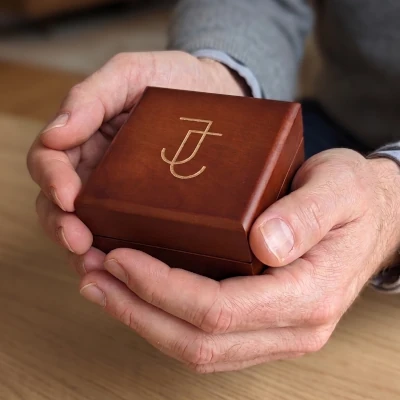
Once the design was approved, a 3D wax model was printed and reviewed as a resin preview before any metal was committed. The model was invested in plaster and fired in a kiln to burn out the wax, leaving a hollow mold that was then filled with molten 14k yellow gold under pressure to form the raw band. After cooling, the piece was removed from the mold and cleaned up for finishing.
The band was polished to a smooth, bright finish end to end, since there are no matte or textured zones on this design. The five marquise rubies and four round diamonds were then hand-set in an alternating pattern across the top of the band, each stone individually prong-set to keep the profile low and the arrangement secure for daily wear.
Key note
The rubies and diamonds were ordered and test-fit against the cast model before final setting, since colored stones are sometimes cut slightly deeper than diamonds and can sit differently in a prong.
Pricing guidance
A slim gold band with alternating marquise rubies and round diamonds sits in the mid range for custom rings of this complexity. Natural colored stones in a matched marquise cut are the main cost driver, since sourcing five well-matched stones takes more time than a single center stone. Diamond quality and total stone count are what move the price most from there.
Moves price up ↑
- ↑ Switching to larger or higher-clarity natural rubies
- ↑ Increasing the diamond count or upgrading diamond color/clarity grade
- ↑ Extending the stone pattern further around the band toward a full eternity design
- ↑ Upgrading from 14k to 18k gold
- ↑ Choosing a wider band profile with more hand-finishing
Moves price down ↓
- ↓ Using lab-created rubies and lab diamonds instead of natural stones
- ↓ Reducing the total stone count
- ↓ Choosing a single stone shape instead of an alternating pattern
- ↓ Using 10k gold rather than 14k
- ↓ Selecting a narrower band width
Questions people ask
Yes. This ring was rebuilt using a written description and a photo of a similar ring held up for size comparison, with no original piece or appraisal to work from. The process starts with a sketch, then a 3D render for review, and adjustments are made until the design matches what the client remembers. Stone shape can usually be worked out by comparing proportions in a photo, as was done here to confirm the rubies were marquise rather than oval.
Marquise-cut stones typically have a longer, more pointed elongated shape with a length-to-width ratio around 2:1, while oval stones are rounder with a ratio closer to 3:2. Comparing the pointed ends and overall proportions in a clear photo is usually enough to tell the two apart. When there's genuine ambiguity, either cut can be produced, so the final decision comes down to client preference. In this case the elongated, pointed profile of the original stones pointed clearly to marquise.
Natural and lab-created rubies share the same chemical composition, hardness, and appearance — the difference is origin, not quality. Natural rubies are mined from the earth, while lab-created rubies are grown in a controlled environment over a much shorter timeframe. Lab rubies typically cost less than natural rubies of comparable size and clarity. Either option will look identical to the naked eye once set.
A slim 14k gold band with five natural marquise rubies and four natural diamonds falls in the mid range for custom rings of this type. The primary cost driver is sourcing multiple well-matched natural colored stones rather than a single center stone. Choosing lab-created stones instead of natural, or reducing the stone count, are the two factors that move the price down the most.
The full process typically runs about five to six weeks from deposit to delivery. The first week covers the sketch and 3D render, refined through client feedback until the design is approved. After approval, sourcing the natural rubies and diamonds and completing casting, setting, and finishing takes roughly four weeks.
A slim band with stones set only partway around, like this one, can typically be resized within a standard range without disturbing the stone setting, since the plain lower portion of the band is where the resizing work happens. Larger size adjustments may require more careful handling to avoid affecting the stones nearest the resized area. It's best to have resizing done by the original jeweler when possible.
Yes, a full eternity version with stones continuously around the band is possible as a variation on this design. That said, a partial pattern like the one used here keeps the profile lower and more comfortable against the palm, which is worth considering for a ring meant for daily wear. Extending the pattern fully around would also increase both the stone count and the cost.