


Curved Aquamarine Stacking Band in White Gold
$$
14k white gold, aquamarine
A client wanted a curved aquamarine band that would actually sit flush against her existing wedding ring — something she had struggled to find anywhere else, including one earlier attempt from a different jeweler that didn't match the curve. She shipped her ring in so the new band could be modeled directly against it, and when the design came back she wrote simply: 'Love it! Looks fantastic.' More than a year later she returned to commission a second curved band in a deep red-purple ruby to complete the stack.
'Love it! Looks fantastic.' — on design approval
Quick specs
Design type
Primary Metal
Shape / Cut
Primary Stone
Accent Stones
Design Complexity
Intent: Certainty
Size
Ring size 7½ US (17.73mm). Curved band shaped to fit flush against an existing quatrefoil-design ring; 21 stones set along the curve.
How they made it distinctive
-
01
Curve modeled directly against the client's own wedding ring, scanned and measured rather than estimated, to guarantee a flush fit
-
02
Aquamarine chosen specifically as her son's birthstone, giving the stacking band personal meaning beyond its look
-
03
21 stones set edge-to-edge along the curve in a continuous pave line rather than scattered or spaced accents
-
04
Band designed explicitly to be worn in a stack rather than as a standalone piece
-
05
Returned to by the client over a year later to commission a matching curved band in a different stone, confirming the fit and design held up over time
How you'd make it yours
Stone: this piece uses aquamarine; a new commission could use sapphire, ruby, or another colored stone for a different stacking look
Metal: this piece is 14k white gold; the same curved-pave language works in yellow or rose gold
Stone count: this piece uses 21 stones along the full curve; a new design could use fewer stones or leave portions plain
Curve profile: this piece was modeled against a specific existing ring; a new commission is modeled against its own companion piece or made as a standalone curve
One of a kind: this exact band was modeled against one client's ring and is not reproduced — a new commission is an original piece inspired by this one, not a copy
Design changes made
Design matched the initial brief without major changes.
Who this is for
This is for someone building a ring stack who has been frustrated trying to find a curved band that actually matches the curve of what they already wear. It's especially right if the stone matters to you personally — a birthstone, a meaningful color — and you want the fit to be engineered rather than approximate.
How it's made
Once the client's existing ring arrived, the master jeweler scanned and measured its curved edge so the new band could be modeled to sit flush against it rather than approximating the shape. The approved 3D design was then 3D-printed in wax, attached to a tree, and invested in plaster; the mold was fired in a kiln to burn out the wax, and molten 14k white gold was cast into the resulting cavity under pressure.
After casting, the raw band was cleaned, polished, and finished to a smooth, rounded profile. Twenty-one round aquamarines were then set by hand along the curved top of the band in a shared-prong pave arrangement, following the same curve the band was modeled against so the stones track the line of the existing ring when worn together.
Key note
The band's curve wasn't designed from a sketch or estimate — the client's own wedding ring was shipped in and scanned so the new band could be modeled directly against its physical edge before any metal was cast.
Pricing guidance
A curved pave band in white gold with colored stone accents sits toward the lower end of custom banded rings, in the price range typical for this level of design complexity. Most of the cost comes from the stone count and the labor of hand-setting two dozen small stones in a continuous curved line rather than from the metal itself. Stone type is the single biggest variable in cost from there.
Moves price up ↑
- ↑ Switching from aquamarine to a more expensive colored stone such as ruby or sapphire
- ↑ Increasing the stone count or using a larger stone size along the curve
- ↑ Upgrading from 14k to 18k white gold
- ↑ Adding a matching band on the opposite side to complete a full sandwich stack
- ↑ Using natural, origin-verified stones instead of standard commercial-grade stones
Moves price down ↓
- ↓ Reducing the stone count by leaving portions of the band plain
- ↓ Choosing a less expensive colored stone such as blue topaz instead of aquamarine
- ↓ Using a straight band profile instead of a custom-curved one modeled against an existing ring
- ↓ Selecting a smaller stone size throughout
- ↓ Choosing sterling silver or gold-plated silver instead of solid white gold
Questions people ask
Yes, and the most reliable way to do it is to have the jeweler physically scan your existing ring rather than guess from a photo or description. Curved bands vary enormously in how tightly or loosely they arc, so a band made without reference to your actual ring can end up gapping or sitting unevenly. Shipping the existing ring in for scanning and measuring lets the new band be modeled directly against its edge. This produces a much closer, more reliable fit than estimating the curve from scratch.
Aquamarine rates a 7.5 to 8 on the Mohs hardness scale, which makes it reasonably durable for daily wear, similar to topaz and more durable than opal or pearl. It's not as hard as sapphire or diamond, so it can still pick up surface wear over years of constant contact, but it holds up well in a band setting where the stones are supported by metal prongs on all sides. Regular cleaning and occasional inspection of the prongs is recommended for any stone-set ring worn daily. It is a common choice for stacking bands because of this balance of durability and color.
Rubies and sapphires are both varieties of the same mineral, corundum, and share an identical chemical structure — the only difference is which trace elements caused the color. A stone has to be predominantly red to be classified as a ruby from a gemological standpoint; anything in the pink-to-purple range that isn't dominantly red is technically a sapphire, even if it's sold or described as a 'pink ruby.' This means a lot of the softer-toned red-purple stones people picture as a muted ruby are actually pink sapphires. A jeweler can source either material depending on whether you want the technically correct ruby designation or simply the color you have in mind.
A curved pave band set with a mid-range colored stone like aquamarine falls toward the lower end of the price spectrum for custom banded rings, since the main cost driver is the labor of hand-setting a continuous line of small stones rather than the gold itself. Switching to a more valuable colored stone, such as ruby or sapphire, raises the price because the stones themselves cost more per carat. Stone count, stone size, and metal karat are the other variables that move the price from there. A straight band without a custom curve modeled against an existing ring is generally less expensive than one engineered for a specific fit.
Because the process includes shipping an existing ring in for scanning before any design work starts, this type of project runs a bit longer than a standard band. After the ring is received, the 3D design typically takes about a week or two to complete and send for approval. Once approved, casting, stone-setting, and finishing take roughly four to five more weeks. Factoring in shipping time both ways for the reference ring, the full process is closer to the extended end of the standard timeline.
Yes — if a jeweler already has the exact curve and measurements for a band design on file, creating a second version in a different stone is usually straightforward, since the shape doesn't need to be re-modeled from scratch. The main consideration becomes stone sourcing: certain colors or saturations may be more limited in small sizes, so some flexibility on the exact tone can help. This is a common way to build out a stacking collection over time without needing to ship the original ring back in for each new piece.
Reputable jewelers will generally tell you that photos and digital renders can shift gemstone and metal color slightly compared to the finished piece, due to lighting, screen calibration, and the stone's natural variation. Colored stones especially can look lighter or more saturated depending on the light source they're photographed under. If color matching to an existing piece matters to you, it's worth asking the jeweler to describe the stone's tone in words (not just show a photo) before the piece is finalized. Small natural variation between stones in the same setting is also normal and expected with genuine gemstones.
Resizing a curved band is more complex than resizing a standard round band, because the curve has to be preserved and the stone-set portion typically can't be altered without disturbing the setting. Small adjustments are sometimes possible by working the plain metal portion on the back of the band, but significant size changes may not be feasible without remaking the piece. It's best to confirm your ring size carefully before production, especially when the band is custom-shaped to fit against another ring. If you're uncertain, a resin or 3D-printed test fit before casting can help confirm sizing.
Explore Similar Creations
Every masterpiece starts with a spark. Explore how our clients raw ideas - sketches, heirlooms, inspirations - were transformed into bespoke works of arts.
This eternity band pairs a full circumference of pavé-set round lab diamonds with a distinctive ...

Experience timeless elegance with this exquisite custom eternity ring crafted in luxurious 14K yellow gold. ...
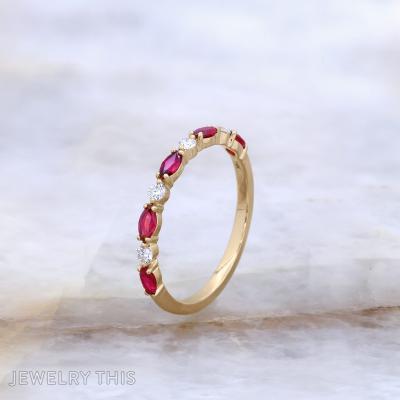
This 14k yellow gold band alternates five marquise-cut natural rubies with four round natural diamonds, ...

This 14k white gold eternity band was designed to be worn every day without feeling ...

This wedding band was built to complete a set, matched in metal, stone grade, and ...

This 14k yellow gold band was built around an open, branch-like leaf pattern that runs ...

This eternity-style band was recreated from a single aged photograph of a ring that had ...

This eternity band pairs two December birthstones — faceted blue topaz and cabochon-cut turquoise — ...

This eternity-style band is built from a continuous run of heart-shaped links, each face polished ...



