


Recreated Marquise Engagement Ring — Matched to Original Band
$$
14k yellow gold, moissanite
A client's engagement ring was designed especially for her 29 years ago and had an unusual open, upside-down-V profile with no exact match anywhere else. After it was lost, she worked with the team using only her surviving wedding band and her own description to rebuild it, choosing a marquise moissanite to balance durability and look. When it arrived, she wrote: 'I am really loving my rings!'
'I love it! My husband does too!' — on seeing the first render
'I am really loving my rings!' — on delivery
Quick specs
Design type
Primary Metal
Shape / Cut
Primary Stone
Accent Stones
Design Complexity
Intent: Certainty
Size
Ring size 7 US (17.35mm). Center stone 8x4mm marquise in a standard prong head.
How they made it distinctive
-
01
Organic bypass band shape with an asymmetrical open profile on one side, rebuilt without any surviving photo of the original design
-
02
Marquise moissanite chosen over cubic zirconia or diamond to balance durability and cost within a defined budget
-
03
Engagement ring built from the fit of the surviving wedding band rather than from a copy of the ring itself
-
04
Standard prong head selected specifically to protect the marquise stone's pointed tips for daily wear
How you'd make it yours
Stone: this piece uses a marquise moissanite; a new commission could use a cubic zirconia for lower cost or a lab diamond for a similar look with added durability
Metal: this piece is 14k yellow gold; the same bypass band language works in white gold, rose gold, or platinum
Stone size: this piece uses a .75 carat marquise; a new piece could use a larger or smaller center stone
Band profile: the asymmetrical open design is a defining feature of this piece and would need to be redesigned around a different companion band if changed
One of a kind: this exact ring was rebuilt to fit one client's specific wedding band and is not reproduced — a new commission is an original piece inspired by this one, not a copy
Design changes made
The team adjusted the stone measurements mid-process after catching an error in the original estimate (9x7mm was corrected to the accurate 8x4mm for a .75ct marquise), and the final stone choice shifted from a cubic zirconia estimate to a moissanite center stone at the client's request.
Who this is for
This piece is for someone who had a ring that mattered disappear and wants it made whole again, even without a photo to work from. It's especially right if you still have a companion piece — a wedding band, a setting, anything physical — that can anchor the recreation and guide the fit.
How it's made
Because no photo of the original engagement ring survived, the master jeweler began from the client's physical wedding band, scanning and measuring it to build a 3D model that would nest correctly against it. A photorealistic render was shared for approval before a wax/resin version was produced, then invested and cast in 14k yellow gold, with the organic, asymmetrical profile hand-adjusted to match the band's existing curve.
After casting, the band was hand-finished and polished to a bright, consistent shine across its curved, bypass-style surface. A standard prong head was fabricated and installed to hold the marquise moissanite, and the stone was then hand-set and secured into the prongs as the final production step.
Key note
Because the original ring no longer existed, the design had to be built backward from the surviving wedding band rather than from any image or model of the engagement ring itself.
Pricing guidance
A custom marquise solitaire with an organic bypass band in 14k gold sits toward the lower end of custom engagement ring pricing. Most of the baseline cost comes from the labor of hand-fitting an asymmetrical band design against a companion piece rather than from the stone itself. Stone choice is the biggest lever available for moving the total up or down from there.
Moves price up ↑
- ↑ Upgrading the center stone from moissanite to a natural or lab-grown diamond
- ↑ Choosing platinum or 18k gold instead of 14k yellow gold
- ↑ Adding pavé or channel-set accent stones along the band
- ↑ Increasing the center stone size beyond .75 carat
Moves price down ↓
- ↓ Choosing a cubic zirconia center stone instead of moissanite
- ↓ Using 10k gold instead of 14k
- ↓ Simplifying the band profile to a straight shank instead of an organic bypass curve
- ↓ Reducing the center stone to a smaller carat weight
Questions people ask
Yes, though it requires more to work with than a typical recreation. In this case, the engagement ring itself had no surviving photo, so the design was built from the client's matching wedding band and her written description of the setting. The jeweler scanned the existing band to understand its exact curve and fit, then modeled the missing ring to nest against it. The result won't be guaranteed to be pixel-identical to the original, but it captures the overall design faithfully.
Moissanite is a lab-created gemstone, chemically distinct from diamond, known for strong brilliance and high durability. It rates a 9.25 on the Mohs hardness scale, just below diamond's 10, making it suitable for daily wear in a ring setting. It typically costs significantly less than a natural or lab diamond of comparable size. Many people choose it specifically for that combination of durability and value.
A custom marquise solitaire in 14k gold with a bypass-style band generally falls toward the lower end of custom engagement ring pricing, with the center stone choice driving most of the variation. A cubic zirconia or moissanite stone keeps the price lower, while a natural or lab diamond raises it. Labor for an asymmetrical, hand-fitted band design is a bigger cost factor than people often expect. The exact number depends on metal karat, stone type, and size.
Yes, and it's a common request when one ring in a set is lost while the other survives. The jeweler scans and measures the existing band to understand its contour, then builds the new ring's profile to nest against it correctly. This is especially important for organic or asymmetrical band shapes, where a generic engagement ring wouldn't sit flush. The existing piece becomes the primary reference for the new design.
On a standard timeline, design typically takes about a week from first sketch to an approved photorealistic render. Production after approval generally runs another three to four weeks, covering casting, hand-finishing, prong fabrication, and stone setting. Complex organic band shapes that require hand adjustment can add some time to the finishing stage. Total turnaround from deposit to shipment is usually around a month to five weeks.
Yes, a standard prong head is the typical setting style for a marquise cut and works well for an engagement ring meant for daily wear. Marquise stones have pointed ends that benefit from prong protection at the tips, which a well-fitted prong head provides. This setting also allows more light into the stone compared to a bezel, maximizing brilliance. It's a reliable, time-tested choice for this stone shape.
Yes, white gold or even platinum can generally be substituted for yellow gold on a similar organic band design without altering the structure. The choice mostly comes down to personal preference and cost, since platinum is denser and typically priced higher than gold. If the ring needs to match a companion piece already in a specific metal, that existing piece should guide the choice. Either option works well with a prong-set marquise stone.
Because the design and model already exist on file, recreating a lost or stolen custom ring is generally more straightforward than the original creation process. The jeweler can reference the prior model and notes rather than starting from nothing. Keep in mind that without insurance, the cost of a replacement is typically the same as commissioning a new piece. It's worth considering jewelry insurance once a custom piece like this is delivered.
Explore Similar Creations
Every masterpiece starts with a spark. Explore how our clients raw ideas - sketches, heirlooms, inspirations - were transformed into bespoke works of arts.
This custom wedding set is a celebration of everlasting love and elegance. The engagement ring ...

This modern 14k rose gold ring features a unique wrapping design that splits at the ...

This engagement ring recreates a stolen original as closely as possible from photographs alone — ...

This engagement ring centers a 1.5 carat emerald-cut moissanite, flanked on each side by a ...

This engagement ring reimagines a familiar silhouette with the colors flipped: a colorless oval center ...
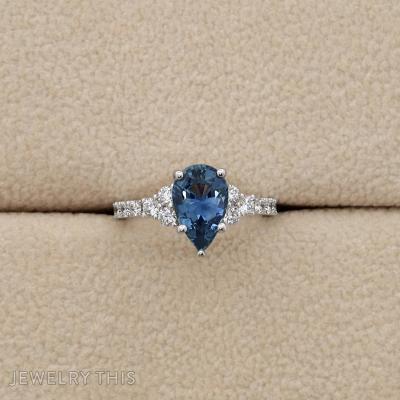
This engagement ring centers a 2.02 carat pear-shaped blue sapphire, chosen for its color over ...
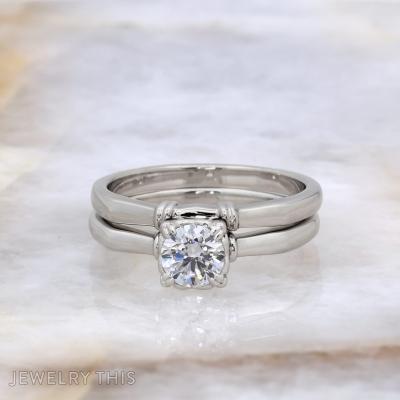
This engagement ring and wedding band were recreated as a single soldered piece in 14k ...

This enchanting vine-inspired engagement ring showcases a nature-inspired design, with a 1ct pear-shaped moss agate ...
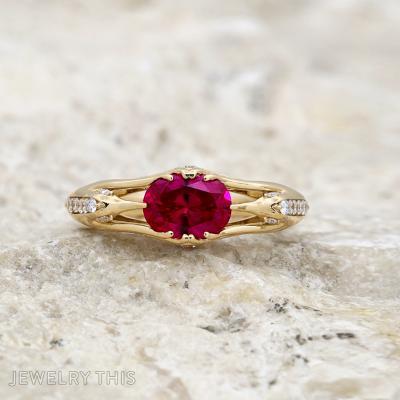
This engagement ring reimagines a hummingbird in flight, with sculpted wing forms wrapping around a ...

Introducing our Modern Three Stone Engagement Ring. A new twist on the timeless three stone ...

Crafted for the superhero enthusiast, this custom engagement ring seamlessly merges elegance with fandom. Cast ...

A one-of-a-kind 14k white gold three stone engagement ring. The center stone is a faceted ...



