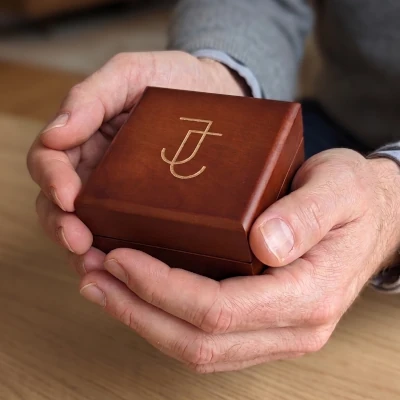


Recreated Amethyst Engagement Ring — Stolen Ring Rebuilt
$$
14k yellow gold, 14k white gold, amethyst, white sapphire
A client came to us wanting her stolen engagement ring rebuilt as closely as possible — the original jeweler was out of business, and photographs were all she had left. She was specific about every detail: the white gold prongs on the amethyst, a subtle ridge along the shoulders, a thinner band than a typical setting, and the engraved phrase from the original. When it arrived she wrote: 'I just got it and I am overall thrilled! It looks almost identical.'
'Wow that looks really close!' — on seeing the first render
'I just got it and I am overall thrilled! It looks almost identical.' — on delivery
Quick specs
Design type
Primary Metal
Secondary Metal
Shape / Cut
Primary Stone
Accent Stones
Design Complexity
Intent: Certainty
Size
Ring size 6.5 US. Band thickness 2.10-2.7mm. Center stone approximately 6.85 x 6.91 x 4.17mm; side stones approximately 6 x 4 x 2.4mm pear shape (qty 2).
How they made it distinctive
-
01
Built from the ground up from photographs alone, not a pre-made setting, after the original jeweler went out of business
-
02
White gold prong head on the amethyst paired with a yellow gold band, matching the two-tone detail of the original ring
-
03
Raised ridge detail along the shoulders near the side stones, carried over from the original design at the client's request
-
04
Band kept deliberately thin to match the dainty feel of the ring it replaces
-
05
Inside engraving in a script style reproducing the phrase from the original ring
How you'd make it yours
Center stone: this piece uses amethyst — a new commission could use sapphire, tourmaline, or a lab-created stone in a similar color
Side stones: this piece uses white sapphire — a new commission could use diamond or moissanite for more brilliance
Metal: this piece is two-tone 14k yellow and white gold — the same look works in all-yellow, all-white, or rose gold combinations
Engraving: the inside of the band can carry a new phrase, date, or initials on a fresh commission
One of a kind: this exact ring was rebuilt for one client from her own photographs and is not reproduced — a new commission is an original piece inspired by this one, not a copy
Design changes made
The band was thinned slightly and the shoulder edges near the side stones were softened after the client felt the first render looked too thick and angular compared to the original. The white gold prongs on the amethyst were confirmed and carried through as originally requested.
Who this is for
This piece is for someone who had a ring that mattered and lost it through no fault of their own, and wants it back exactly as it was rather than reimagined or upgraded. It's especially right if you have photos but no paperwork, and if the small details — a ridge, a band thickness, a stone shape — matter more to you than starting fresh with something new.
How it's made
Once the design was approved, a wax model was 3D printed and affixed to a tree inside a flask, which was placed in a kiln to burn out the wax and leave a hollow mold. Molten 14k yellow gold was then cast into the mold to form the band and shoulders, while the amethyst's prong head was made separately in white gold to match the original ring's two-tone detail.
After casting, the piece was cleaned and polished, with particular attention to smoothing the shoulder ridge near the side stones so it read cleanly without sharp edges. The pear-shaped white sapphires were set into yellow gold prongs on either shoulder, and the amethyst was set last into its white gold prong head at the center. The inside of the band was engraved with the client's chosen phrase in a script style before final polishing.
Key note
The amethyst's prong head was cast separately in white gold and joined to the yellow gold band, allowing the two-tone detail from the original ring to be reproduced precisely.
Pricing guidance
A three-stone engagement ring built from scratch with a colored center stone and two accent side stones sits in the mid range for fully custom engagement work. Most of the cost comes from building the setting from the ground up rather than modifying an existing template, plus the labor of two-tone prong work and hand engraving. Stone choice and metal karat are the next biggest variables.
Moves price up ↑
- ↑ Using natural sapphire or diamond accent stones instead of white sapphire
- ↑ Upgrading the band metal from 14k to 18k gold
- ↑ Adding stone-setting detail along the full shank rather than just the shoulders
- ↑ Requesting a fully custom two-tone build across the entire setting rather than just the center prongs
- ↑ Adding a matching wedding band designed to nest against this ring
Moves price down ↓
- ↓ Using a single metal throughout instead of a two-tone white and yellow gold build
- ↓ Simplifying the shoulder ridge detail to a plain smooth band
- ↓ Choosing lab-created stones over natural or premium graded stones
- ↓ Omitting the engraving
- ↓ Using a simpler prong style with fewer hand-finishing steps
Questions people ask
Yes, this is a common request and photographs are often enough to work from. The more angles and detail shots you have, the more accurately the setting, stone shapes, and proportions can be matched. Reference materials like an old product listing or appraisal, if available, help confirm stone dimensions. The result is built new from the ground up rather than copied from an existing template, so small differences from the original are normal.
Amethyst rates a 7 on the Mohs hardness scale, which is durable enough for regular wear but softer than sapphire or diamond, so it can show wear over years of daily use. It's a good choice for someone replacing a ring they already wore comfortably for a decade without issue. Avoiding hard knocks against countertops or tools helps preserve the stone's polish over time. Regular gentle cleaning keeps the color and clarity looking their best.
White sapphire and diamond look similar to the eye at a glance but differ in hardness and brilliance — diamond rates a 10 on the Mohs scale versus sapphire's 9, and diamond has more fire and sparkle due to its higher refractive index. White sapphire is a more budget-conscious option that still holds up well to daily wear. Many clients choose white sapphire specifically to match an original piece that used that stone rather than upgrading to diamond. Either stone works well as a durable side accent in a three-stone setting.
A three-stone engagement ring built from scratch with a colored center stone and two side stones typically falls in the mid range for custom engagement work, since the setting is built new rather than using a pre-made mounting. The main cost drivers are the from-scratch setting construction, any two-tone metal work, and the stone setting labor. Engraving and ridge or shoulder detailing add modest additional labor. Choosing lab-created or more common stones over premium graded natural stones can bring the cost down.
The design phase typically takes about a week, during which a sketch and 3D render are shared for approval and adjusted based on feedback. Once the design is approved, production takes approximately four to five weeks, covering wax modeling, casting, stone setting, engraving, and polishing. The full process from deposit to completion generally runs five to six weeks. Rush timelines are sometimes available if needed.
Yes, this is called a two-tone build, and it's done by casting or fabricating the two metal sections separately and joining them during assembly. It's commonly used when a center stone's prongs are meant to stand out in a different color than the band, as with white gold prongs on a yellow gold shank. The two metals are securely joined during production so the ring functions and wears as a single piece. This technique allows a design to closely match an original two-tone piece being recreated.
Yes, inside-band engraving is a standard option and can be done in a range of font styles, including script styles similar to elegant cursive fonts. The engraving is added after the stones are set and before final polishing so it comes out clean. A short phrase, date, or initials all work well for this kind of engraving. It's a popular way to personalize a ring without changing its outward appearance.
In most three-stone settings, yes — the prongs holding the side stones can typically be adjusted or reset to accommodate a diamond of similar shape and size by a jeweler. Because white sapphire and diamond are cut in comparable shapes and sizes, the swap is usually straightforward rather than requiring a full remount. This makes white sapphire a practical starting choice if there's future interest in upgrading. It's worth having a jeweler confirm prong compatibility before making the switch.
Explore Similar Creations
Every masterpiece starts with a spark. Explore how our clients raw ideas - sketches, heirlooms, inspirations - were transformed into bespoke works of arts.
This enchanting 14 karat rose gold ring captures the beauty of nature and the promise ...
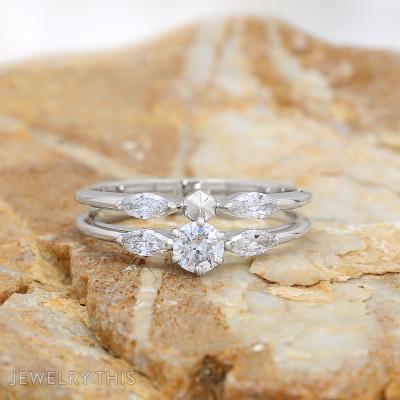
This two-band engagement and wedding set was recreated in 14k white gold from a single ...

This 14karat white gold ring celebrates the unbreakable bond between a mother and her daughters. ...

This sterling silver ring is timeless in style, exudes beauty and elegance. With its classic ...

This elegant rose gold engagement ring features a round brilliant-cut moissanite as its centerpiece. Surrounding ...
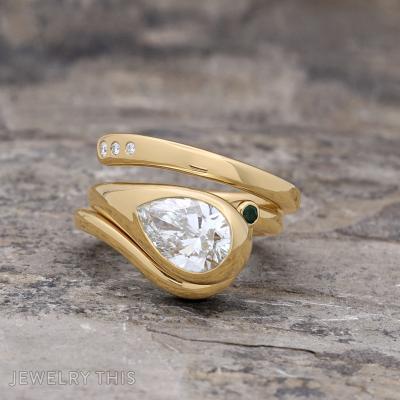
This breathtaking yellow gold wedding set is a masterclass in organic, bypass-style design. The engagement ...

Exquisite and timeless, this ring boasts a captivating design featuring two marquise-shaped stones set in ...

This enchanting rose gold engagement ring features a pear-shaped center diamond set at a graceful ...

This exquisite platinum engagement ring showcases a captivating radiant-cut yellow diamond at its center, set ...
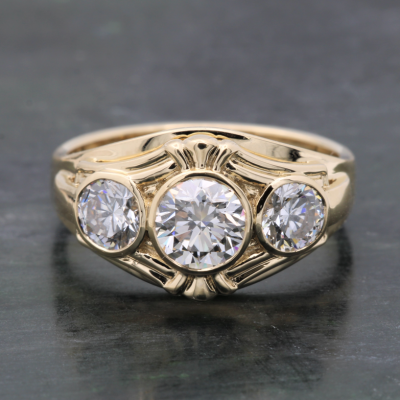
Experience the breathtaking beauty of this custom ring. Crafted with precision in 14k yellow gold, ...

This platinum engagement ring showcases a stunning Asscher cut diamond at its center, set in ...

This stunning 10k yellow gold engagement ring is a masterpiece in recreation and continuity. At ...