


Emerald-Cut Three Stone Engagement Ring in 18k White Gold
$$$
18k white gold, moissanite, lab-grown diamonds
D. set out to design an engagement ring with a clear vision already in mind — an emerald-cut center stone with a twisted band — and worked through several rounds of changes to get it exactly right, including flattening the profile and adding an antique-inspired cluster of stones around the sides after finding a reference image he loved. He added a hidden inside engraving reading 'I love you' with a small heart. When it arrived, he wrote back: 'she said yes and she absolutely loves it and she finds it unbelievably pretty.'
'Yes ma'am I definitely think that is the one' — on seeing the revised render
'she said yes and she absolutely loves it and she finds it unbelievably pretty' — on delivery
Quick specs
Design type
Primary Metal
Shape / Cut
Primary Stone
Accent Stones
Design Complexity
Intent: Certainty
Size
Ring size 6 US (16.51mm).
How they made it distinctive
-
01
Emerald-cut center stone paired with triangular diamond clusters rather than single side stones — added after the client found an antique-style reference he wanted to match
-
02
Band changed from twisted to straight specifically to lower the stone profile for comfort
-
03
Milgrain detailing added along the basket edges to reinforce the antique aesthetic the client was after
-
04
Hidden inside-band engraving reading 'I love you' with a small heart, placed higher on the shank so it takes a deliberate look to find
-
05
Accent stones switched from moissanite to lab diamond mid-production due to a sourcing delay, with no visual or cost impact
How you'd make it yours
Center stone: this piece uses moissanite — a new commission could use a lab or natural diamond for a different look and price point
Side clusters: this piece uses triangular diamond clusters — a new piece could use a single stone per side or a different cluster shape
Metal: this piece is 18k white gold — the same design language works in yellow or rose gold
Band profile: this piece uses a straight band for a lower setting — a twisted or braided band is possible with a slightly higher profile
Engraving: the inside of the band can carry a different phrase, date, or initials on a new commission
One of a kind: this exact ring was designed for one client and is not reproduced — a new commission is an original piece inspired by this one, not a copy
Design changes made
The band was changed from twisted to straight to lower the height of the side stones, and the simple triangular side stones were replaced with a more detailed cluster of small diamonds after the client shared an antique-style reference image he wanted to match.
Who this is for
This piece is for someone who already has a clear picture in their head and wants to work through the details until it matches exactly. It's especially right for someone drawn to a vintage-influenced look — milgrain, clustered side stones, a lower profile — who also wants the practicality of a modern lab-created stone underneath it.
How it's made
Once the design was approved, a resin model was 3D printed from the final CAD file and shared with the client for review before casting. The resin was then affixed to a wax tree, invested in plaster, and fired in a kiln to burn out the pattern, leaving a hollow mold. Molten 18k white gold was cast into the mold, then cooled, extracted, and cleaned in preparation for finishing.
After casting, the band was polished to a mirror finish throughout, since the design uses a single consistent finish rather than mixed textures. The triangular clusters on either side of the center stone were hand-set with small round diamonds, with milgrain detailing added along the basket edges to frame them. The emerald-cut center stone was then set last, secured with prongs positioned to keep the profile as low as the straight-band design would allow. The inside-band engraving was added in a discreet location closer to the top of the shank.
Key note
The band was changed from a twisted to a straight profile specifically to lower the setting's height, since a twisted band requires extra arc at the shoulders that pushes the side stones higher.
Pricing guidance
A three-stone emerald-cut engagement ring with clustered diamond side accents and milgrain detailing sits in the mid range for custom engagement rings of this complexity. The main cost drivers are the labor for the hand-set diamond clusters and milgrain work, plus the center stone choice. Metal karat and whether the center and accent stones are moissanite or lab diamond move the price meaningfully from there.
Moves price up ↑
- ↑ Upgrading the center stone from moissanite to a lab or natural diamond
- ↑ Increasing the number or size of the accent diamonds in the side clusters
- ↑ Adding milgrain or filigree detail to additional areas of the band
- ↑ Choosing platinum instead of 18k white gold
- ↑ Adding a matching wedding band designed to nest against this profile
Moves price down ↓
- ↓ Reducing the side clusters back to a single stone per side instead of a multi-stone triangle
- ↓ Choosing a smaller center stone carat weight
- ↓ Using 14k gold instead of 18k
- ↓ Simplifying or omitting the milgrain edge detailing
- ↓ Skipping the inside-band engraving
Questions people ask
Yes. Moissanite is a distinct gemstone that is harder than nearly every other stone besides diamond, rating 9.25 on the Mohs scale versus a diamond's 10, so it holds up very well to daily wear. It has a higher refractive index than diamond, which gives it slightly more fire and rainbow flash in certain lighting. The main reason clients choose it is cost, since it runs significantly less than an equivalent lab or natural diamond at the same size. Visually, a well-cut moissanite reads as a bright, colorless stone to the naked eye.
Moissanite is silicon carbide, a naturally occurring mineral that is now lab-created for jewelry use, while a lab grown diamond is chemically identical carbon, just as a natural diamond is. Lab diamonds test as diamond on standard diamond testers, while moissanite does not, which is one way jewelers distinguish them. Lab diamonds tend to look closer to a natural diamond's sparkle pattern, while moissanite has a more colorful flash. Cost is the biggest practical difference, with moissanite generally being the more budget-friendly option at comparable sizes.
Yes, accent stones can generally be swapped between moissanite and lab diamond without changing the setting design, since both are set the same way. This ring actually went through that exact substitution during production, when a supply delay on a specific moissanite accent size led to a switch to small lab diamonds instead, at no cost difference. The setting and prong structure work the same for either stone type at a given size. The main consideration is making sure the stone sizes ordered match the setting's prong spacing exactly.
A three-stone or clustered-accent engagement ring with milgrain edging and an emerald-cut center stone sits in the mid range for custom engagement work, largely due to the hand-finishing the milgrain and multi-stone clusters require. Moissanite or lab-grown center and accent stones keep the cost lower than natural diamonds of equivalent size. Metal karat, whether 14k or 18k, and the number of accent stones are the other major price variables. The complexity of the side clusters specifically adds more labor than a simple single-stone side setting.
The full process from approved design to shipping typically runs six to eight weeks. The design phase, including a sketch, a 3D CAD model, and a photorealistic render for approval, usually takes about a week per round of revisions, and this particular ring went through two full rounds of design changes. Once the design and stones are finalized, production, including casting, stone setting, and finishing, generally takes about four weeks. Stone sourcing delays, such as waiting on a specific accent stone size, can add extra time to that window.
Yes, inside-band engraving is a common addition and can typically fit around fifteen to twenty characters including spaces. The engraving can be positioned in different spots on the inside of the shank; a location closer to the top of the ring under the stone requires more of a deliberate look to find, while a location further down toward the bottom is easier to spot when the ring is removed. Short phrases, initials, or a date all work well in this space. The engraving does not affect the ring's structural integrity or sizing.
An emerald-cut stone is a rectangular step cut, so the prongs and side stone clusters have to be designed around its elongated shape and flat facets rather than a symmetrical round outline. This typically means the side accents are shaped or angled, often triangular, to visually taper toward the corners of the emerald cut rather than sitting as simple round clusters. Because an emerald cut has a large open table, inclusions or color are more visible than in a round brilliant, so stone clarity and color grade matter more for this cut. The setting height is also more sensitive to the band profile, since the elongated stone and any side detailing need enough clearance for prongs and setting depth.
Yes, this is a common design decision and it directly affects the setting height. A twisted band, where two or three strands of metal cross over each other, requires the metal to arc upward at the shoulders to accommodate the crossing pattern, which raises the height of any side stones set near it. A straight band allows the side stones and center stone to sit lower and closer to the finger. Clients who prioritize a lower profile for comfort or an antique look typically choose the straight band for this reason.
Explore Similar Creations
Every masterpiece starts with a spark. Explore how our clients raw ideas - sketches, heirlooms, inspirations - were transformed into bespoke works of arts.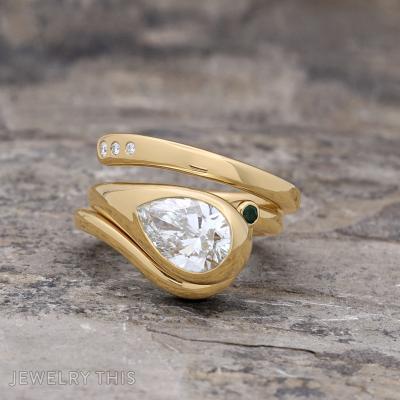
This breathtaking yellow gold wedding set is a masterclass in organic, bypass-style design. The engagement ...
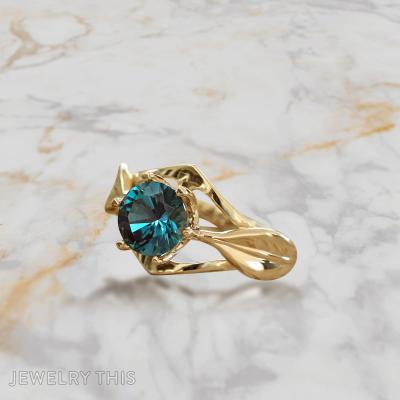
This meticulously recreated ring carries the emotional weight of a lost family heirloom, reborn in ...

This custom wedding set is a celebration of everlasting love and elegance. The engagement ring ...
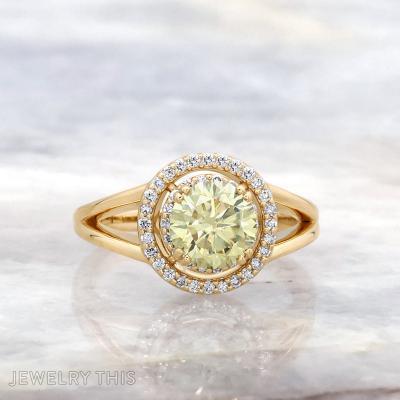
Crafted as a beautiful and cost-effective tribute to a cherished original, this yellow gold engagement ...
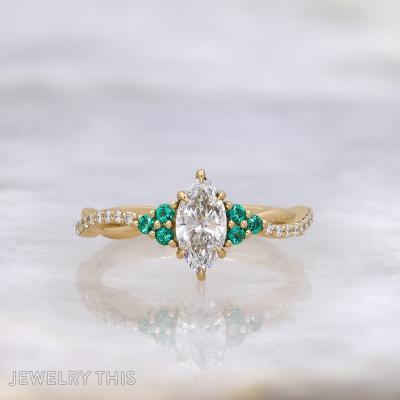
This extraordinary engagement ring tells a story of elegance, strength, and timeless romance—designed to capture ...

This White gold masterpiece of a ring showcases a mesmerizing 3.2 carat Moissanite stone at ...

This ring was built to bring back a one-of-a-kind piece that had been lost — ...
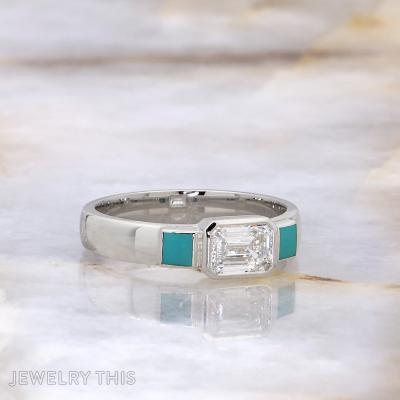
This elegant custom ring beautifully combines a .75 carat emerald cut lab diamond centerpiece with ...
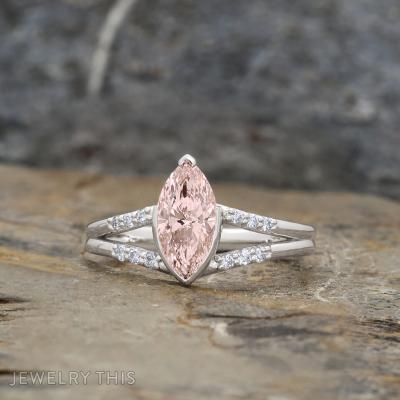
This elegant white gold engagement ring features a captivating pale pink marquise-shaped lab grown diamond ...

This captivating 14K white gold engagement ring features a center 0.75 carat round moissanite.The center ...

This engagement ring replaces one that was lost, recreated as closely as possible to the ...

This engagement ring is a bold yet elegant statement piece. It features a 1-carat central ...



