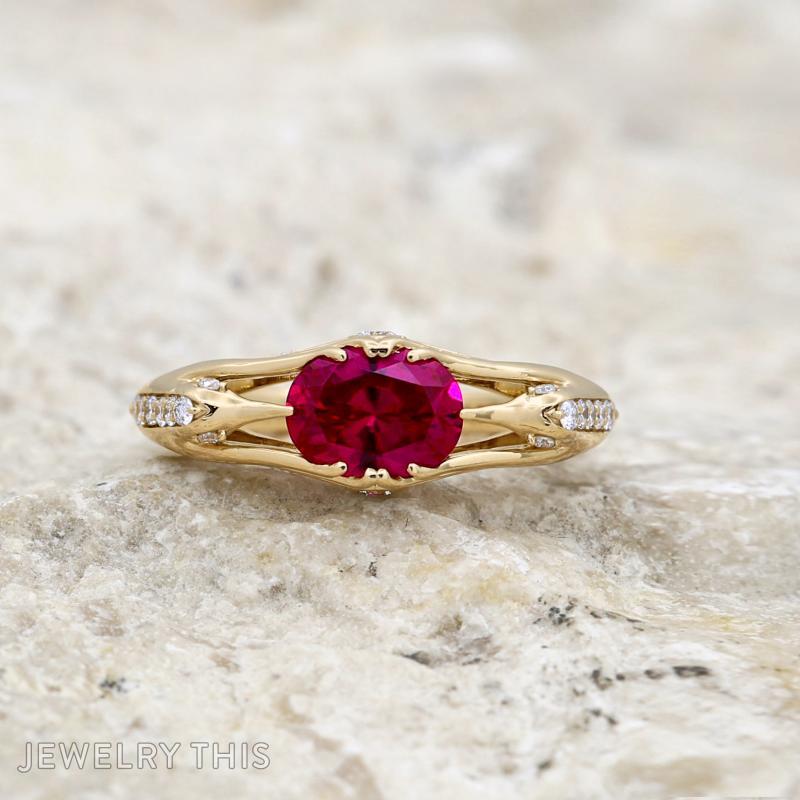
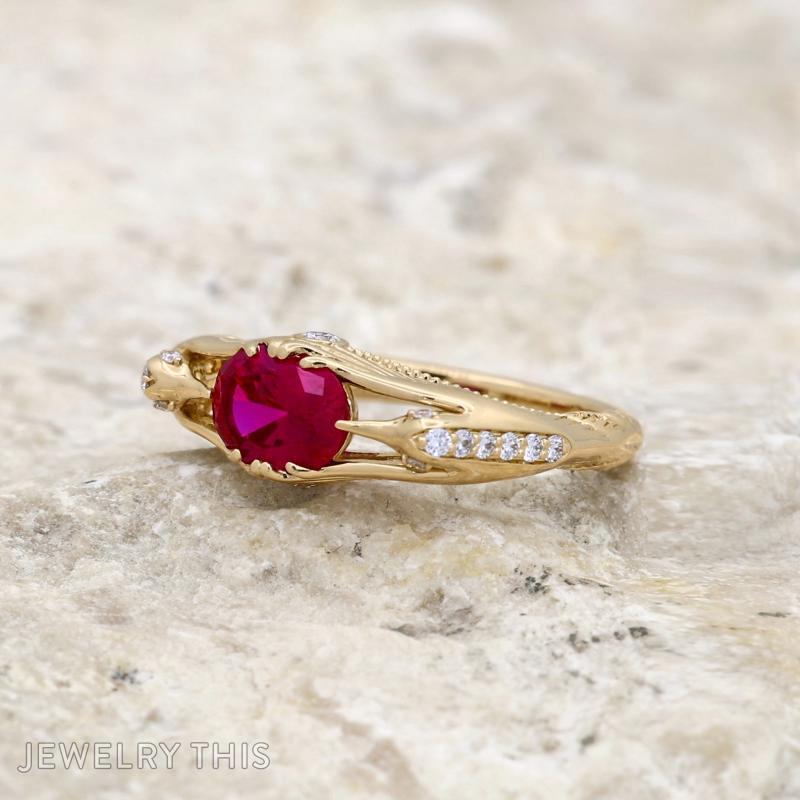
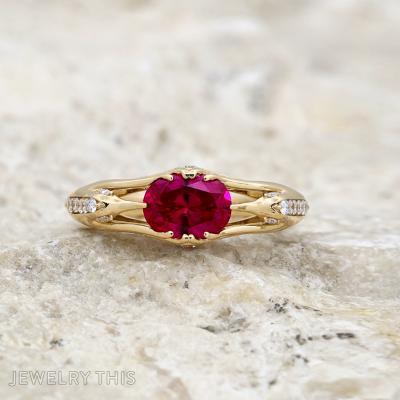
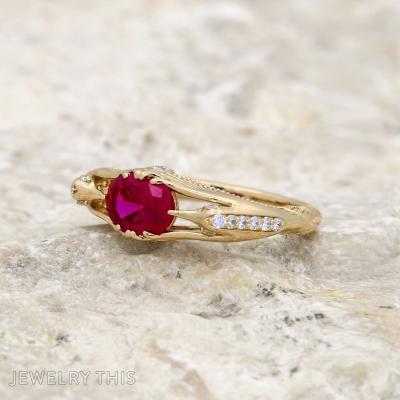
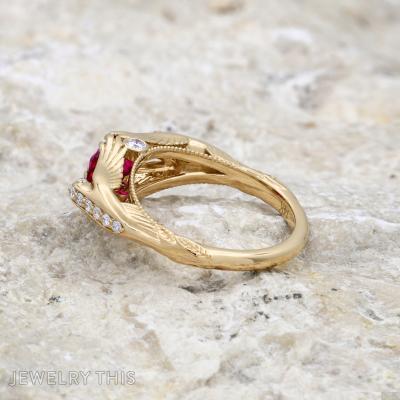
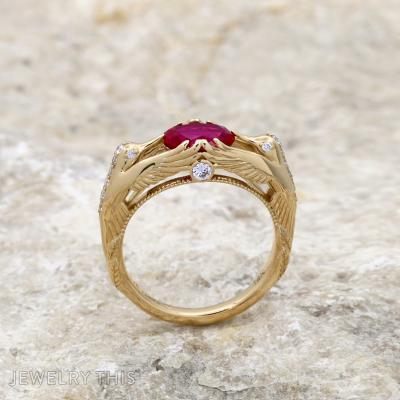
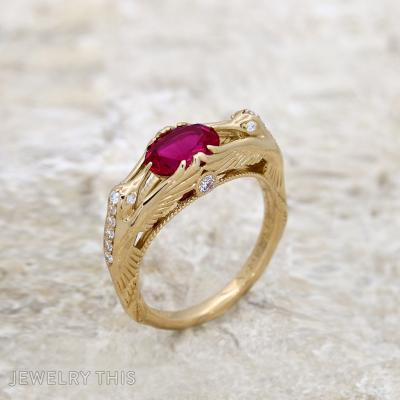
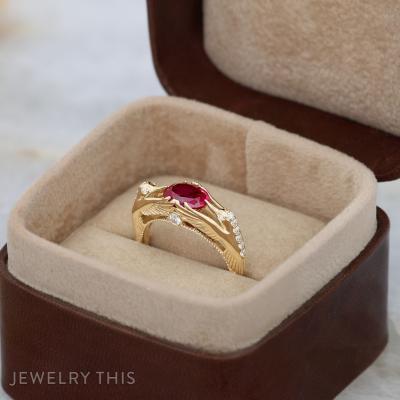
Hummingbird-Inspired Ruby Engagement Ring in Yellow Gold
$$$
14k yellow gold, lab-created ruby, lab-grown diamonds
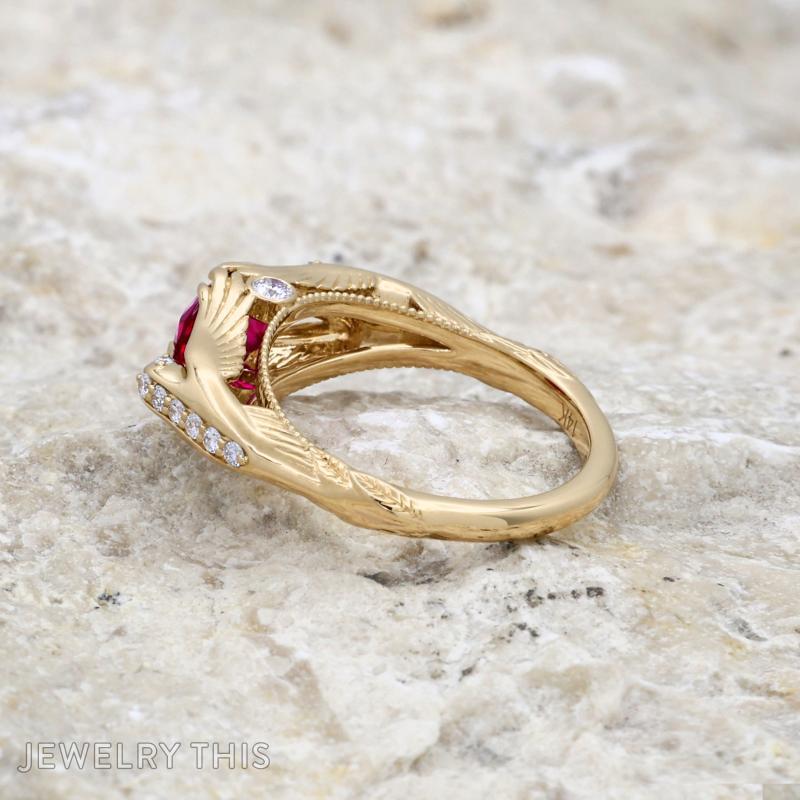
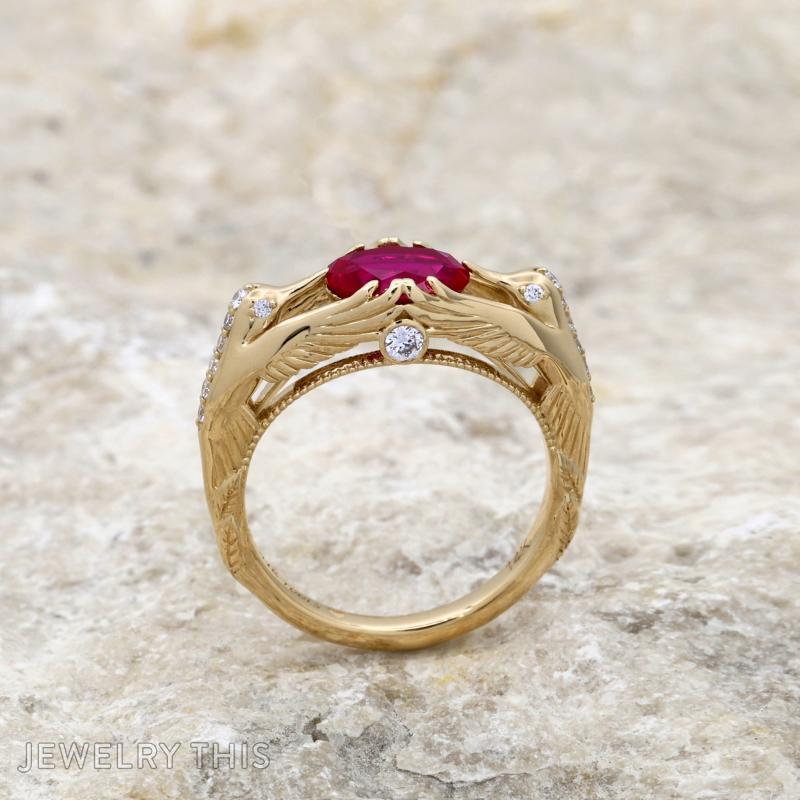
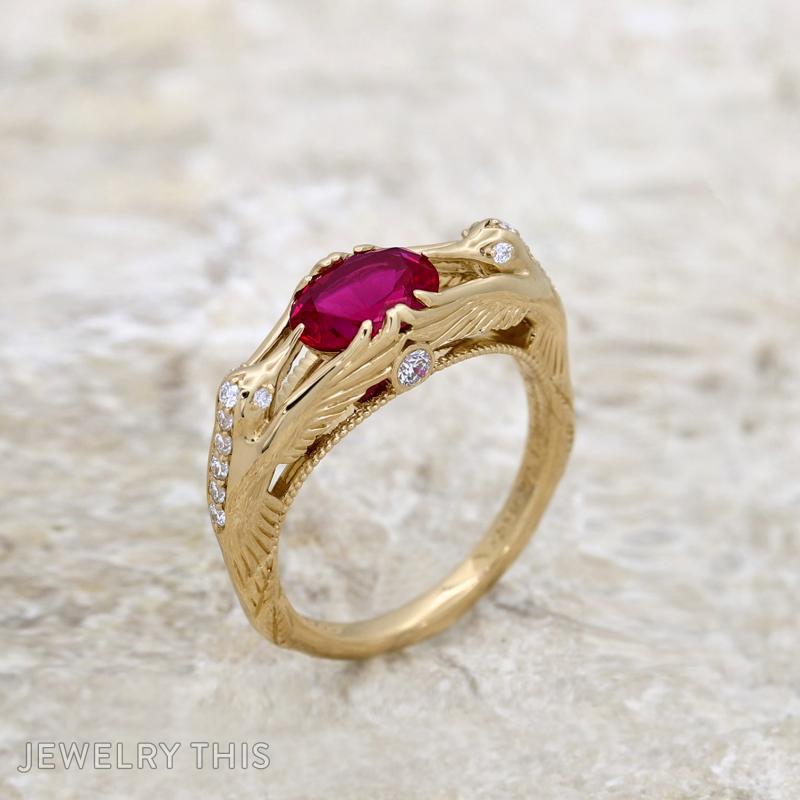
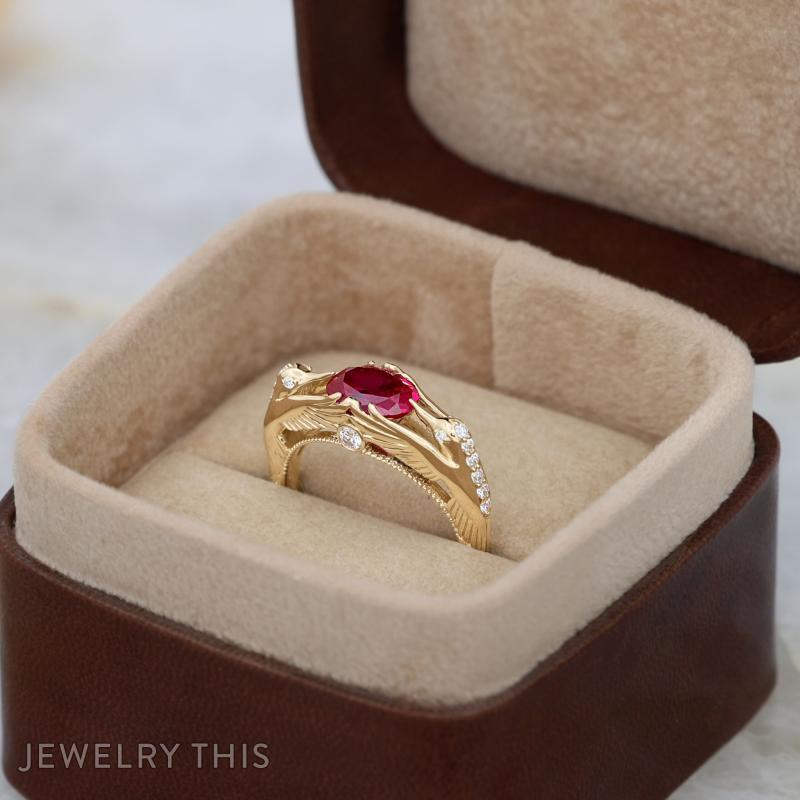
D. wanted a ring for his partner that would echo his own — nature-inspired, with a hummingbird cradling the center stone — but with its own meaning. He worked in his own birthstone alongside a red stone chosen to represent his partner's, landing on a lab-created ruby set in yellow gold with wing-like details wrapping the stone. He had the band engraved with a phrase they wrote together: "Growing OUR roots." When he saw the finished piece, he wrote: "This is beyond what I imagined it to look like. It is truly beautiful."
'I love it.' — on seeing the first 3D render
'This is beyond what I imagined it to look like. It is truly beautiful.' — on delivery
Quick specs
Design type
Primary Metal
Shape / Cut
Primary Stone
Accent Stones
Design Complexity
Intent: Certainty
Size
Ring size 6¾ US (17.12mm). Widest point (center stone) approximately 7mm; back of band approximately 3–4mm.
How they made it distinctive
-
01
Hummingbird wing motif sculpted around the center stone, echoing the design of the client's own ring
-
02
Flush bezel setting chosen specifically to keep a low profile with no protruding prongs
-
03
Lab-created ruby selected over natural ruby or garnet for durability and the client's preference for lab-grown stones
-
04
Center stone color chosen to represent the partner's birthstone, paired with the client's own diamond birthstone in the design concept
-
05
Inside-band engraving added as a personal, hand-finished final touch
-
06
Rounded, beaded edge detailing and feather-texture engraving carried over from the client's original ring for visual continuity
How you'd make it yours
Center stone: this piece uses a lab-created ruby; a new commission could use natural ruby, sapphire, or garnet for a different look or budget
Metal: this piece is 14k yellow gold; the same wing-and-bezel design works in rose gold, white gold, or 18k
Setting style: this piece uses a flush bezel; a new commission could use a raised bezel or prong setting for a different profile
Engraving: the inside of this band carries a personal phrase; a new piece can carry its own inscription
Accent stones: this piece uses small round lab diamonds; a new commission could substitute colored gems for more contrast
One of a kind: this exact ring was designed for one client's partner and is not reproduced — a new commission is an original piece inspired by this one, not a copy
Design changes made
The center stone shifted from an initial salt-and-pepper diamond to a lab-created ruby, and the metal changed from rose gold to 14k yellow gold partway through production. The engraving text was also revised twice before landing on its final wording.
Who this is for
This piece is for someone who wants an engagement ring that carries real symbolism rather than a generic silhouette — someone drawn to nature motifs that feel protective rather than decorative. It's especially right for a couple building a design around two people's birthstones or a shared visual language from an existing piece, and who wants a low-profile setting that holds up to everyday wear.
How it's made
Once the sketch and 3D model were approved, a wax model was 3D-printed and shared with the client as a resin preview before any metal was committed. The wax was attached to a tree, invested in plaster, and fired in a kiln to burn out the wax and leave a hollow mold. Molten 14k yellow gold was then cast into the mold, cooled, and extracted as the raw ring.
After casting, the ring was cleaned and polished, with the wing-like shoulders hand-finished to bring out the feather engraving and rounded, beaded edges the client asked for. The oval lab-created ruby was set into a flush bezel at the center, secured with hand-applied prongs disguised within the wing forms, while the small round lab diamonds were channel and bead-set along the shoulders. The inside of the band was engraved last, once all stone-setting and polishing were complete.
Key note
The center ruby was re-cut and re-sourced from the cutter mid-production after the first stone didn't meet the studio's quality standard, delaying casting by about a week.
Pricing guidance
An engagement ring with this level of sculptural detail — wing-like shoulders, flush bezel setting, and hand engraving — sits toward the higher end of the mid-range for custom engagement work. Most of the added cost comes from the hand-finishing required to carve and texture the wing details and from the labor of a flush bezel setting, which takes more time than a standard prong setting. Center stone choice and diamond accent count are the next biggest levers on price.
Moves price up ↑
- ↑ Upgrading the center stone from lab-created to natural ruby or sapphire
- ↑ Increasing the number or size of the round diamond accents along the shoulders
- ↑ Extending the feather-texture engraving further around the band
- ↑ Choosing 18k gold instead of 14k
- ↑ Adding matching wedding band with continued wing motif
Moves price down ↓
- ↓ Simplifying the wing detail to a single pair rather than a fuller sculpted form
- ↓ Reducing the diamond accent count
- ↓ Choosing a smaller center stone
- ↓ Using a prong setting instead of a flush bezel, which requires less hand-finishing time
- ↓ Selecting a lower-cost accent stone such as garnet instead of diamond
Questions people ask
Yes. A lab-created ruby has the same chemical composition and hardness rating as a natural ruby — both score 9 on the Mohs scale, just below diamond. This makes it very well suited to an engagement ring worn daily, since it resists scratching from ordinary contact far better than softer stones like opal or pearl. The main difference between lab and natural ruby is origin and cost, not durability or appearance.
A flush bezel setting is where the stone sits level with or just below the surrounding metal, held in place by a continuous rim rather than raised prongs. It's sometimes called a gypsy setting. Because nothing protrudes above the metal surface, it's a good choice for anyone who wants a lower-profile ring that won't catch on gloves, clothing, or hair. The tradeoff is that a flush setting takes more hand-finishing time to execute well than a standard prong setting.
It depends on the form and purity of the gold. Very high-karat gold, like 24k coins or bars, is too soft to use directly in a ring and has to be alloyed down to 14k or 18k, which is a labor-intensive process. In many cases it's more practical to apply the melt value of the existing gold as a credit toward a new ring, or to save higher-karat metal for a piece like a pendant that can be made in a softer, higher-karat gold. It's worth discussing your specific metal with a designer before assuming it can be used directly.
Pearls are much softer than diamonds or corundum stones like ruby and sapphire, generally rated around 2.5 to 4 on the Mohs scale. That softness means a pearl set in an engagement ring worn daily is at real risk of chipping, scratching, or cracking, and a damaged pearl typically cannot be repaired — it has to be replaced. For pearls with sentimental or cultural significance, a pendant or a piece not worn every day is usually a better setting than a ring.
A ring with this much hand-finished detail — sculpted wing shoulders, a flush bezel setting, and diamond accents — sits toward the higher end of the mid-range for custom engagement rings. The main cost drivers are the labor for the sculptural hand-finishing and the flush setting technique, plus the choice of center stone and diamond accent count. Choosing lab-created stones over natural ones is one of the more effective ways to manage cost without changing the look.
The process typically starts with about a week to finalize a sketch, followed by five to seven days to build the 3D model once the sketch is approved. Production begins once the design and 75% of payment are finalized, and typically takes about four weeks from there, though sourcing a specific center stone can add time if the first cut doesn't meet quality standards. Engraving is usually one of the last steps, added after all stone setting and polishing is complete.
Yes, adjustments are expected as part of the process — most studios build in at least one round of changes after the sketch and after the 3D model. It's common for details like metal color, stone type, or band width to shift slightly as the design comes together, since seeing something in a render often clarifies preferences that were hard to describe in words. Larger constraints, like what a design can structurally support once cast, are usually flagged by the design team along the way.
Yes, inside-band engraving is a common finishing step and is typically done last, after all stone setting and polishing are complete. Space is limited, so intricate shapes or long phrases may need to be simplified — a small symbol like a heart usually fits, while more detailed shapes like a specific icon may not read clearly at that scale. It's worth finalizing engraving wording early, since changes are easiest to make before the piece goes into final production.
Explore Similar Creations
Every masterpiece starts with a spark. Explore how our clients raw ideas - sketches, heirlooms, inspirations - were transformed into bespoke works of arts.
Introducing our captivating twist on a classic style, the 2.13 carat Emerald Cut Lab Created ...

A contemporary masterpiece the Multi-Row Crossover Wedding Ring. A stunning symbol of love and commitment ...
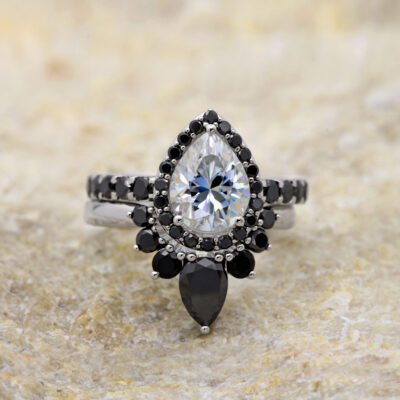
Exquisitely unique, this white gold wedding set weaves a tale of contrast. The engagement ring ...

This white gold engagement ring is an exquisite blend of elegance and brilliance, featuring a ...

Celebrate everlasting love with this custom wedding set in luminous 14k white gold. The engagement ...
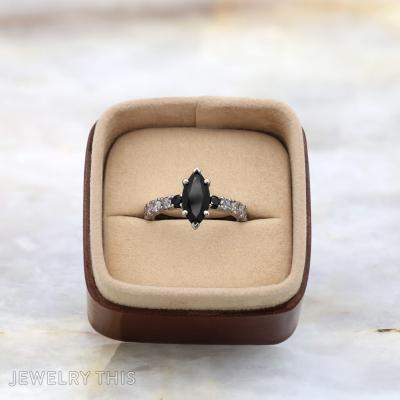
This architectural platinum engagement ring is a breathtaking study in monochrome elegance and graduated light. ...

This 14K yellow gold showcases a unique octagonal shape that sets it apart from traditional ...
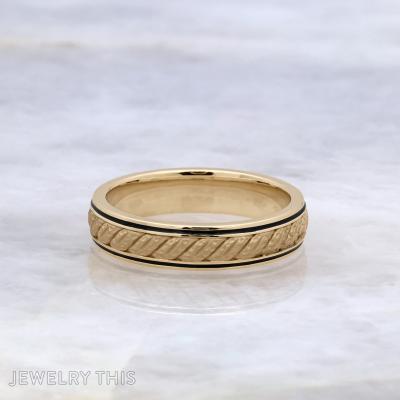
This unique gold ring was inspired by the delicate artistry of uni sushi, transforming a ...
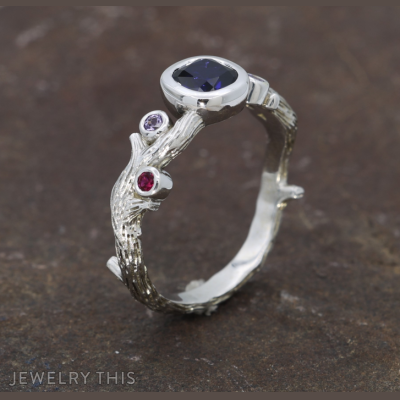
This exquisite engagement ring tells a story of love, individuality, and resilience—crafted to reflect the ...

This is a custom-designed travel ring created to replicate the client’s original engagement ring. The ...
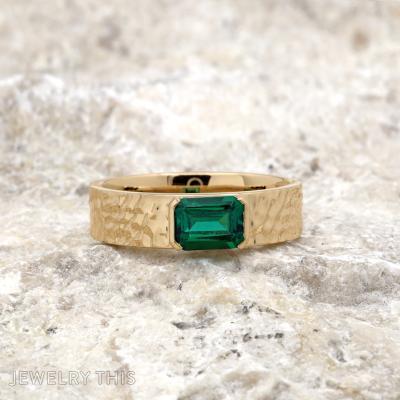
This striking 14-karat yellow gold band offers a bold, handcrafted aesthetic that balances rugged texture ...
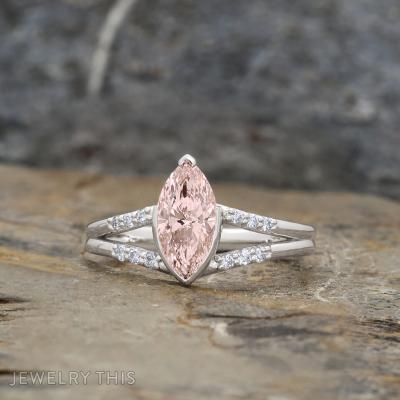
This elegant white gold engagement ring features a captivating pale pink marquise-shaped lab grown diamond ...