




Antique-Inspired Platinum Engagement Ring with Wings & Dreamcatcher
$$$$
Platinum, lab diamond, lab diamond accents
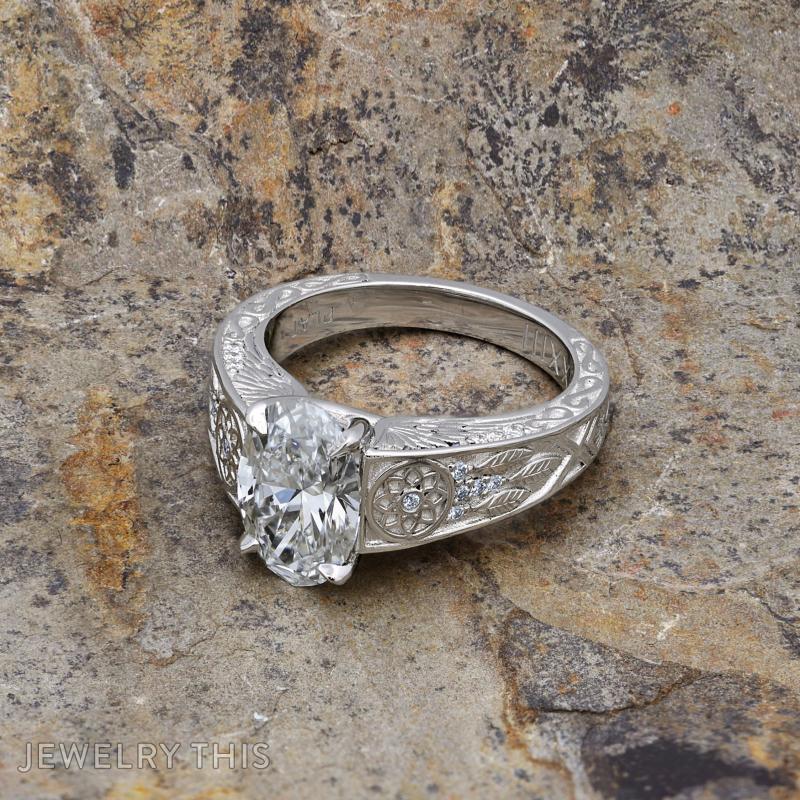
A client came to us wanting an engagement ring that combined an antique-inspired cathedral setting with symbols meaningful to him — a dream catcher, resting angel wings on each side representing two people who have passed, and infinity symbols. He worked closely with the design team through several rounds of sketches to get the wing detail right, and the final piece was hand-finished after casting to bring out feather texture that hadn't translated cleanly in the digital render. A roman numeral date is engraved inside the band.
'This looks great.' — on seeing the first technical drawing
'I do love it.' — on reviewing the revised render with dream catcher and diamond bead details
Quick specs
Design type
Primary Metal
Shape / Cut
Primary Stone
Accent Stones
Design Complexity
Intent: Certainty
Size
Ring size 7½ US (17.73mm). Band width 4mm minimum, tapered toward the back.
How they made it distinctive
-
01
Dream catcher and feather motif chosen in place of an original tree-of-life concept, to better reflect personal meaning important to the client
-
02
Resting angel wings placed on the cathedral shoulders on either side, representing two people who have passed
-
03
Infinity symbols worked into the side walls alongside the wings
-
04
Roman numeral date engraved inside the band as a private, personal detail
-
05
Wing feather texture added by hand-engraving after casting because the flat cast surface didn't capture it the way the technical drawing did
-
06
Tiny diamond accents set as beads along the hanging feather strands and dream catcher center
How you'd make it yours
Center stone: this piece uses a lab diamond; a new commission could use a natural diamond or a colored gem for a different look
Metal: this piece is platinum; the same detailed etching language works well in 18k white or yellow gold
Symbolic motifs: the dream catcher, wings, and infinity symbols are specific to this client; a new piece could substitute other personal symbols in the same side-wall layout
Engraving: the interior of the band can carry a different date, phrase, or initials on a new piece
Band width: this piece uses a 4mm tapered band; a new commission could go narrower or wider depending on how much detail is wanted
One of a kind: this exact ring was designed for one client's personal story and is not reproduced — a new commission is an original piece inspired by this one, not a copy
Design changes made
The tree of life motif from the original brief was replaced with a dream catcher and feather design after the client felt the Celtic-style treetop didn't fit his vision; infinity symbols were added to the side walls and a roman numeral date engraving was added inside the band. The wing detail was also refined with hand engraving after casting to add texture that the 3D render couldn't fully convey.
Who this is for
This piece is for someone who wants an engagement ring to carry real personal meaning, not just visual impact. It's especially right if you have specific symbols or memories you want worked into a traditional ring format, and you're willing to go through a few rounds of design refinement to get small details exactly right.
How it's made
Once the technical drawing and 3D model were approved, the ring was built as a photorealistic digital model before being cast in platinum. The center oval lab-grown diamond was sourced and received from the cutter, and small technical adjustments were made to the setting to fit its exact proportions before the piece moved into casting.
After casting, the master jeweler hand-engraved the wing details on each shoulder to define individual feathers — a step added specifically because the flat casting didn't capture the texture seen in the technical drawing. The dream catcher medallions, infinity symbols, and sunburst etching along the side walls were then finished, and the tiny accent diamonds were set by hand into the feather-strand beads and side walls. The roman numeral date was engraved inside the band as a final step.
Key note
The feather detail on the wings was added by hand after casting specifically because the flat-cast surface couldn't reproduce the fine texture shown in the original technical drawing.
Pricing guidance
A platinum cathedral engagement ring with an oval center stone in this carat range and this level of side-wall detail sits toward the higher end for custom engagement rings. Most of the added cost comes from the ornate hand-finishing and multiple rounds of design refinement rather than the center stone alone. Platinum itself also carries a higher material cost than gold alternatives.
Moves price up ↑
- ↑ Increasing the center stone size beyond roughly 2.75-2.79 carats
- ↑ Choosing a natural diamond over a lab-grown diamond of the same size and grade
- ↑ Adding more accent diamonds along the side walls or dream catcher medallions
- ↑ Requesting additional hand-engraving beyond the wing detail
- ↑ Upgrading diamond color/clarity grade for the center stone
Moves price down ↓
- ↓ Switching from platinum to 14k or 18k white gold
- ↓ Reducing the center stone to a smaller carat weight
- ↓ Simplifying the side-wall etching to a single motif instead of multiple layered symbols
- ↓ Choosing moissanite instead of lab diamond for the center stone
- ↓ Omitting the accent diamonds in favor of plain etched detailing
Questions people ask
Platinum is one of the most durable precious metals used in fine jewelry and is naturally hypoallergenic. It develops a soft patina over time rather than losing metal the way gold prongs can wear down, though this patina can be polished back to a bright finish if desired. It's heavier than gold, which many people notice as a more substantial feel on the hand. For a ring with detailed etching like this one, platinum also holds fine engraved lines well over decades of wear.
Lab-grown and natural diamonds are chemically and optically identical — same hardness, same brilliance, same fire. The only difference is origin: one is grown in a controlled lab environment, the other is mined. For a large center stone like an oval over 2.5 carats, choosing lab-grown typically allows for a bigger or higher-grade stone at a lower cost than an equivalent natural diamond. Certification and grading (color, clarity) still apply the same way to lab-grown stones.
A platinum cathedral setting with a large center stone and this much side-wall detail sits toward the higher end of custom engagement ring pricing. The primary cost drivers are the platinum itself, the size of the center stone, and the hand-finishing labor required for detailed etching and hand-engraved elements. Simplifying the metal to gold or reducing the amount of side detail are the two most effective ways to bring the cost down while keeping a similar design language.
From an approved 3D model to a finished ring, production typically takes about four to five weeks, following one to two weeks for the initial technical drawing and design revisions. Highly detailed designs with multiple symbolic elements often go through a few rounds of sketch and render feedback before the design is locked in, which can add time before production even starts. Once the center stone is sourced and the design approved, casting, hand-finishing, and stone-setting make up the bulk of the production timeline.
Yes — a 3D render shows the design's geometry, but very fine linear texture, like individual feather lines on a wing motif, doesn't always translate cleanly into the rendered surface. A master jeweler can hand-engrave that texture directly into the metal after casting, working from the original technical drawing as reference. This is a normal step for pieces with fine decorative detail and doesn't change the underlying design, only how crisply certain textures read in person.
Yes, roman numeral date engravings are a common request for the interior of a band and can be added as a final production step after the ring is cast and finished. The engraving doesn't affect the ring's structural integrity when placed on the interior surface. Most jewelers can accommodate a specific date format if you let them know how you'd like the numerals arranged.
Yes, very small diamonds — down to around 0.7mm — can be set into fine decorative elements like feather-strand beads or the center of a dream catcher medallion. The exact placement and number of stones that will fit is usually confirmed once the design moves from a 2D sketch into a 3D model, since very small spaces may not physically accommodate a stone without overcrowding the design. It's common for jewelers to suggest simplifying certain areas if too many tiny stones would compromise the pattern's clarity.
For a ring with layered etching, symbols, and side-wall detail, a band width of at least 4mm is generally recommended to give the design enough surface area to read clearly. Wider bands can also be tapered toward the back of the finger for comfort, so the widest, most detailed section sits visibly on top while the back stays comfortable for daily wear. Going narrower than that risks crowding multiple decorative elements into too small a space.
Explore Similar Creations
Every masterpiece starts with a spark. Explore how our clients raw ideas - sketches, heirlooms, inspirations - were transformed into bespoke works of arts.
This captivating custom engagement ring emanates timeless beauty and exquisite craftsmanship. At its heart lies ...

This Oval Hidden Halo Engagement Ring stands as a timeless yet personalized masterpiece. Crafted in ...

Exquisite and timeless, this ring boasts a captivating design featuring two marquise-shaped stones set in ...


For horror movie aficionados and fans of the macabre, this custom engagement ring is a ...

This engagement ring pairs a 1.05-carat oval lab-grown diamond with two symmetrical clusters of accent ...

Introducing this stunning Jade Halo Engagement Ring. A mesmerizing blend of elegance and sophistication. At ...
This exquisite engagement ring is a heartfelt recreation of a cherished vintage heirloom from 1925, ...

Crafted in white gold, this enchanting engagement ring features an oval diamond at its center, ...

This custom engagement ring features a stunning three-stone design that beautifully highlights the uniqueness of ...

Recreating the lost engagement set of a beloved grandmother, this set is sure to evoke ...

This stunning rose gold ring features a captivating center oval-shaped opal cabochon that’s perfectly bezel ...



