

Recreated Men's Gold Wedding Band with Bezel Diamond
$$$
14k yellow gold, lab diamond
D. wanted to bring back a wedding band he had lost — working only from a few photos on his phone, with no measurements or original piece to reference. He and the design team went back and forth several times on how the tapered rises around the diamond should sit, and a small gap near the stone was corrected with additional gold after he received the finished ring. When it arrived, he wrote: 'I received the ring and it is perfect, your team did a great job. My wife thinks it looks great.'
'I received the ring and it is perfect, your team did a great job. My wife thinks it looks great.' — on delivery
Quick specs
Primary Metal
Shape / Cut
Primary Stone
Accent Stones
Design Complexity
Intent: Certainty
Size
Ring size 12 US (21.39mm). Center stone 5mm round.
How they made it distinctive
-
01
Bezel setting chosen to keep the round diamond low-profile and close to flush with the band
-
02
Alternating tapered rises flanking the stone, thin to wide on opposite sides, recreating an asymmetrical detail from the original lost ring
-
03
Design rebuilt entirely from a handful of client photos with no original piece or measurements to reference
-
04
A small post-casting gap near the bezel was closed by hand-soldering additional gold rather than recasting the piece
How you'd make it yours
Stone: this piece uses a lab diamond; a new commission could use a natural diamond for the same look at a different cost basis
Metal: this piece is 14k yellow gold; the same tapered design works in 18k yellow gold or white gold
Setting: this piece uses a bezel for a low profile; a new commission could use a prong setting for more stone visibility
Taper direction: the alternating thin-to-wide rise is a specific recreated detail; a new piece could use a symmetrical taper instead
One of a kind: this exact ring was recreated for one client from his own reference photos and is not reproduced — a new commission is an original piece inspired by this one, not a copy
Design changes made
The band profile near the diamond was adjusted from a flat, open-cutout look to a more solid, domed rise after the client compared the render to his reference photos. The bezel setting was also lowered to sit closer to flush with the band rather than raised.
Who this is for
This piece is for someone who has a clear memory of a ring they used to wear and is willing to work through several rounds of feedback to get small details right, even when starting from just a few photos. It's especially suited to someone who wants a substantial, low-profile men's band that reads as solid and sculptural rather than delicate.
How it's made
Once the design was approved, a wax model was 3D-printed and shared with the client as a resin preview before any metal was committed. The wax was then set in investment plaster and fired in a kiln to burn out the wax, leaving a hollow mold. Molten 14k yellow gold was cast into that mold under pressure, then the raw ring was extracted, cleaned, and prepared for finishing.
After casting, the band was polished to a mirror finish across its full surface, and the tapered rises flanking the center were shaped and blended by hand so the transitions read as solid rather than open. The round diamond was then bezel-set close to the band's surface to keep the stone low-profile. A small open area near the bezel that appeared after casting was closed by hand-soldering additional gold and re-polishing the affected area before the piece shipped.
Key note
The small gap that appeared near the bezel after casting was closed by hand-soldering in additional gold rather than recasting the piece, which is why the fix could be completed in about a week instead of restarting production.
Pricing guidance
A men's yellow gold band with a bezel-set center diamond and a sculpted, tapering profile sits in the mid range for custom men's rings of this complexity. Most of the baseline cost comes from the hand-finishing needed to shape the asymmetrical taper and set the stone flush, rather than from the diamond itself. Gold weight and any post-casting adjustments are the next biggest variables.
Moves price up ↑
- ↑ Upgrading the center stone from a lab diamond to a natural diamond of the same size and clarity
- ↑ Increasing the band's gold weight or width for a heavier, more substantial feel
- ↑ Choosing 18k gold instead of 14k for a richer color and higher metal content
- ↑ Adding hand-finishing work after casting to correct or refine surface details
- ↑ Recreating a design from limited photo references, which often requires extra rounds of sketch and render revisions
Moves price down ↓
- ↓ Simplifying the taper to a symmetrical design rather than an alternating rise on each side
- ↓ Reducing the center stone size below 5mm
- ↓ Choosing a prong setting instead of a hand-fitted bezel
- ↓ Using a lower karat gold such as 10k
- ↓ Skipping the sketch-and-render revision cycle when the design is confirmed on the first pass
Questions people ask
Yes, recreations from photos alone are a common request and this ring is an example of one. The process typically starts with a written description plus whatever images are available, followed by a sketch and then a 3D render for review. Because photos rarely show every angle or detail, expect a few rounds of feedback to nail down specifics like taper direction, setting depth, or whether a transition is open or solid. It helps to circle or mark up the reference images when giving feedback so the design team can see exactly what you mean.
A bezel setting surrounds the stone's outer edge with a continuous rim of metal, holding it in place without raised prongs. This makes the stone sit lower and more protected, which is a common preference for men's rings meant for daily wear. A prong setting uses individual metal claws to hold the stone and typically shows more of the stone's profile above the band. Bezel settings are generally more durable against snagging and impact but can be slightly more labor-intensive to set.
Yes, lab-grown and natural diamonds are chemically and physically identical, both scoring 10 on the Mohs hardness scale. There is no durability difference between them for daily wear. The primary difference is origin and cost, with lab diamonds typically priced lower than natural diamonds of comparable size and clarity. For a men's band worn every day, either option will hold up the same way over time.
A standard timeline runs about one week for design revisions followed by three to four weeks for production, so roughly five to six weeks total under normal circumstances. Recreations based on limited reference photos can take longer on the design side since more back-and-forth is often needed to match remembered details. If a post-delivery adjustment is needed, that typically adds another one to two weeks depending on the scope of the fix.
A men's yellow gold band with a bezel-set round diamond and a sculpted taper profile like this one falls in the mid range for custom men's jewelry. The cost is driven mainly by the labor involved in shaping the tapered transitions and setting the stone flush against the band, plus the gold weight of a substantial men's profile. Stone origin (lab versus natural) and gold karat are the two biggest levers on price from there.
Minor issues, such as a small gap or seam near a setting, can sometimes be corrected after casting by hand-soldering in additional metal and re-polishing, without needing to recast the entire piece. Larger design changes, however, usually require a full recast since the mold has already been used and the design file has been finalized. It's always worth reviewing the 3D render and sketch closely before final approval, since that's the point where changes are easiest and least costly to make. Once a piece is in production, adjustments are more limited and may involve additional cost.
Yes, whether the metal transitions around a center stone are solid or have small open gaps is a specific design choice that should be confirmed during the sketch and render stage. Open transitions can create a lighter, more delicate look, while solid transitions give a more substantial, seamless appearance. If you have a strong preference either way, point it out clearly on the render before approving it, since this detail can be hard to catch in a rendered image. It can be corrected after casting in some cases, but it's easier to specify upfront.
A bezel-set diamond in a polished gold band is relatively low-maintenance since the setting protects the stone's edge from daily knocks. Periodic cleaning with mild soap and water or an occasional professional polish will keep the gold looking bright, since daily wear can create fine surface scratches over time. The bezel setting itself rarely needs maintenance since there are no prongs to check or re-tighten. Deep scratches on the polished band can be buffed out by a jeweler if the finish becomes dull.
Explore Similar Creations
Every masterpiece starts with a spark. Explore how our clients raw ideas - sketches, heirlooms, inspirations - were transformed into bespoke works of arts.
This 14k yellow gold band recreates a design the client’s father already wears, rebuilt from ...

Celebrate lasting love with our men’s slim comfort fit Wedding Band in platinum. Meticulously crafted, ...

A deeply personal and symbolic expression of love, this wedding band embodies the unique connection ...
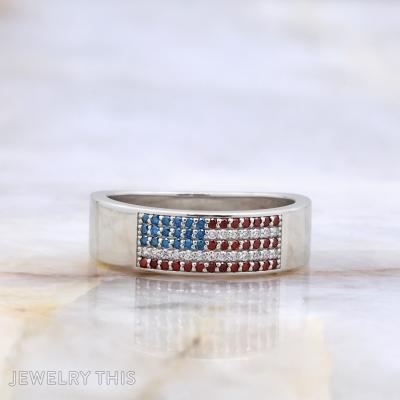
This wide 14k white gold band carries a pave-set American flag across its face, built ...

This custom ring is a timeless tribute to family heritage and tradition. Crafted in 14k ...
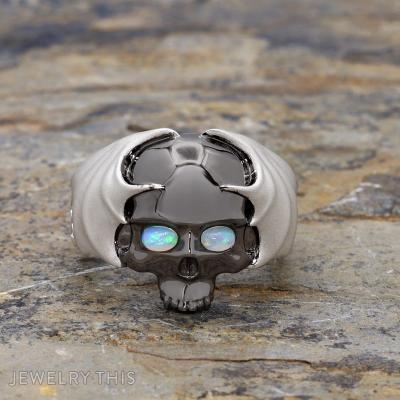
This sterling silver ring centers on a dimensional skull motif finished in black rhodium plating, ...
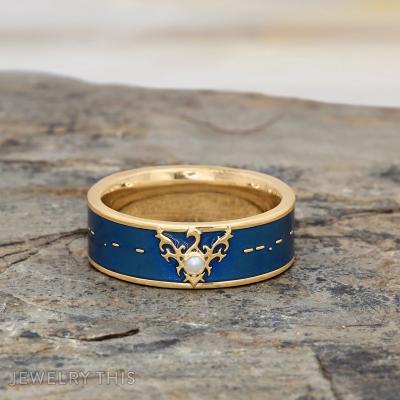
This sterling silver band translates a favorite video game ring into a piece meant for ...
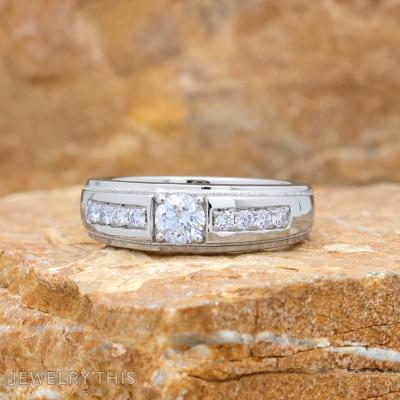
This men’s wedding band was designed to capture the look of a specific ring the ...
This custom wedding band is a sophisticated tribute to a shared journey, blending modern design ...
This men’s ring was designed as a gift, built around a bold square silhouette that ...

his personalized signet ring is a symbol of individuality and character. Its square top boasts ...
This custom wedding band is a thoughtfully recreated piece, transformed from an alternative metal design ...



