
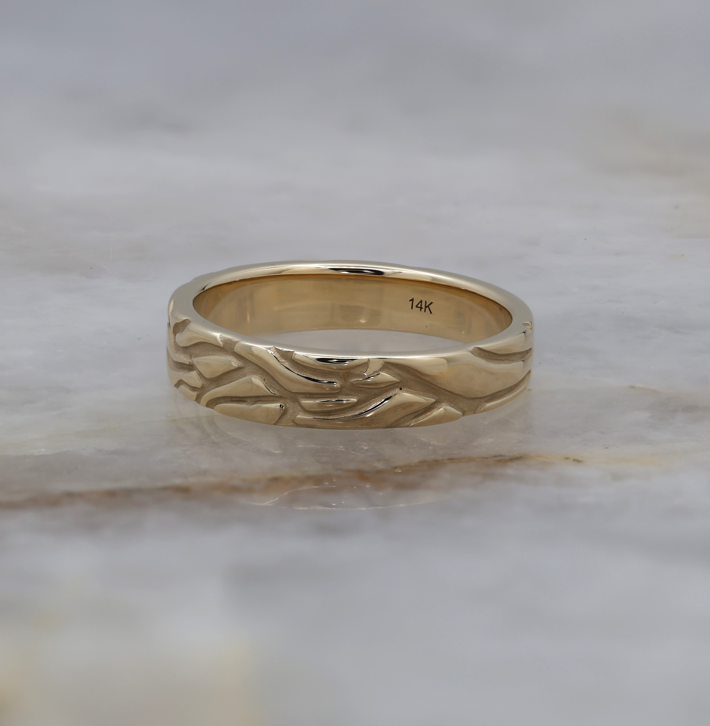


Tapered Gold Band with Carved Wave Pattern
$$
14k yellow gold
A daughter set out to recreate a ring her father already owns and wears, working from a reference photo rather than the original piece. She initially asked about adding a dark painted finish to the grooves, but once the practical drawbacks were explained, she and her father were happy with the matte-and-polish contrast in the render and moved forward. When it arrived, she wrote back simply: 'we love it.'
'we love it....thank you!' — on delivery
Quick specs
Primary Metal
Primary Stone
Accent Stones
Design Complexity
Intent: Certainty
Size
Ring size 8 US (18.14mm). Band width 5mm tapering to 4mm.
How they made it distinctive
-
01
Recreated from a reference photo of an existing family ring, not from the physical piece itself
-
02
Tapered profile from 5mm at the front to 4mm at the back, rather than a uniform band width
-
03
Continuous flowing groove pattern carved across the entire band rather than a single motif
-
04
Dual finish — polished raised surfaces against matte recessed grooves — used to create contrast without any plating or color treatment
-
05
Liver-of-sulfur blackening was requested but avoided in favor of a safer, longer-lasting matte finish
How you'd make it yours
Groove pattern: this piece uses a dense flowing linear design; a new commission could use a simpler or more geometric groove pattern
Metal: this piece is 14k yellow gold; the same carved design works well in 18k yellow gold or rose gold
Band profile: this piece tapers from 5mm to 4mm; a new piece could use a uniform width instead
Finish: this piece contrasts matte grooves against polished surfaces; a new commission could use a single all-over finish instead
Engraving: the smooth interior band surface can carry a personal inscription on a new piece
One of a kind: this exact ring was designed to match one client's father's ring and is not reproduced — a new commission is an original piece inspired by this one, not a copy
Design changes made
The client asked about adding a dark liver-of-sulfur treatment to the recessed grooves for more contrast, but this was ruled out due to its toxicity and tendency to wear off over time. The design proceeded with a matte finish in the recessed grooves instead, which both the client and her father approved.
Who this is for
This piece is for someone who wants to give a meaningful gift tied to an existing family piece, recreated faithfully but built fresh for its new wearer. It's especially right for a man who prefers texture and movement in his jewelry over a plain, smooth band, and who wears his ring every day without much fuss.
How it's made
Once the design was approved, a digital 3D model was built and reviewed as a photorealistic render before any metal was committed. That model was used to produce a wax pattern, which was invested in plaster and burned out in a kiln to leave a hollow mold. Molten 14k yellow gold was then cast into the mold under pressure, producing the raw tapered band ready for finishing.
After casting, the band was cleaned up and the flowing linear grooves were refined by hand to keep their depth consistent across the taper from 5mm to 4mm. The raised surfaces were then polished to a bright mirror finish, while the recessed grooves were left with a matte, brushed texture to create contrast between the two surfaces. No plating or color treatment was applied, keeping the piece to a single warm gold tone throughout.
Key note
The matte-versus-polish contrast is achieved entirely through surface finishing technique on a single metal — no plating, enamel, or coloring agent was used to create the visual depth.
Pricing guidance
A tapered, hand-finished gold band with carved organic detailing sits toward the lower end of the mid-range for custom bands. Most of the cost comes from the hand-finishing labor needed to carve and contrast-finish the grooves, since the metal itself is a standard karat gold. Band width and the extent of surface detailing are what move the price most from there.
Moves price up ↑
- ↑ Widening the band beyond 5mm, which increases both metal weight and surface area to finish
- ↑ Upgrading from 14k to 18k gold for a richer color and higher gold content
- ↑ Adding stones set into or alongside the grooves
- ↑ Extending the textured pattern to cover the full band rather than a tapered section
- ↑ Adding a plating step such as black rhodium for deeper contrast in the grooves
Moves price down ↓
- ↓ Narrowing the band width, which reduces both metal and finishing time
- ↓ Simplifying the groove pattern to fewer, wider channels rather than a dense flowing design
- ↓ Choosing a uniform width rather than a tapered profile
- ↓ Reducing the polish contrast to a single all-over finish
- ↓ Choosing 10k gold rather than 14k if a lighter gold tone is acceptable
Questions people ask
Yes. This band was recreated from a reference photo of an existing ring rather than the physical piece itself. The process starts with a detailed conversation about the design, followed by a 3D digital model and a photorealistic render for approval before anything is cast. Because the render is reviewed carefully before production, small details like groove depth and taper can be adjusted to match what's shown in the photo as closely as possible.
Many older rings use a treatment called liver of sulfur, which oxidizes the metal to create a dark, blackened finish in recessed areas. It was common in jewelry made in the 1970s through the early 1990s, but it is a toxic compound that requires careful handling and isn't standard practice anymore. It's also not permanent — it wears away with handling and daily contact over time. A matte or brushed finish in the recessed areas achieves a similar visual contrast without the safety concerns or fading.
14k gold is a durable choice for daily wear and does not tarnish the way sterling silver can, since it contains enough gold content to resist typical oxidation. It can still pick up fine surface scratches over time, especially on polished high-contact areas like the outer edges of a ring. Textured or matte-finished areas tend to show wear less visibly than a fully polished surface. Occasional professional polishing can restore the shine to the raised areas if desired.
A tapered gold band with hand-finished organic groove detailing typically falls toward the lower end of the mid-range for custom bands. The primary cost driver is the labor required to carve, refine, and contrast-finish the grooves rather than the metal itself. Band width, the density of the pattern, and metal karat are the variables most likely to shift the price up or down.
A band like this typically takes several weeks from design approval to completion, following a standard production timeline. The design phase includes a 3D render for review and any adjustments before casting begins. Production can occasionally run slightly longer around major holidays when workshops are operating at reduced capacity.
A tapered band can generally be resized within a modest range, though the tapering profile can make significant resizing more complex than with a uniform-width band. Because the grooves run continuously around the surface, any resizing has to account for maintaining the pattern's consistency at the seam. It's best to confirm sizing carefully before production, since minor adjustments are more straightforward than major ones on a textured, tapered design.
A matte finish is created by lightly abrading the metal surface, which scatters light and produces a soft, non-reflective look, while a polished finish is buffed smooth to reflect light sharply. Using both on the same piece — polished on the raised surfaces and matte in the recessed grooves — creates visual depth and makes a carved pattern easier to see at a glance. This dual-finish approach is a common technique for texture-driven designs rather than smooth bands. It doesn't affect the metal's durability, only its surface appearance.
Yes, recreating a design from an existing family piece is a common request, whether the goal is a matching companion piece or a personal remake of a design someone admires. The process typically starts with photos of the original ring along with measurements like width and size, and a 3D render is produced for review before production. Small style differences — like width, taper, or finish — can be adjusted to fit the new wearer's preferences even while keeping the core design recognizable.
Explore Similar Creations
Every masterpiece starts with a spark. Explore how our clients raw ideas - sketches, heirlooms, inspirations - were transformed into bespoke works of arts.
A deeply personal and symbolic expression of love, this wedding band embodies the unique connection ...

This custom ring is a timeless tribute to family heritage and tradition. Crafted in 14k ...

This wide 14k white gold band translates a favorite piece of pop-culture design into a ...

This men’s wedding band was built to bring back a ring that had been lost ...
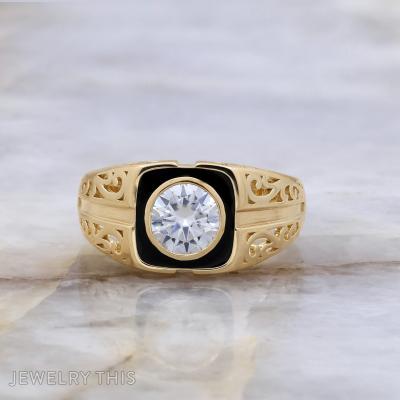
This custom statement ring is a bold fusion of classical ornamentation and modern contrast, designed ...
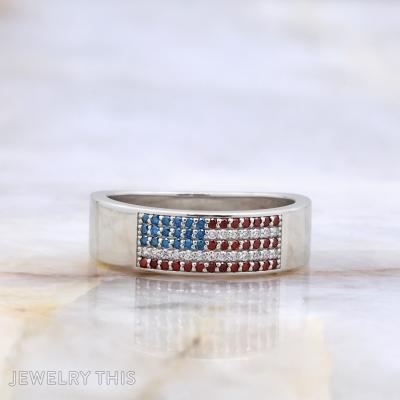
This wide 14k white gold band carries a pave-set American flag across its face, built ...
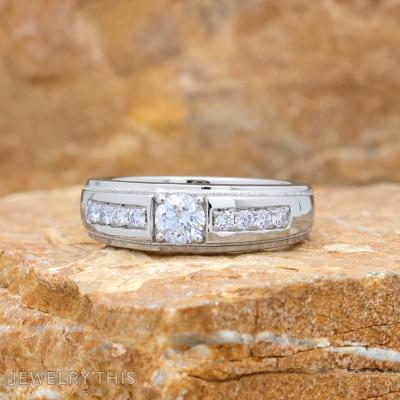
This men’s wedding band was designed to capture the look of a specific ring the ...

his personalized signet ring is a symbol of individuality and character. Its square top boasts ...
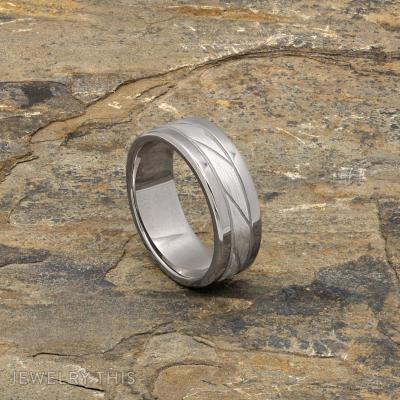
This custom wedding band is a thoughtfully recreated piece, transformed from an alternative metal design ...
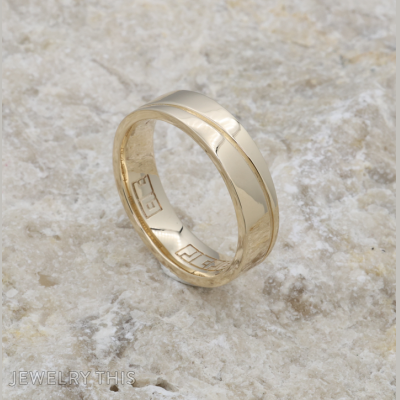
This custom wedding band is a sophisticated tribute to a shared journey, blending modern design ...

Crafted for the adventurous soul, this sterling silver ring features a captivating eagle with intricate ...
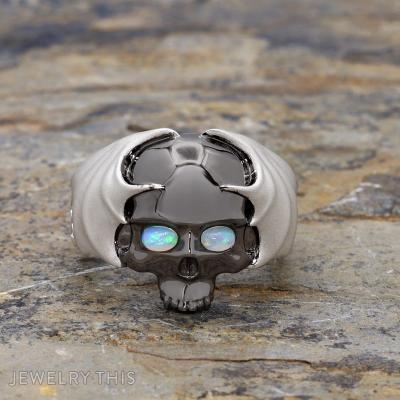
This sterling silver ring centers on a dimensional skull motif finished in black rhodium plating, ...



