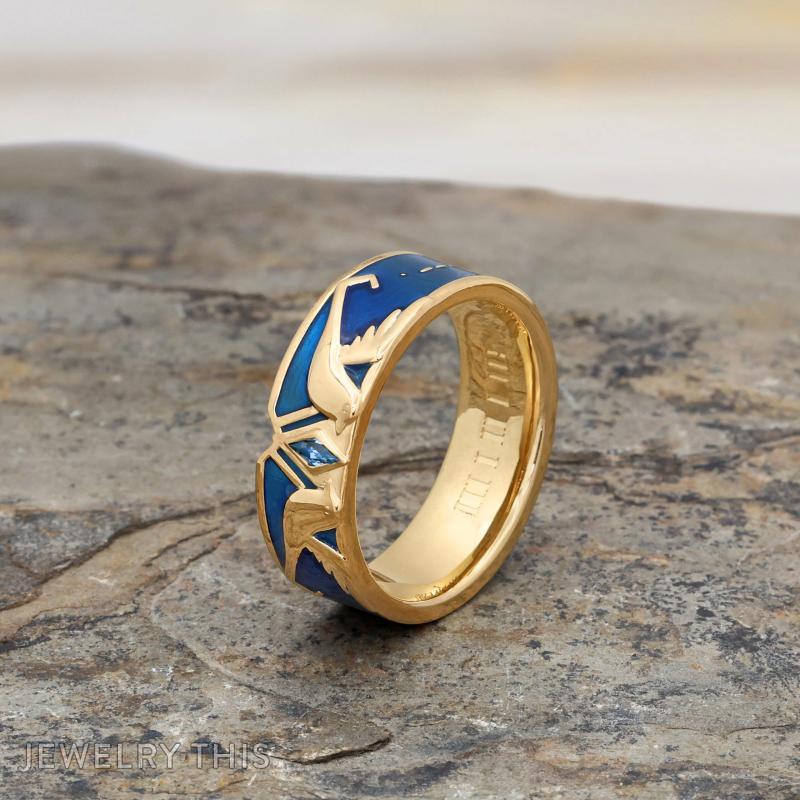
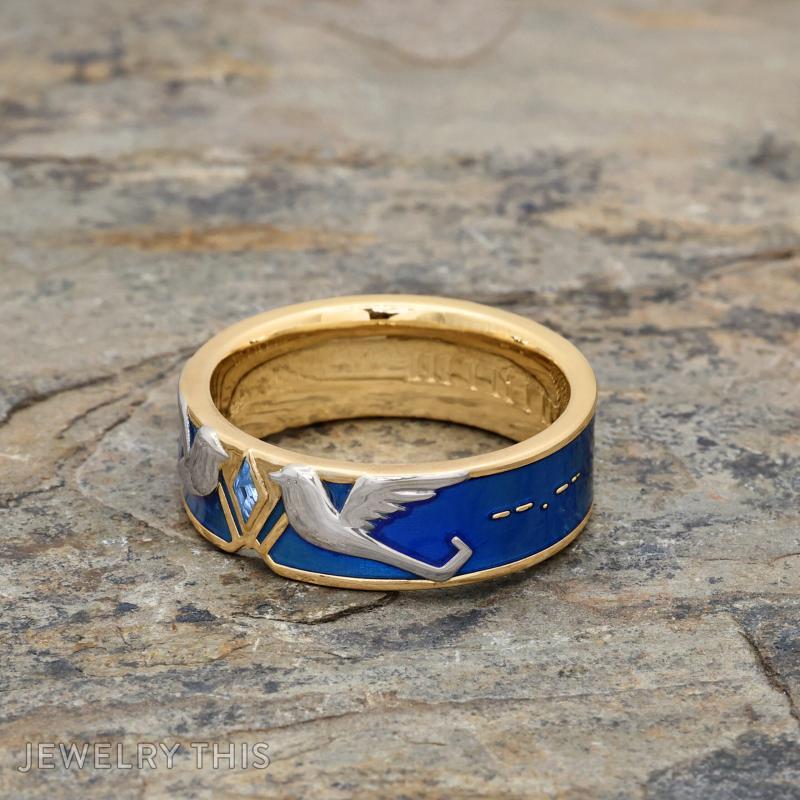
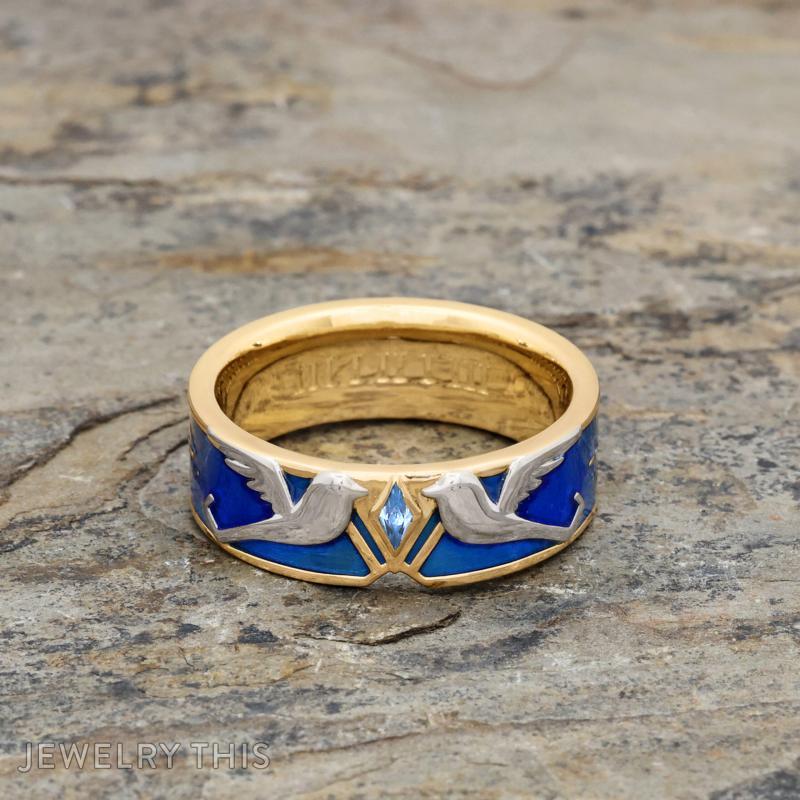
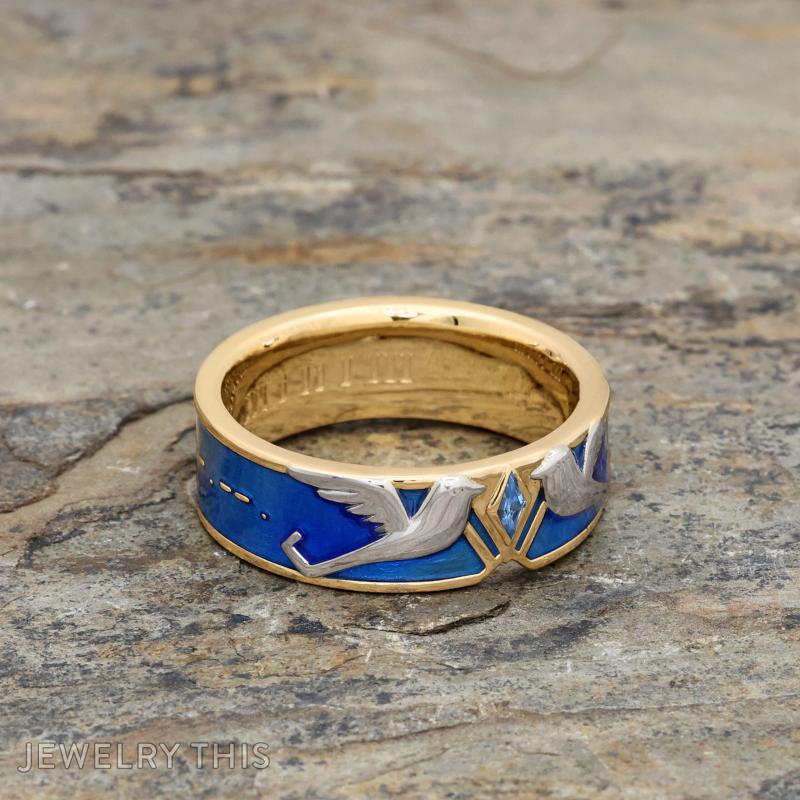
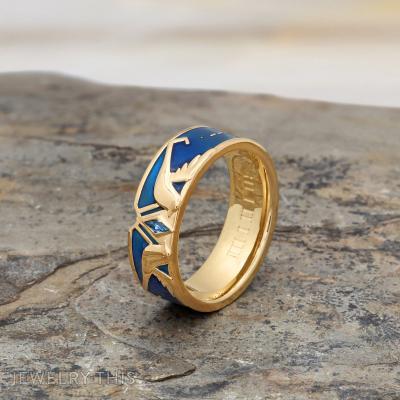
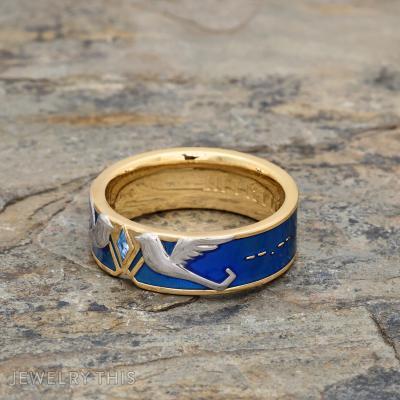
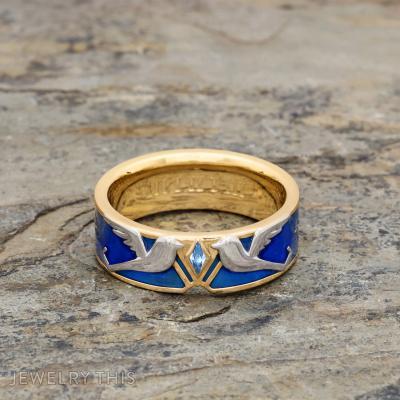
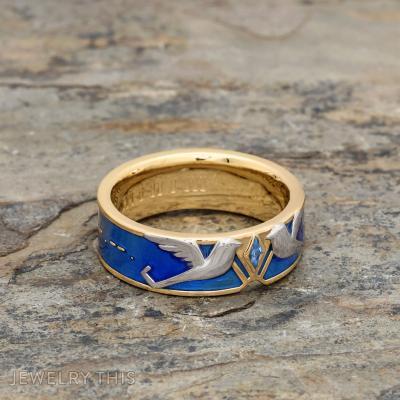
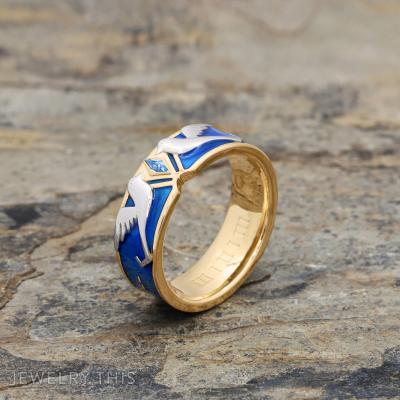
Two-Tone Enamel Band with Bird Motifs and Cipher Detail
$$
Sterling silver, yellow gold plating, white rhodium plating, blue enamel, moissanite
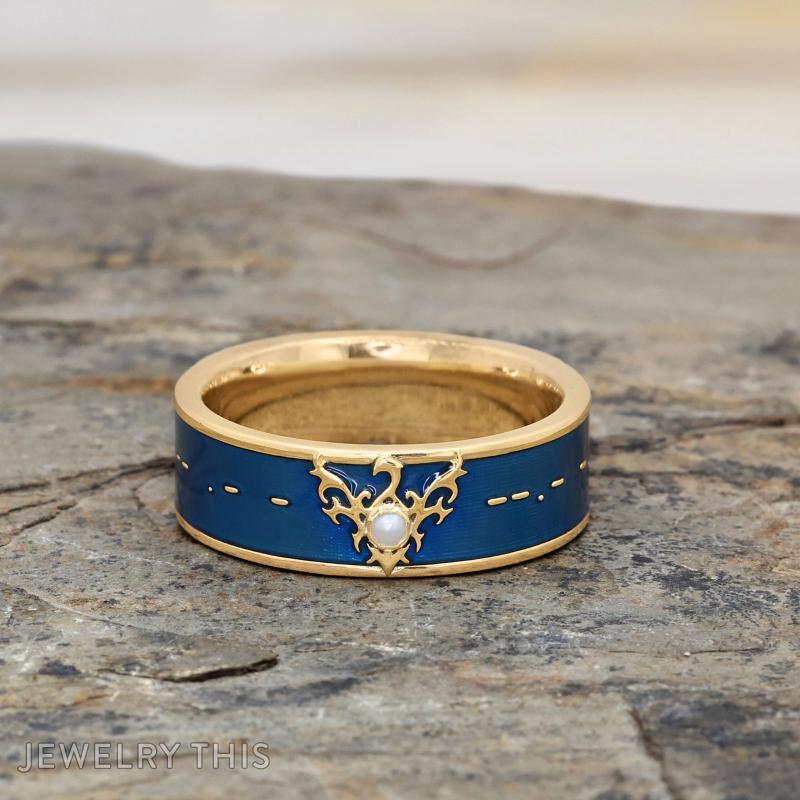
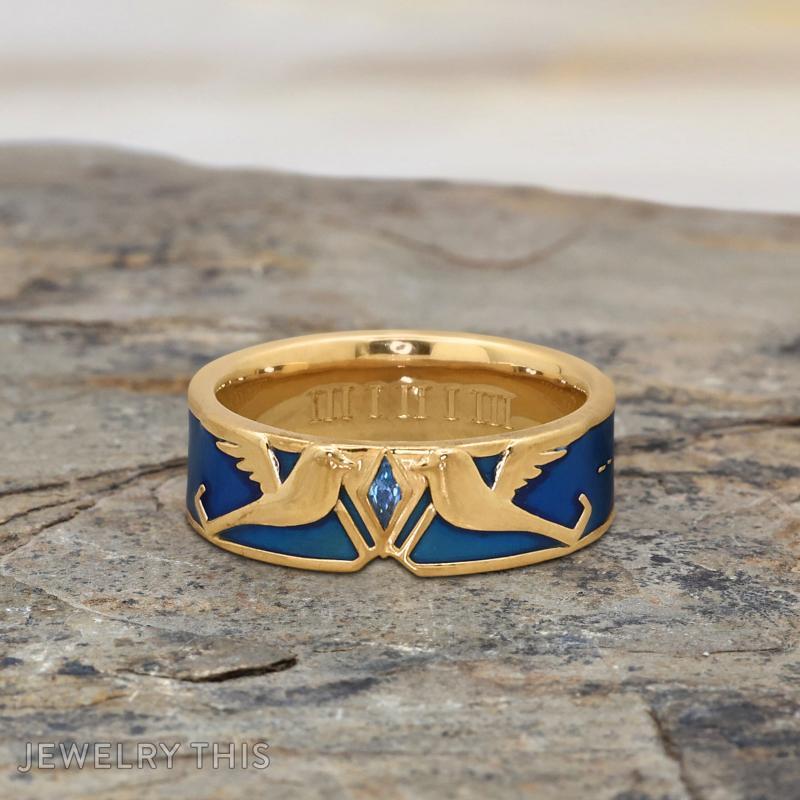
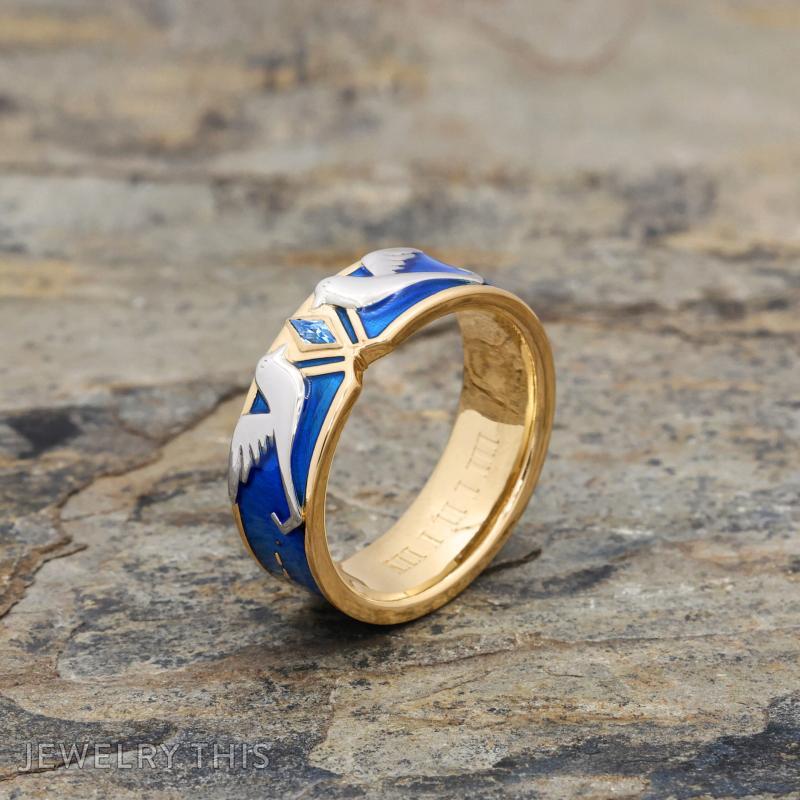
G. wanted to recreate a ring from her partner's favorite video game series, but reworked so it could actually be worn every day. Over several weeks of back-and-forth, the design shifted from a slim minimalist band to an 8mm width that could hold the level of detail the original required, with birds, a hidden coded message, and a small gemstone kept front and center. When it finally arrived, she wrote that they both loved it very much.
'Holy cows that looks super duper awesome!! I'm so excited!' — on seeing the first render
'We both love the ring very much!! Thank you so so so much.' — on delivery
Quick specs
Primary Metal
Secondary Metal
Shape / Cut
Primary Stone
Accent Stones
Design Complexity
Intent: Certainty
Size
Ring size 10.75 US. Band width 8mm.
How they made it distinctive
-
01
8mm band width chosen specifically so the fine bird and emblem details from the original reference would stay legible after casting
-
02
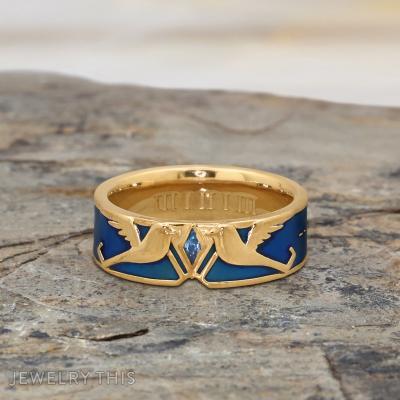
Two-tone plating combines white rhodium birds with yellow gold linework to create visual contrast between design elements
-
03
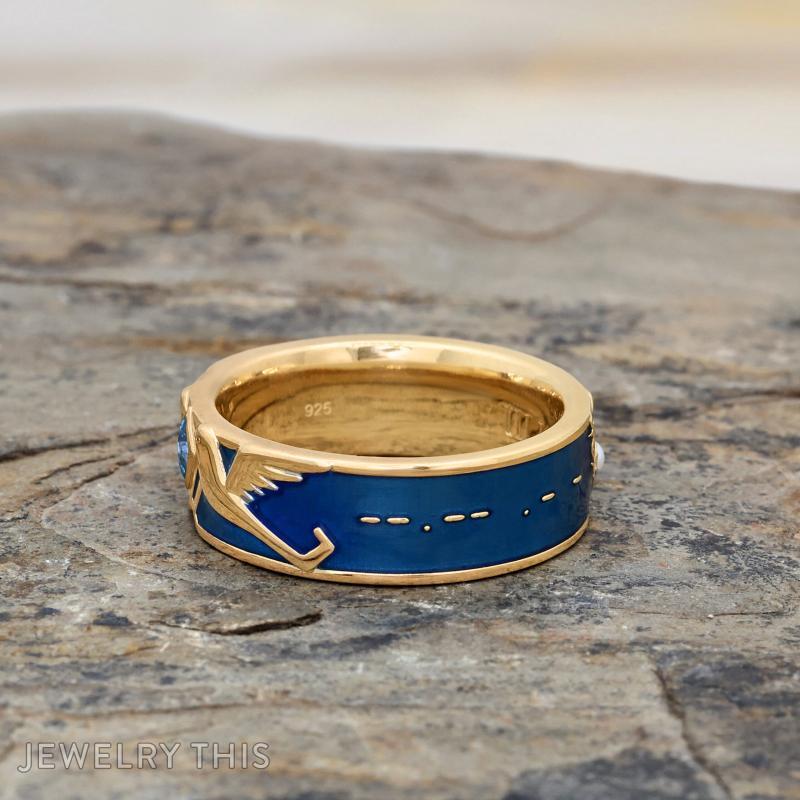
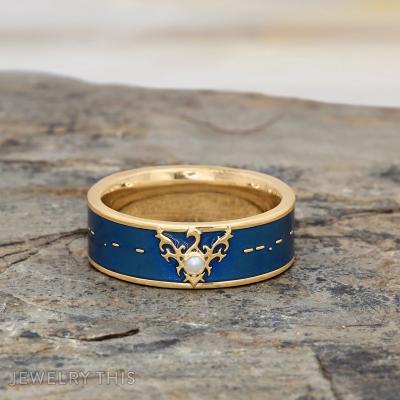
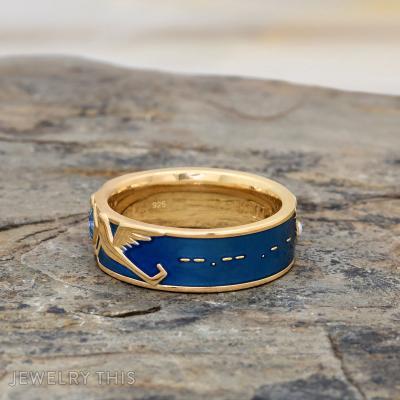
Hidden wabun-code inscription running along both sides of the emblem, spelling a private phrase in dash-based code
-
04
Bezel-set aqua moissanite chosen as a colorless-look alternative in a kite shape that could not be achieved with a faceted diamond
-
05
Blue enamel background selected over gemstone paving to keep the design within budget while preserving the color scheme
-
06
Design deliberately adapted rather than copied exactly from its video game source to keep the ring wearable and comfortable
How you'd make it yours
Stone: this piece uses a bezel-set aqua moissanite and a round cabochon stone; a new commission could use sapphire, other moissanite colors, or a different cabochon gem
Metal: this piece is sterling silver with yellow gold and white rhodium plating; the same two-tone design language works in solid 14k gold or platinum
Enamel color: this piece uses blue enamel; a new commission could use a different color to match a different source design or personal preference
Engraving: a new commission can carry a different hidden coded phrase or roman numeral sequence on the interior of the band
One of a kind: this exact ring was designed for one client's partner and is not reproduced — a new commission is an original piece inspired by this one, not a copy
Design changes made
The ring widened from an initially requested 2-3mm to 8mm after early tests showed the design's birds and emblem could not read clearly at a slimmer width. The client also moved from planning a gemstone-heavy design to an engraved, dimensional metal approach to manage cost, and later added a hidden coded inscription along the band.
Who this is for
This piece is for someone whose partner has a favorite fictional world or game they never expected to see turned into something wearable. It's especially right if you want the reference to be genuine and detailed rather than watered down, but still comfortable enough for someone to wear every single day without thinking about it.
How it's made
Once the design was finalized in CAD, a resin model was 3D printed and shared with the client for approval before casting. The resin was attached to a wax tree and invested in plaster, which was fired in a kiln to burn out the pattern and leave a hollow mold. Molten sterling silver was then cast into the mold under pressure and cleaned of investment material once cooled.
After casting, the raised linework and bird details were plated in select areas: the birds finished in white rhodium for a platinum-like contrast, while the emblem and border details received yellow gold plating. The background fields were filled with blue enamel, fired to set permanently against the raised metal walls. The aqua moissanite was bezel-set into its kite-shaped frame, and a round cabochon stone was set on the opposite face, with fine wabun-code dashes and roman numeral engraving finished last by hand.
Key note
The two-tone finish required plating the birds and the emblem separately in white rhodium and yellow gold, since enamel has to be fired onto the bare metal before any plating is applied.
Pricing guidance
An engraved, enamel-detailed silver band with two-tone plating and a small bezel-set stone sits in the mid range for custom rings of this complexity. Most of the cost comes from the hand engraving, multi-step plating, and enamel work rather than the metal itself. Adding gemstones in place of engraved details, or increasing band width and detail density, moves the price up from there.
Moves price up ↑
- ↑ Setting the round and kite-shaped elements with faceted gemstones instead of engraved metal or cabochon stones
- ↑ Adding gemstone accents in place of the wabun-code dash engraving
- ↑ Using 14k gold instead of gold-plated sterling silver for the base metal
- ↑ Extending the bird or emblem detail fully around the band rather than on two focal sections
- ↑ Choosing platinum for a dimensional-only design without plating or enamel
Moves price down ↓
- ↓ Reducing the band width from 8mm to a slimmer profile with fewer visible details
- ↓ Removing the two-tone plating and finishing the entire design in a single metal tone
- ↓ Simplifying the coded engraving or omitting it entirely
- ↓ Using a single stone accent instead of two
- ↓ Choosing a fully engraved, flat design without any enamel fill
Questions people ask
Yes, video game and fandom-inspired designs are common requests, and the level of detail that can be preserved depends on the width of the band and how the elements are rendered. A design with fine details like birds, emblems, or small text usually needs a wider band, often 6-8mm, so those elements stay clear and legible after casting. The team can advise which elements to keep dimensional and which to simplify into engraving to keep the design readable at ring scale. Full recreations are possible, but a good design often adapts the source material rather than copying it exactly.
Enamel is a colored glass-like coating that is fired onto bare metal to fill in background areas with solid color, while gemstones are individually set stones that catch light and have their own depth. Enamel is generally more budget-friendly for covering larger background areas with color, while gemstones are typically reserved for focal points like a center stone. On this design, blue enamel fills the background fields while a bezel-set stone and a cabochon stone serve as the two focal accents. Enamel requires a raised metal border to hold it in place during firing, which is why designs with enamel often have a slightly raised linework pattern.
Moissanite ranks 9.25 on the Mohs hardness scale, just below a diamond's 10, making it highly resistant to scratching and suitable for daily wear. It has more brilliance and fire than a diamond of the same size, meaning it throws more rainbow-colored sparkle under light. It is also significantly less costly than a natural or lab diamond of comparable size, which makes it a common choice for accent stones or colored center stones like the aqua tone used here. Unlike a diamond, moissanite is not colorless by nature, so colored moissanites like aqua or blue are sourced specifically for that hue rather than treated.
Yes, this is a common technique called two-tone plating, where different sections of a design are selectively plated in different colors. It requires more production steps than a single-tone finish, since each section has to be isolated and plated separately, but it allows contrasting elements like raised figures against a gold background to stand out from each other. On a piece like this, the birds were finished in white rhodium for a platinum-like look while the emblem and border details received yellow gold plating. Both platings sit over the same base metal, in this case sterling silver, so the underlying structure is identical.
A design of this complexity, with two-tone plating, enamel fill, hand engraving, and two small stone accents, sits in the mid range for custom fine jewelry rings. The primary cost driver is labor rather than material: the enamel firing, the selective plating process, and the fine engraving all require multiple hands-on production steps. Simplifying any one of those elements, such as choosing a single metal tone or omitting the coded engraving, brings the price down from there, while upgrading to gemstones in place of engraved details raises it.
Rings with enamel fill and continuous design detail around the band typically cannot be resized using standard methods, because resizing stretches or cuts the metal and would crack or dislodge the enamel. For a ring like this, getting an accurate size before production is essential, and if the size is wrong after delivery, the ring usually needs to be remade rather than adjusted. This is different from a plain metal band, which can often be resized up to a full size or more without issue. Anyone ordering a ring with all-around enamel or engraving should plan for careful, confirmed sizing upfront.
A ring of this complexity typically takes several weeks from final design approval to completion, covering resin modeling, casting, cleanup, multi-step plating, enamel firing, stone setting, and hand engraving. The design phase itself can also take time if there are multiple rounds of revisions, since fine details like engraving placement and color layering often need adjustment before the final CAD is locked in. Rush requests around a holiday or specific date are sometimes possible but depend on how far in advance the request is made relative to the piece's complexity. Because this type of ring involves several sequential production steps that cannot be parallelized, complex pieces generally take longer than a simple band.
Yes, coded or hidden text is a popular way to add a personal element without making it obvious to a casual observer. Morse code, wabun code, and similar dash-and-dot systems can be engraved along the band, often positioned so they read as decorative linework unless someone knows to look for a message. These codes typically need to be kept short since space along a ring's circumference is limited, especially on a narrower band. Placement and spacing usually take a few rounds of review to get right, since minor misreadings of dot and dash order are easy to make during production.
Explore Similar Creations
Every masterpiece starts with a spark. Explore how our clients raw ideas - sketches, heirlooms, inspirations - were transformed into bespoke works of arts.
Celebrate lasting love with our men’s slim comfort fit Wedding Band in platinum. Meticulously crafted, ...

Crafted for the adventurous soul, this sterling silver ring features a captivating eagle with intricate ...
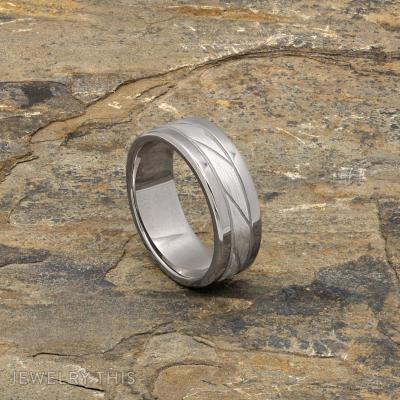
This custom wedding band is a thoughtfully recreated piece, transformed from an alternative metal design ...

This wide 14k white gold band translates a favorite piece of pop-culture design into a ...
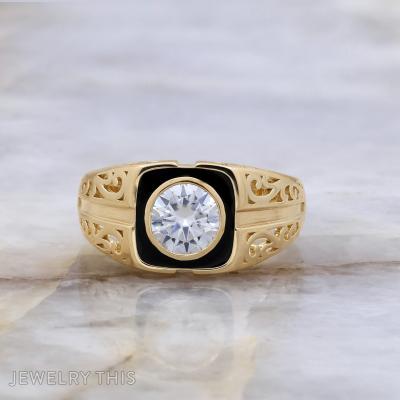
This men’s ring was designed as a gift, built around a bold square silhouette that ...
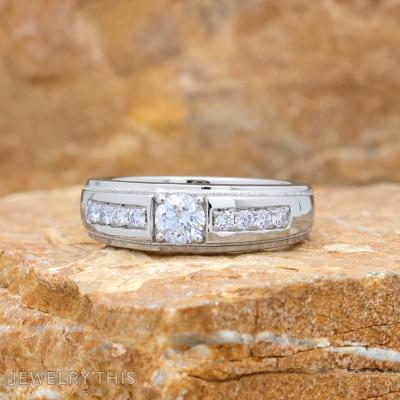
This men’s wedding band was designed to capture the look of a specific ring the ...
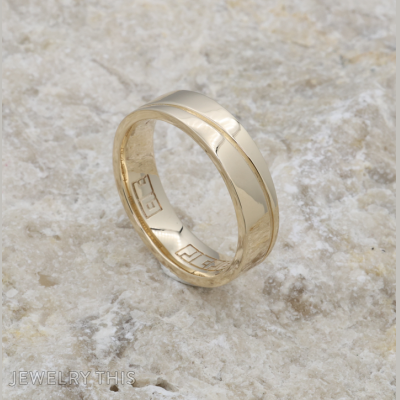
This custom wedding band is a sophisticated tribute to a shared journey, blending modern design ...
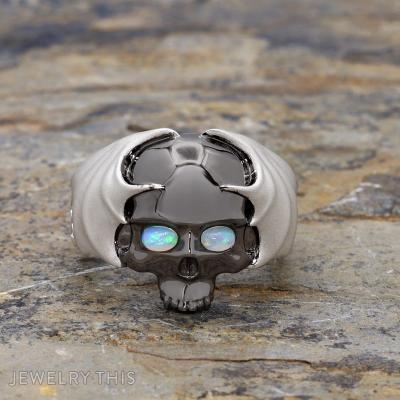
This sterling silver ring centers on a dimensional skull motif finished in black rhodium plating, ...

This custom ring is a timeless tribute to family heritage and tradition. Crafted in 14k ...

A deeply personal and symbolic expression of love, this wedding band embodies the unique connection ...

This 14k yellow gold band recreates a design the client’s father already wears, rebuilt from ...
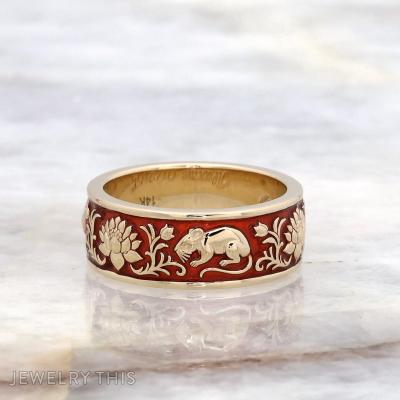
This wide men’s band was built around a Chinese zodiac rat and lotus flower motif, ...