


Men's Squash Plant Wedding Band in Black Rhodium Silver
$
Sterling silver, black rhodium plating
B. wanted a wedding band that captured her fiance's unexpected passion for gardening — specifically his soft spot for squash. She asked for a design that leaned into the stalks and squash shapes rather than the flowers, worried a botanical ring might read as too delicate for him. When the technical sketch came back, she wrote that she was blown away by how much detail had been packed in, and that the blossoms had been worked in without losing the masculine feel she wanted.
'Woah!! I am blown away. That is so much more detailed than I thought it could be, and the incorporation of the blossoms worked out really well.' — on seeing the first technical sketch
'It is stunning! I want one for me!' — on seeing the final 3D render
Quick specs
Primary Metal
Primary Stone
Accent Stones
Style
Design Complexity
Intent: Certainty
Size
Ring size 11 US (20.6mm); band width 5–6mm.
How they made it distinctive
-
01
Squash plant chosen as the central motif + reflects the recipient's specific, personal love of gardening rather than a generic nature theme
-
02
Design emphasizes stalks and structural plant forms over soft florals + addresses the client's concern that a botanical ring would read as too delicate for a man
-
03
Small blossoms worked into the stalk-and-leaf pattern + preserves the plant's distinctive shape without overwhelming the masculine aesthetic
-
04
Black rhodium plating over silver + matches a wearer who avoids shiny jewelry while keeping the cost below gold
-
05
Continuous engraving around the full band + required the finger size to be locked in before casting to avoid disrupting the pattern
How you'd make it yours
Plant subject: this piece uses squash stalks and blossoms; a new commission could reference any plant with personal meaning to the wearer
Metal: this piece is black rhodium-plated silver; the same engraved design works in 14k gold or in natural polished silver without plating
Band width: this piece is 5–6mm; a new commission could be made wider or narrower depending on hand size and preference
Pattern coverage: this piece is engraved all the way around; a new piece could use a partial band design with a plain back section for easier resizing
One of a kind: this exact ring was designed for one client's fiance and is not reproduced — a new commission is an original piece inspired by this one, not a copy
Design changes made
The initial brief asked for a design that minimized floral elements in favor of stalks and squash forms, out of concern the ring would otherwise look too delicate. The final sketch incorporated small blossoms alongside the stalks and leaves, which the client approved as striking the right balance between detail and a masculine feel.
Who this is for
This piece is for someone who wants their wedding band to reflect a specific, slightly unusual personal interest rather than a generic symbol. It's especially right for a partner who knows exactly what makes their person who they are — down to an oddly specific love of a garden vegetable — and wants that captured in something worn every day.
How it's made
Once the hand-engraved botanical design was finalized from the technical sketch and 3D model, the ring was 3D printed in wax and attached to a wax tree inside a flask. The flask was placed in a kiln to burn out the wax, leaving a hollow mold of the ring's exact form, including the full relief pattern. Molten sterling silver was then cast into that mold under pressure, producing the raw ring once the metal cooled and the mold was broken away.
After casting, the band was cleaned and polished to bring out the contrast between the raised botanical relief and the recessed background before any plating was applied. A black rhodium plating was then applied over the entire polished silver surface last, giving the stalks, leaves, and blossoms a darker, non-reflective finish suited to a wearer who avoids shiny jewelry. Because the pattern runs the full circumference with no breaks, the ring was cast to the client's confirmed finger size before any finishing began, to avoid disrupting the continuous design with a later resize.
Key note
The ring was cast to the exact confirmed finger size before any engraving detail was finished, because resizing a band with a continuous, unbroken pattern after casting would break the design's seamless wraparound.
Pricing guidance
A heavily hand-detailed men's silver band like this sits toward the upper end of silver custom work, though still well below gold or platinum pieces of similar complexity. Most of the cost comes from the labor required to model and cast a continuous, high-relief botanical pattern rather than from the metal itself. Plating and band width are secondary factors that move the price modestly from there.
Moves price up ↑
- ↑ Increasing the band width beyond 6mm, which requires more surface detail to fill
- ↑ Switching from silver to 14k gold for the same engraved pattern
- ↑ Adding gemstone accents within the botanical design
- ↑ Requesting a two-tone finish (e.g. polished silver stalks with gold-plated blossoms)
- ↑ Commissioning a matching women's band with coordinating botanical detail
Moves price down ↓
- ↓ Reducing the engraving to a partial band rather than full circumference
- ↓ Simplifying the pattern to fewer plant elements
- ↓ Narrowing the band to 4mm
- ↓ Skipping the black rhodium plating for a natural polished silver finish
- ↓ Choosing a shallower, less dimensional engraving depth
Questions people ask
Yes, a specific plant can be the entire design focus of a band, as this ring shows with its squash-plant engraving. The design team works from photos and descriptions to translate a real plant's stalks, leaves, and blossoms into a continuous engraved pattern. Masculine-leaning botanical designs typically emphasize structural elements like stalks and stems rather than soft florals, which keeps the look from reading as delicate. A technical sketch is produced first so the client can approve the layout before any 3D modeling begins.
Black rhodium is a dark metal plating applied over the base metal, in this case sterling silver, to achieve a matte, non-reflective black-grey finish. It is a surface treatment, not a permanent alteration to the metal underneath, so it will gradually wear with daily contact, especially on raised or high-touch areas. Most wearers get one to two years of solid wear before a re-plating service is needed. There is no permanent way to darken silver or gold without plating, since the base metal itself remains its natural color.
When a pattern wraps the full circumference of a band with no breaks or gaps, cutting the band to resize it would interrupt the design at the seam and the pattern would no longer align cleanly. For that reason, bands with continuous engraving are typically cast to the exact confirmed finger size from the start rather than sized afterward. This is why finger size is confirmed and double-checked before the piece moves into production. A ring with a plain, undecorated back section has more flexibility for resizing than one with an all-around pattern.
A heavily hand-detailed silver band with a continuous botanical engraving pattern falls in the lower-to-mid range for custom work, generally more than a simple plain band but well under gold or platinum pieces of similar detail. The main cost driver is the labor involved in modeling a high-relief, full-circumference pattern rather than the cost of the silver itself. Band width, plating choice, and pattern complexity are the factors that move the price from there.
The design phase for a detailed engraved band typically takes about one to two weeks, covering a technical sketch followed by a 3D render for approval. Once the design is approved and finger size is confirmed, production takes approximately four additional weeks using lost-wax casting. The full process from first approved sketch to a finished, shipped ring generally runs five to six weeks total. Complex, full-circumference patterns do not usually add time beyond standard production as long as the sizing is locked in before casting begins.
Yes, the same hand-engraved botanical pattern can be produced in yellow, white, or rose gold rather than sterling silver. Gold does not take black rhodium plating to achieve a dark look the same way silver does, so a gold version would typically be left in its natural polished or matte finish rather than plated. Gold is also more expensive than silver for a piece of this size and detail. The design itself — stalks, leaves, and blossoms wrapping the band — would translate the same way regardless of metal choice.
Yes, black rhodium plating wears gradually with regular wear, particularly in areas that see the most friction or contact, such as the palm side of the band. It does not peel or flake suddenly; it fades evenly over time, often becoming slightly lighter or showing the silver underneath at the highest points of a raised design. Re-plating is a standard service most jewelers can perform once the original finish has worn down. The underlying silver and the engraved detail are unaffected by the plating wearing off.
A band with raised, high-relief engraving across its entire surface has more texture than a smooth band, but a 5–6mm width with professionally finished edges is a comfortable, wearable size for daily use. The raised pattern is polished smooth during finishing so there are no sharp edges despite the depth of the engraving. Comfort depends more on band width and edge finishing than on the presence of a pattern itself. Men who work with their hands regularly may notice more wear on raised detail over time than someone with a less hands-on routine.
Explore Similar Creations
Every masterpiece starts with a spark. Explore how our clients raw ideas - sketches, heirlooms, inspirations - were transformed into bespoke works of arts.
This 14k yellow gold band recreates a design the client’s father already wears, rebuilt from ...

This 14k yellow gold band recreates a ring originally purchased overseas decades ago and passed ...
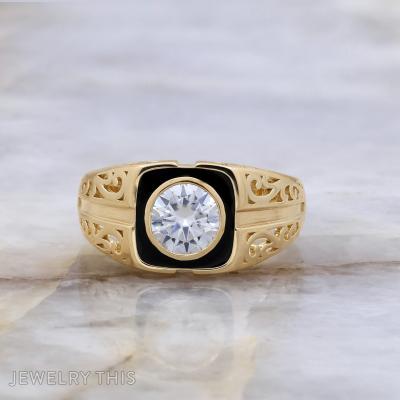
This men’s ring was designed as a gift, built around a bold square silhouette that ...

Crafted for the adventurous soul, this sterling silver ring features a captivating eagle with intricate ...
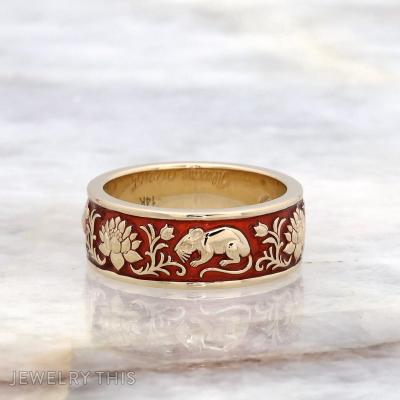
This wide men’s band was built around a Chinese zodiac rat and lotus flower motif, ...

This wedding band is a beautifully remade version of a cherished piece that originally symbolized ...
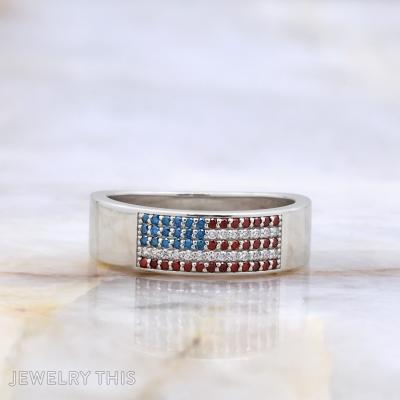
This wide 14k white gold band carries a pave-set American flag across its face, built ...

This wide 14k white gold band translates a favorite piece of pop-culture design into a ...
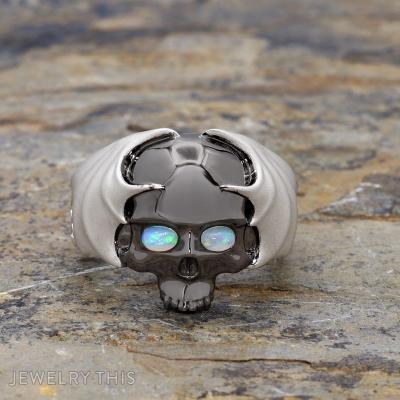
This sterling silver ring centers on a dimensional skull motif finished in black rhodium plating, ...

This men’s championship-style ring is cast with a sterling silver base and eight 14k yellow ...

A deeply personal and symbolic expression of love, this wedding band embodies the unique connection ...
This custom wedding band is a sophisticated tribute to a shared journey, blending modern design ...



