


Recreated Opal Engagement Ring with Chevron Diamond Band
$$$
14k yellow gold, opal, lab-created diamonds
A client came to us hoping to recreate her great-grandmother's engagement ring and wedding band, lost a few years earlier with only a couple of photos and a hand-drawn sketch to work from. She corrected the first render herself, trimming each wedding band triangle down to match the original's three-diamond pattern, and a new opal was sourced to match the lost stone as closely as possible since the family opal on hand didn't fit the design. When it arrived, she wrote simply: 'Love it! Thank you!'
'Love it! Thank you!' — on delivery
Quick specs
Design type
Primary Metal
Shape / Cut
Primary Stone
Accent Stones
Design Complexity
Intent: Certainty
Size
Ring size 7 US (17.32mm).
How they made it distinctive
-
01
Opal center stone chosen to match a lost family ring as closely as possible, rather than a conventional diamond solitaire
-
02
Wedding band's three triangle clusters each hold exactly three diamonds, corrected from the first render at the client's request to match her memory
-
03
Replacement opal specifically sourced to match the size, color, and shape of the original lost stone
-
04
Diamond crown cluster above the center stone mirrors the curved, nesting profile of the wedding band beneath it
-
05
Two-piece set designed to stack together as a single cohesive silhouette despite being cast and finished separately
How you'd make it yours
Stone: this piece uses a sourced opal center stone — a new commission could use a different opal, a sapphire, or a lab diamond for a different look
Metal: this piece is 14k yellow gold — the same cluster design works in 18k yellow gold, white gold, or rose gold
Diamond count: this band uses three diamonds per triangle — a new commission could use more or fewer per cluster
Diamond type: this piece uses lab-created diamonds — natural mined diamonds are an option for a new commission at a different cost
One of a kind: this exact bridal set was designed to recreate one family's lost ring and is not reproduced — a new commission is an original piece inspired by this one, not a copy
Design changes made
The wedding band's two outer triangles originally included extra diamonds; the client asked that all three triangles match the center one, each carrying just three stones, based on her memory and a hand-drawn sketch of the original.
Who this is for
This set is for someone who wants their ring to carry real family history rather than just a striking look. It's especially right if you're working from limited documentation — old photos, a rough sketch, a few details from memory — because that's exactly the kind of recreation this process is built for.
How it's made
Once the design was approved, the ring and band were 3D printed in wax and attached to a wax tree inside a flask. The flask was invested in plaster and fired in a kiln to burn out the wax, leaving a hollow mold. Molten 14k yellow gold was then cast into each mold under pressure, producing the raw engagement ring and wedding band.
After casting, both pieces were cleaned, polished, and finished to a bright yellow gold luster throughout. The cabochon opal was set into its prong setting on the engagement ring alongside the two flanking diamonds and the upper diamond cluster, while the wedding band's three diamond-set triangles were set by hand to curve evenly along the band's profile.
Key note
The opal was sourced separately from the diamonds specifically to match the original stone's size, color, and shape, since the client's own family opal stones weren't the right dimensions for the design.
Pricing guidance
An opal-and-diamond bridal set with a cluster-style engagement ring and a curved triangle-motif wedding band sits toward the lower-to-mid range for two-piece custom bridal sets of this complexity. The main cost drivers are the two separate cast pieces, the diamond count across both rings, and the cabochon opal setting. Metal karat and diamond quality are where the price moves most from there.
Moves price up ↑
- ↑ Upgrading from lab-created to natural mined diamonds across both rings
- ↑ Increasing the opal size or choosing a higher play-of-color grade
- ↑ Adding more diamonds per triangle on the wedding band
- ↑ Upgrading from 14k to 18k yellow gold
- ↑ Choosing a larger center opal with a bezel rather than prong setting
Moves price down ↓
- ↓ Using lab-created diamonds instead of natural mined diamonds
- ↓ Switching to gold-plated sterling silver instead of solid 14k gold
- ↓ Reducing the wedding band to two triangle clusters instead of three
- ↓ Choosing a smaller center opal
- ↓ Simplifying the upper diamond cluster on the engagement ring to fewer stones
Questions people ask
Yes. This bridal set was rebuilt using only a couple of photographs and a hand-drawn sketch of the original ring, which had been lost years earlier. The process starts with a 3D render based on your description and any images you have, and you can request adjustments until it matches your memory. In this case, the client corrected the number of diamonds per cluster on the wedding band after seeing the first render, and the second version matched what she remembered.
Opal is softer than diamond or sapphire, rating around 5.5 to 6.5 on the Mohs hardness scale, which means it can scratch or chip more easily with daily impact. A prong or bezel setting that protects the stone's edges helps reduce this risk. Opal should be removed before heavy manual work, swimming, or exposure to harsh chemicals, and a light polish from a jeweler periodically keeps it looking its best. Many clients still choose opal for a center stone because of its unique play of color, accepting slightly more care than a diamond would require.
You can send in a stone for consideration, but it has to be physically measured and scanned before it's confirmed for the design, since photos alone can't verify exact size, shape, or color match. In this case, the client's family opals were reviewed but turned out not to be the right size or shape to match the original ring's proportions, so a new opal was sourced separately instead. When a client-provided stone doesn't fit, sourcing a replacement that matches the original in size, color, and shape is a common solution. The final design can always be adjusted once the actual stone is in hand.
A two-ring bridal set combining an opal engagement ring with a diamond-accented curved wedding band falls toward the lower-to-mid range for custom bridal sets of this complexity. The cost reflects two separately cast and finished rings, the diamond count across both, and the opal sourcing and setting. Choosing lab-created diamonds and 14k gold keeps the cost down, while natural diamonds or 18k gold would raise it. Metal karat and diamond quality are the two factors that move the price most.
The design phase for a 3D render typically takes about one week from the design deposit. Once the final design is approved and production begins, casting, stone setting, and finishing generally take four to five weeks. Sourcing a specific replacement stone, like a matched opal, can add some time before production starts. Total time from deposit to delivery is usually several weeks to a couple of months, depending on how many design revisions are needed.
Lab-created and natural diamonds are chemically and visually identical — same hardness, same brilliance, same durability. The only real difference is origin: lab diamonds are grown in a controlled setting rather than mined from the earth. For small accent stones like the ones in this wedding band, lab-created diamonds offer the same look at a lower cost than natural mined diamonds of equivalent clarity and color. Many clients choose lab diamonds for accent stones specifically to keep the overall cost down without changing the appearance.
Yes, the number of accent stones per cluster on a curved triangle-motif band like this can be adjusted up or down. In this project, the client specifically asked to reduce each of the three triangle sections to three diamonds total, rather than the four shown in the first render, to match her memory of the original band. Reducing stone count typically lowers the cost slightly, while adding more stones increases both the diamond cost and the setting labor. This kind of adjustment is usually made after the first 3D render, before any metal is cast.
Not always — a gemstone has to match the physical requirements of the new design, including its size, shape, and cut, which can't be fully judged from photos alone. In this case, the client's heirloom opals were considered but didn't match the size and shape needed to recreate the original ring closely, so a comparable replacement opal was sourced instead. Stones can only be confirmed for a design once they've been physically received and measured by the jeweler. When an heirloom stone doesn't fit, sourcing a visually similar replacement is a common path forward.
Explore Similar Creations
Every masterpiece starts with a spark. Explore how our clients raw ideas - sketches, heirlooms, inspirations - were transformed into bespoke works of arts.
This wedding ring reimagines a rose in metal, with the center stone nestled inside sculpted ...

This captivating custom engagement ring emanates timeless beauty and exquisite craftsmanship. At its heart lies ...

This engagement ring began as two heirloom pieces — an original engagement ring and anniversary ...

This exquisite white gold ring captures the timeless elegance of a three-stone design with a ...
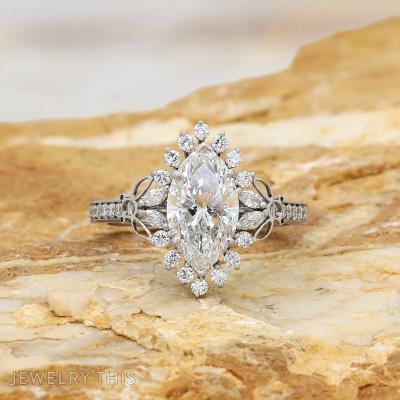
This engagement ring centers a marquise-cut lab diamond, colorless and just under two carats, surrounded ...
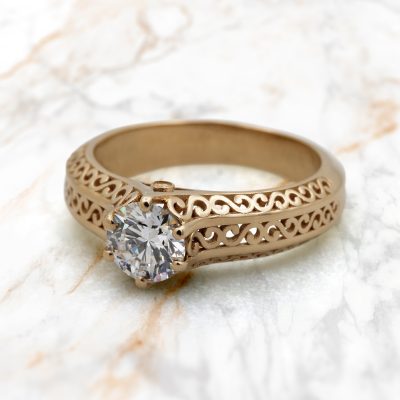
A 14k yellow gold engagement ring with filagree details set with a round lab created ...

This bridal set recreates a wedding ring that had been lost — originally a grandmother’s ...

This white gold ring is a bold and captivating statement piece designed to allure and ...

This platinum engagement ring centers a large oval lab-grown diamond in a raised cathedral setting, ...

This 14k yellow gold ring reinterprets the traditional Claddagh design — hands cradling a crowned ...

This Platinum ring is a symbol of life’s vibrant connections. At its heart, a 1 ...

This custom engagement ring is a breathtaking piece that beautifully captures the essence of love ...



