


Recreated Heirloom Ring Set — Solitaire & Sapphire Guards
$$
Gold-plated sterling silver, diamond, lab-grown blue sapphire
A husband wanted to recreate his wife's grandmother's wedding ring after it was lost — a two-ring set he only had a single photo to go on, with no paperwork to confirm the original stones or measurements. His mother-in-law offered to send in a diamond to be set as the center stone, and after seeing the first render, he confirmed the ring guard's accent stones should be blue sapphire rather than moissanite to match the original. When the finished rings shipped, he wrote back simply: 'Awesome thanks for all your hard work, I look forward to seeing it in person.'
'That looks just like the original one, the original Stones were blue sapphire. If you can put those in that would be awesome.' — on seeing the first render
'Awesome thanks for all your hard work, I look forward to seeing it in person.' — on delivery
Quick specs
Design type
Primary Metal
Shape / Cut
Primary Stone
Accent Stones
Design Complexity
Intent: Certainty
Size
Ring size 10.25 US (19.96mm). Center stone approximately 5mm round.
How they made it distinctive
-
01
Two-ring nesting design recreated from a single photograph with no appraisal or measurements to work from
-
02
Center stone is a family diamond sent in by the client's mother-in-law and set to its exact scanned proportions
-
03
Accent stone type corrected to blue sapphire after client feedback on the first render, matching the original more closely
-
04
Gold-plated silver construction chosen specifically to fit the client's budget while achieving the yellow gold look of the original
-
05
Chevron-shaped ring guard designed to nest flush against the solitaire's curved band
How you'd make it yours
Stone: this piece uses a client-provided center stone; a new commission could use a lab diamond, moissanite, or sapphire as the center stone
Accent stones: this piece uses lab-grown blue sapphire; a new commission could use moissanite or natural sapphire for a similar look
Metal: this piece is gold-plated sterling silver; the same chevron-and-solitaire design works in solid 14k or 18k gold
Ring count: this piece is a two-ring nesting set; a new commission could be designed as a single ring or a three-ring stack
Engraving: the inside of either band can carry a new inscription on a fresh commission
One of a kind: this exact two-ring set was designed around one client's family stone and is not reproduced — a new commission is an original piece inspired by this one, not a copy
Design changes made
The accent stones in the ring guard were changed from blue moissanite to lab-grown blue sapphire after the client confirmed the original ring guard used sapphires, and the center stone was switched from a moissanite placeholder to a family diamond sent in partway through the process.
Who this is for
This set is for someone piecing together a family ring from incomplete information — a photo, a memory, maybe a stone passed down but no paperwork to confirm the details. It's especially right if you want to involve family in the process, whether that means a relative's stone becoming the center of the piece or matching original details as closely as possible from limited reference material.
How it's made
Once the design was approved, a 3D digital model was built and printed as a resin prototype — the physical preview of the ring shared with the client before any metal was cast. The resin was then used to create an investment mold, which was fired to remove the resin and leave a hollow cavity. Molten sterling silver was cast into that cavity for both the solitaire and the ring guard, producing the raw bands ready for finishing.
After casting, both bands were cleaned up, polished to a bright finish, and gold-plated to achieve the yellow gold look specified in the brief. The center setting was custom-built to the exact measurements of the client's mother-in-law's diamond, which had been shipped in and scanned before the model was finalized, ensuring a secure fit. The ring guard's chevron peaks were then set by hand with small lab-grown blue sapphires along both sides.
Key note
The center setting was engineered around the physical dimensions of the family diamond after it arrived and was scanned — not estimated from the photo — so the stone's actual proportions, not a placeholder size, determined the final setting geometry.
Pricing guidance
A two-ring gold-plated silver bridal set with a client-supplied center stone and lab-grown sapphire accents falls toward the lower end of the price range for custom recreation work. Choosing gold-plated silver over solid gold is the single biggest factor keeping the cost down, since most of the expense in a piece like this comes from metal content and stone sourcing rather than labor alone. Using a family-supplied stone also removes the cost of sourcing a center stone.
Moves price up ↑
- ↑ Upgrading from gold-plated silver to 14k or 18k solid gold
- ↑ Sourcing a natural sapphire rather than lab-grown for the accent stones
- ↑ Increasing the number or size of accent stones in the ring guard
- ↑ Choosing a larger or higher-clarity center stone if a new one were sourced rather than provided by the client
- ↑ Adding hand engraving to the inside of either band
Moves price down ↓
- ↓ Using moissanite instead of sapphire for the accent stones
- ↓ Reducing the number of accent stones in the guard
- ↓ Making a single ring rather than a two-ring nesting set
- ↓ Choosing a smaller diameter accent stone size
- ↓ Skipping the gold plating for a plain sterling silver finish
Questions people ask
Yes, this exact set was rebuilt from a single reference photo with no appraisal or paperwork on the original. The process starts with a detailed sketch and moves to a 3D render, which the client reviews and can request changes to before anything is cast. In this case, the accent stone type was corrected from moissanite to sapphire after the client saw the first render and recalled the original detail more clearly. A photo reference is enough to get very close, even without exact measurements.
Yes, sending in a family stone to be set into a new ring is a common request. The stone needs to be shipped in and physically measured and scanned so the setting can be built to its exact proportions, which is important for security. A jeweler cannot guarantee a stone will fit safely in a setting built from estimated measurements alone, so the physical stone is required rather than just a description. Once received, the design phase moves forward around that stone's real dimensions.
Gold-plated silver is a sterling silver base with a layer of gold plating applied over the surface, giving the visual appearance of solid gold at a lower cost. Solid gold, by contrast, is gold alloy all the way through, whether 10k, 14k, or 18k. The tradeoff with plating is that it is a surface layer and will gradually wear thinner with daily wear, especially at points of friction like the underside of the band. Re-plating is a straightforward and widely available service when the color starts to fade.
Yes, lab-grown sapphire has the same chemical composition and the same hardness rating, 9 on the Mohs scale, as natural sapphire. The only meaningful difference is origin — one is grown in a controlled lab environment and one is mined — with no difference in how the stone wears over time. For small accent stones like the ones in this ring guard, lab-grown sapphire performs identically to natural while typically costing less. Visually, the two are indistinguishable to the naked eye.
A custom bridal set like this typically takes around four to five weeks from design approval to completion, following about one week for the sketch and render phase. If a client is sending in their own stone, that shipping and scanning process adds time before production can begin. Once the design is approved and the stone is confirmed, the rings move through casting, finishing, and stone setting in sequence. Rush timelines are sometimes possible depending on the scope of work and the current production schedule.
Yes, a chevron-style ring guard like this one is designed to nest against a solitaire ring but can generally be worn on its own or stacked with other rings. The V-shaped profile is built specifically to fit flush against the curve of the solitaire's band, which is why the two are designed together as a set rather than sold separately. Worn alone, it functions as a stackable band with stone detail along the peak. Worn together, the two create the appearance of a single more elaborate ring.
Gold plating is a surface treatment, so it will thin gradually with regular wear, particularly on areas that experience the most friction or contact. Most wearers see a noticeable fade after one to two years of daily wear, though this varies by how the ring is worn and cared for. Re-plating is a routine service most jewelers offer, and it restores the original color and finish. It does not damage the underlying silver or the stones set into the piece.
Yes, this is a normal part of the design process, as long as the change is made before the ring moves into production. In this project, the accent stone type was changed from moissanite to sapphire after the client reviewed the render and recalled additional detail about the original ring. Changing stone type after casting and setting would require reworking the piece, which is why reviewing the render carefully before approval is the ideal time to make these calls.
Explore Similar Creations
Every masterpiece starts with a spark. Explore how our clients raw ideas - sketches, heirlooms, inspirations - were transformed into bespoke works of arts.
This engagement ring is a bold yet elegant statement piece. It features a 1-carat central ...

This 18karat yellow gold engagement ring exudes elegance and vintage charm. At the heart of ...
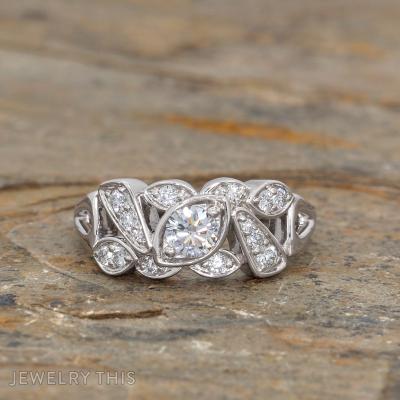
This exquisite engagement ring is a heartfelt recreation of a cherished vintage heirloom from 1925, ...

This wedding ring reimagines a rose in metal, with the center stone nestled inside sculpted ...

Behold this stunning custom wedding ring set, meticulously crafted to capture the essence of eternal ...

This stunning white gold engagement ring showcases a pear-shaped center diamond set in a full ...

Elegance meets allure in this custom 14k rose gold ring. At its heart, a resplendent ...
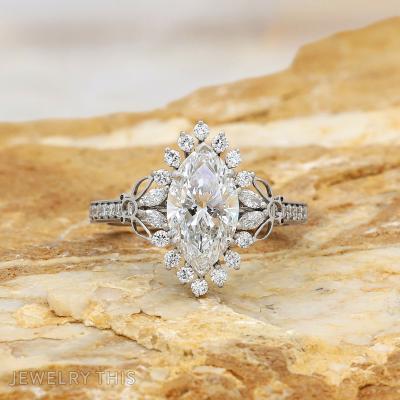
This engagement ring centers a marquise-cut lab diamond, colorless and just under two carats, surrounded ...

Celebrate your love story with this captivating pair of 14karat Rose gold rings. The engagement ...

This yellow gold ring is a heartfelt recreation of a cherished, lost engagement ring. At ...

This white gold ring is a mesmerizing creation that captures the essence of elegance with ...
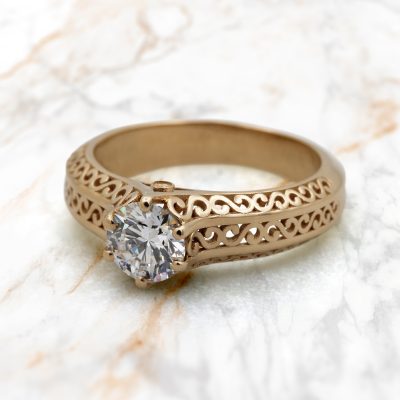
A 14k yellow gold engagement ring with filagree details set with a round lab created ...



