


Birthstone Engagement Ring — Oval Diamond, Family Swirls
$$$
14k white gold, lab diamond, blue topaz, pink tourmaline, amethyst, citrine
A father of three came to us designing a proposal for his partner, wanting a ring that represented not just the two of them but the family they were forming together. Four birthstones were arranged around the center diamond — hers, his, and the children's — worked out stone by stone until the colors and positions felt balanced. When the finished ring shipped, he wrote: 'I'm so excited, love the pictures, can't wait to have the ring in hand!'
'That looks wonderful! Yes, we can go forward with making the ring!' — on seeing the first render
'I'm so excited, love the pictures, can't wait to have the ring in hand! I know Bethany will love it, too!' — on shipping notification
Quick specs
Design type
Primary Metal
Shape / Cut
Primary Stone
Accent Stones
Design Complexity
Intent: Certainty
Size
Ring size 8\u00bc US (18.34mm). Center stone 1.52ct oval, 9.34\u00d76.46mm.
How they made it distinctive
-
01
Four birthstones represent the client, his partner, and his three children, with two children sharing one stone
-
02
Caddy-corner stone placement chosen over a simple linear arrangement after reviewing render options together
-
03
Swirl detail simplified to smooth metal on request, removing the original stone-accented texture
-
04
Lower swirl detail removed entirely after the client felt it was unnecessary to the design
-
05
Oval center diamond selected over round specifically because the client's partner preferred its look in the opera-style reference
How you'd make it yours
Stone type: this piece uses a lab diamond center stone — a new commission could use a natural diamond or a colored center stone for a different look
Center stone size: this piece uses 1.52ct — a new piece could be sized larger or smaller depending on preference and budget
Metal: this piece is 14k white gold — the same swirl design works in 18k white gold, yellow gold, or rose gold
Birthstone count: this piece represents five family members with four stones — a new commission could represent more or fewer people
Engraving: the inside of the band can carry a date or initials on a new piece
One of a kind: this exact ring was designed for one family and is not reproduced — a new commission is an original piece inspired by this one, not a copy
Design changes made
The thinner swirl was changed from stone-accented to smooth metal, the bottom swirl detail was removed entirely, and the gaps between swirls were evened out so both sides could hold matching stones. The amethyst and tourmaline positions were also swapped per the client's request.
Who this is for
This piece is for someone forming a new family unit through marriage and wanting the ring itself to say so — not just a symbol of a couple, but of everyone involved. It's especially right if you have children from a previous relationship and want them represented alongside the engagement itself, in a way that's personal rather than purely decorative.
How it's made
Once the final design was approved, the piece was 3D printed in wax using the finalized model, then attached to a wax tree and invested in plaster. The mold was fired in a kiln to burn out the wax, leaving a cavity that was then filled with molten 14k white gold under pressure. After cooling, the raw casting was removed from the mold and prepared for finishing.\n\nThe cast band was cleaned and polished to a bright white gold finish throughout, since the design uses a single consistent sheen rather than mixed textures. The oval center diamond was set first in its multi-prong setting, followed by the pave diamonds lining the swirl shoulders, and finally the four birthstones were set caddy-corner to the center stone in their individual prong settings.
Key note
The ring came out heavier than the original digital estimate once cast in solid metal, which is why the final metal cost shifted from the initial render-stage quote.
Pricing guidance
An engagement ring with a lab diamond center stone and four additional birthstone accents sits in the mid-to-upper range for custom engagement work. The main cost drivers are the center stone size and the labor required to hand-set five separate stones plus a pave-lined shoulder design. Metal karat and the number of accent stones are what move the price most from there.
Moves price up ↑
- ↑ Increasing the center stone from 1.52ct to 2ct or larger
- ↑ Switching the center stone from lab-grown to a natural diamond of the same size and clarity
- ↑ Adding more pave diamonds along a longer swirl section
- ↑ Upgrading from 14k to 18k white gold
- ↑ Adding a matching wedding band designed to nest against the swirl shape
Moves price down ↓
- ↓ Reducing the center stone size, which lowers both diamond cost and metal needed for prongs
- ↓ Reducing the number of birthstone accents from four to two or three
- ↓ Using a round cut instead of oval, which is often more readily available at lower cost
- ↓ Choosing a less complex shoulder design without the pave-lined swirl detail
- ↓ Selecting smaller birthstone accents
Questions people ask
Yes. Lab-grown diamonds have the same chemical composition and the same 10 rating on the Mohs hardness scale as natural diamonds, so they wear identically in daily use. The only difference between the two is origin — one is grown in a controlled lab environment, the other is mined. For an engagement ring worn every day, a lab diamond will hold up exactly the same as a natural one of equivalent cut and clarity.
Yes, this is a common request for blended families or multi-generational pieces. Each birthstone is set in its own individual prong setting, which means stones of different hardness and size can be combined safely in the same ring. The key design consideration is spacing and placement so the arrangement reads as intentional rather than cluttered, which usually takes a few rounds of review during the render stage.
A ring in this category — a one-plus carat center stone with several smaller accent stones and a detailed shoulder design — typically falls in the mid-to-upper range for custom engagement work. The center stone size is usually the biggest cost factor, followed by the labor involved in setting multiple accent stones individually. Metal choice and the complexity of any surrounding pave or swirl detailing also affect the final cost.
The full process typically takes several weeks from deposit to shipping. The initial 3D design and render usually takes about a week, and once approved, production including casting, finishing, and stone setting takes several more weeks. A ring with multiple accent stones set individually, like one with several birthstones, can take a bit longer than a simple solitaire because each stone is set separately.
Yes, oval is a popular alternative to round for a center stone and works well with a variety of shoulder and accent designs. An oval diamond of the same carat weight as a round one will typically appear larger because of its elongated shape, which is worth considering if you want the center stone to read as more prominent. The choice mostly comes down to personal preference and how the stone proportions work with the rest of the design.
Birthstone accents can be either natural or lab-created, depending on the stone and your preference. Lab-created versions of stones like sapphire and ruby are widely available and offer the same color and durability as their natural counterparts at a lower cost. The choice usually comes down to budget and whether you have a preference for natural-origin stones specifically.
Round diamonds are generally the most expensive shape per carat because the cutting process produces more waste from the rough stone and the cut is the most researched for maximizing brilliance. Oval and other fancy shapes often cost less per carat at the same clarity and color grade, though pricing varies by the specific stone. This is one reason some clients choose oval or other fancy shapes to get a larger-looking stone within the same budget.
Resizing a ring with stones only on the top portion of the band, rather than stones that go all the way around, is usually straightforward within a reasonable size range. Because the accent stones in a design like this sit close to the center rather than circling the entire band, the smooth lower portion of the shank can typically be adjusted without disturbing the stone settings. Larger resizes may require more significant rework, so it's worth discussing with a jeweler directly.
Explore Similar Creations
Every masterpiece starts with a spark. Explore how our clients raw ideas - sketches, heirlooms, inspirations - were transformed into bespoke works of arts.
This elegant rose gold engagement ring features a round brilliant-cut moissanite as its centerpiece. Surrounding ...

This exquisite 14k white gold ring is adorned with a stunning center oval aquamarine stone, ...
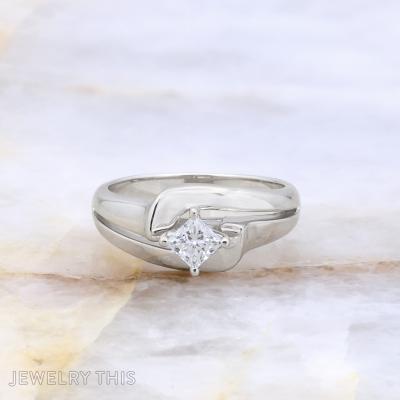
This engagement ring recreates a bypass-style solitaire that was lost two decades earlier, rebuilt entirely ...
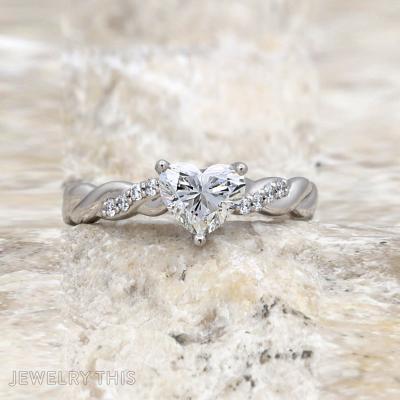
This engagement ring centers on a one-carat heart-shaped lab diamond, held in a four-prong setting ...

Look at this radiant 14k Yellow Gold Heart Shaped Moissanite Solitaire Engagement Ring. It showcases ...

This stunning white gold engagement ring showcases a pear-shaped center diamond set in a full ...
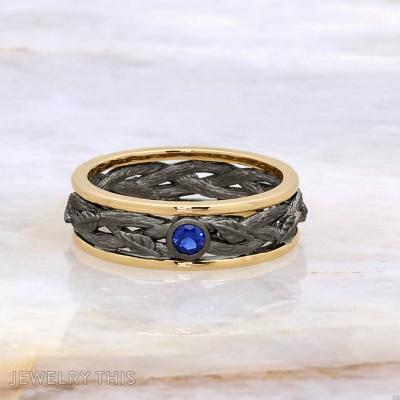
This engagement ring combines a dark, textured center band with two polished 14k yellow gold ...
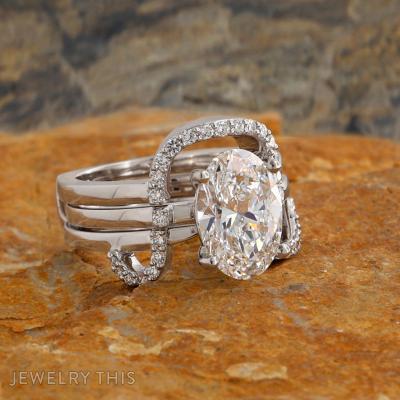
This engagement ring set is built from three interlocking bands in 14k white gold, designed ...

This custom engagement ring is a stunning statement piece, The eye-catching emerald cut sapphire center ...

This engagement ring was recreated to resemble a vintage three-ring set from the early 1980s, ...

This engagement ring centers a 1.56 carat oval-cut lab diamond, flanked by a matched pair ...

14 k yellow gold engagement ring featuring a claddagh design. Set in the center a ...



