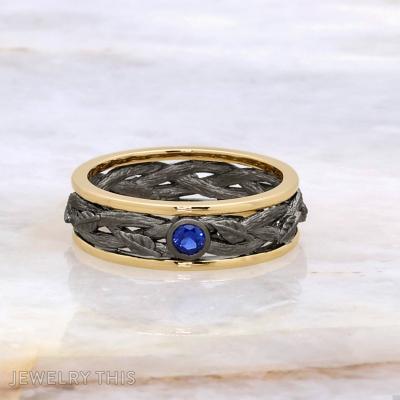
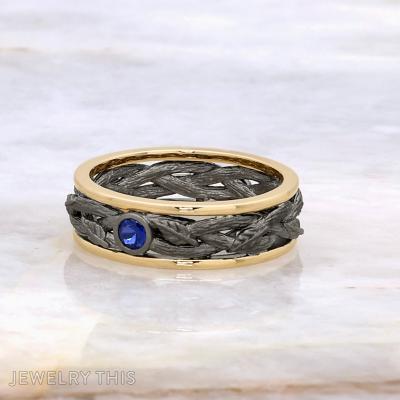
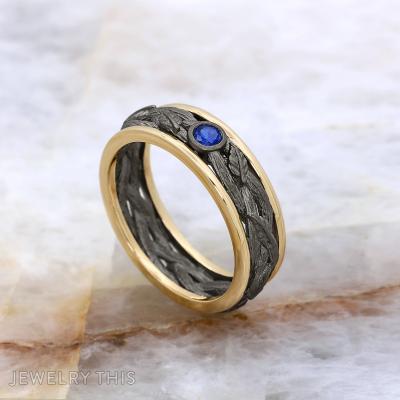
Vine & Leaf Engagement Ring — Black Rhodium & Gold Sapphire Band
$$$
14k yellow gold, black rhodium plated silver, natural sapphire
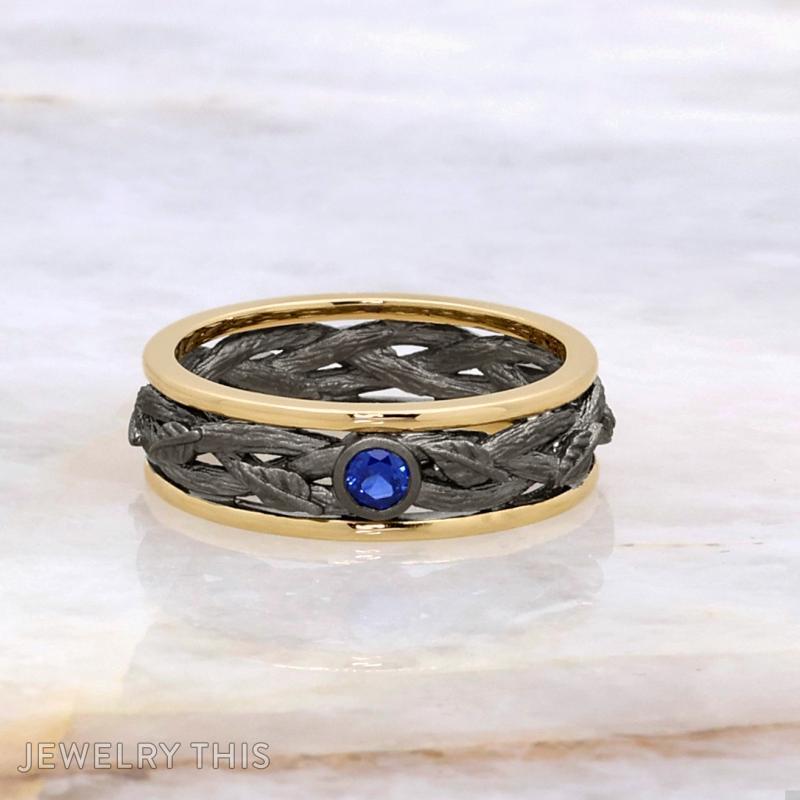
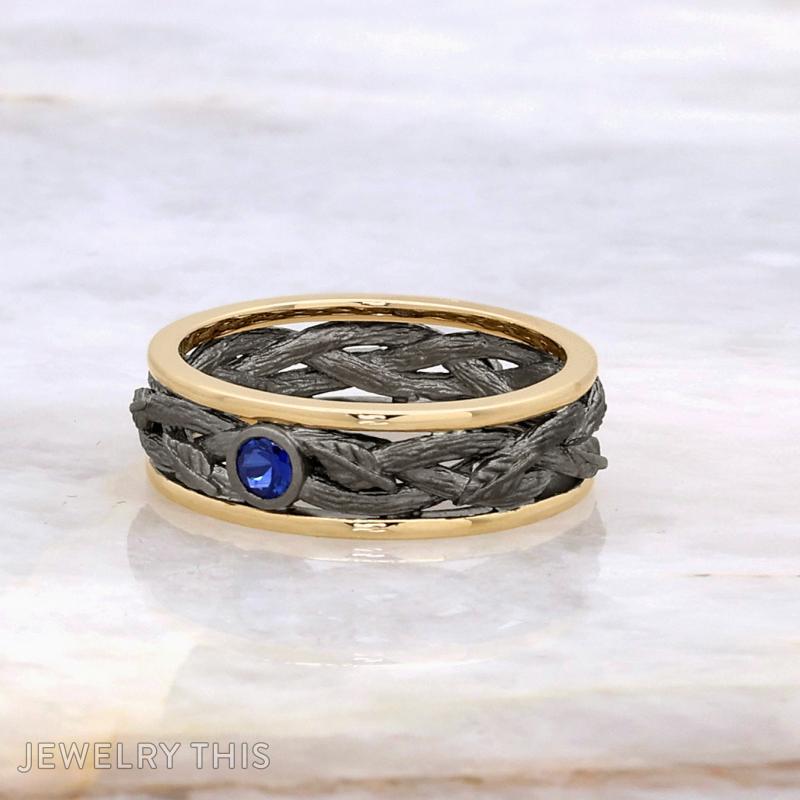
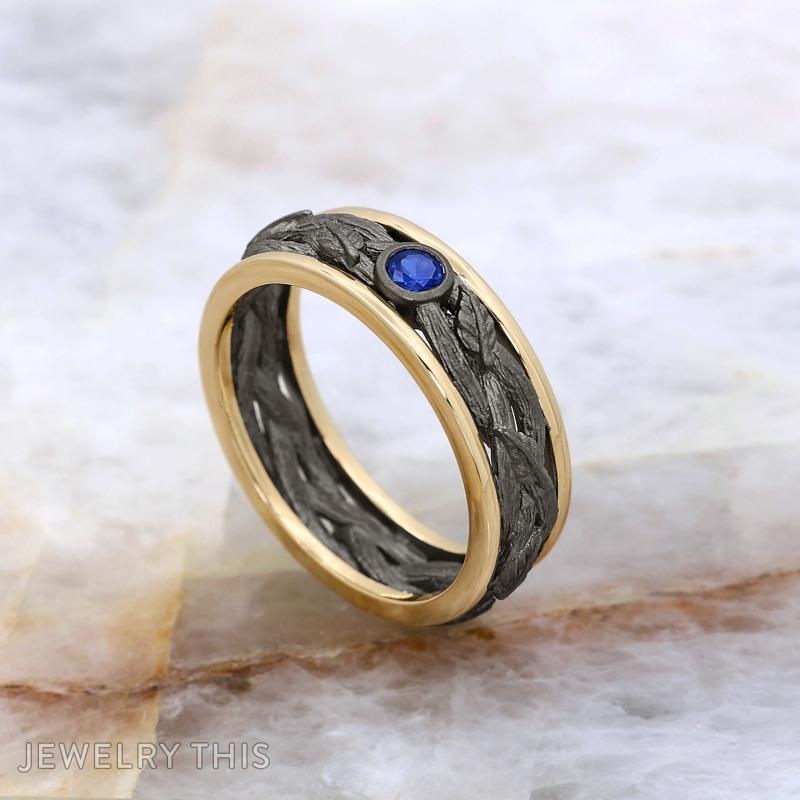
A client set out to design his own engagement ring, pairing a dark woven vine band with polished gold rails and a bezel-set sapphire rather than a traditional prong setting. After seeing the first render, he asked for a matte finish on the center section so the vine and leaf detail would actually read instead of disappearing into the shine — a small change that made a real difference. When it arrived, he wrote that the dark centerpiece turned out even better than he expected.
'Yes I very much like how it turned out. The silver centerpiece turned out better than I expected actually.' — on delivery
Quick specs
Design type
Primary Metal
Secondary Metal
Shape / Cut
Primary Stone
Accent Stones
Design Complexity
Intent: Certainty
Size
Ring size 10 US (19.8mm). Band width 6mm.
How they made it distinctive
-
01
Three-part construction — center vine section and two gold rails cast separately in different metals, then soldered into one solid ring
-
02
Bezel setting chosen specifically so the sapphire sits flush within the textured band rather than rising above it on prongs
-
03
Matte finish added under the black rhodium plating late in the design phase, specifically so the vine and leaf detail would read clearly instead of disappearing into a polished sheen
-
04
Mixed-metal palette pairs a dark, textured center against two polished 14k yellow gold rails for deliberate contrast
-
05
Deep, intense blue natural sapphire selected over a lighter tone at the client's specific request
How you'd make it yours
Stone: this piece uses a natural sapphire; a new commission could use a lab sapphire for the same color at lower cost, or a different colored stone entirely
Metal palette: this piece pairs black rhodium plated silver with 14k yellow gold; the same layered look works with white gold or rose gold rails instead
Finish: this piece uses a matte center with polished rails; a new commission could reverse that or apply a different finish combination
Band width: this piece is 6mm; a new commission could be made narrower or wider depending on the wearer's hand
Vine density: this piece has a densely woven leaf pattern; a new commission could use a sparser or more open pattern
One of a kind: this exact ring was designed for one client's engagement and is not reproduced — a new commission is an original piece inspired by this one, not a copy
Design changes made
The center section was switched from a high-polish finish to a matte finish under the black rhodium plating, after the client felt the vine and leaf detail was getting lost in the render's shine. The client also caught a ring size error before production, correcting it to a men's size 10.
Who this is for
This piece is for someone designing their own engagement ring who wants something with real dimensional texture rather than a standard smooth band. It's especially right if you're drawn to a nontraditional dark-and-gold palette and want your center stone set low and integrated into the design rather than raised up on prongs.
How it's made
Once the sketch and 3D model were approved, the ring was built in three separate cast sections — two rail bands and one textured center band — each cast in its designated metal before assembly. The center section was cast in silver and the two flanking rails in 14k yellow gold; a wax model was produced first and shown to the client as a resin preview before any metal was poured, then the wax was invested in plaster and burned out in a kiln to leave the casting mold.
After casting, the three sections were cleaned up and soldered together into a single solid ring rather than left as separate moving parts. The center section received a matte finish to make the vine and leaf texture stand out, then was plated in black rhodium over that matte surface, while the two gold rails were finished to a high polish for contrast. The natural sapphire was bezel-set flush into the textured center so it sits integrated into the design rather than raised on prongs.
Key note
The matte finish was applied to the center section specifically before the black rhodium plating — polishing it first would have caused the fine vine and leaf detail to disappear under the plating's sheen.
Pricing guidance
An engagement ring combining a cast textured center section with separately cast metal rails and a bezel-set colored stone sits in the mid range for custom engagement work of this complexity. The three-part construction — casting each section in its own metal before soldering — adds labor cost beyond a single-cast band. Stone choice, natural versus lab, and metal weight are what move the price most from there.
Moves price up ↑
- ↑ Choosing a larger or higher-clarity natural sapphire over a lab-grown stone
- ↑ Increasing band width beyond 6mm, which adds metal weight across all three sections
- ↑ Casting the vine and leaf detailing in solid gold rather than plating, which requires casting and soldering each leaf individually
- ↑ Upgrading the rail sections from 14k to 18k gold
- ↑ Adding stones along the textured center section rather than a single bezel-set stone
Moves price down ↓
- ↓ Switching from a natural sapphire to a lab-grown sapphire for the same color at lower cost
- ↓ Reducing the band width, which lowers the metal weight needed for all three sections
- ↓ Using white gold or silver throughout instead of a mixed-metal build
- ↓ Simplifying the vine and leaf texture to a shallower or less dense pattern
- ↓ Choosing a smaller center stone
Questions people ask
Yes, this is done with a bezel setting, where a continuous rim of metal wraps around the stone's edge instead of individual prongs holding it up. A bezel setting sits the stone lower and more flush with the surrounding surface, which many people prefer for both look and durability. It also protects the stone's edges from everyday knocks better than exposed prongs. This approach works well with textured or patterned bands because the stone can be set directly into the pattern rather than interrupting it.
Black rhodium is a surface plating applied over a base metal — commonly silver or white gold — to achieve a dark, almost black finish, since no metal alloy naturally produces that color. It is applied as one of the final finishing steps, after any matte or polish work is complete, because the plating is delicate and can be damaged by further mechanical finishing. With daily wear, black rhodium typically holds up well for one to two years before it starts to show wear, especially on high-contact areas, at which point it can be re-plated. It is a well-established and widely used finishing technique, not an experimental one.
A matte finish scatters light more evenly across a textured surface, which makes fine carved or cast detail like leaves and vines much easier to see. A high polish, by contrast, creates strong highlights and reflections that can visually flatten detailed patterns, making them harder to read at a glance. This is especially noticeable in photographs and renders, where a polished textured surface can look blurred or indistinct. Combining a matte textured section with polished plain sections, as in a mixed-finish ring, also creates visual contrast between the two design elements.
A ring built from multiple cast sections in different metals, with hand-finishing and a bezel-set colored stone, falls in the mid range for custom engagement work of this complexity. The main cost drivers are the labor of casting each section separately and soldering them together, plus the finishing work required for a textured surface. Stone choice — natural versus lab-grown, and size — has the biggest effect on the final price beyond that baseline labor cost.
Natural and lab-grown sapphires are chemically and optically identical — both are corundum with the same hardness (9 on the Mohs scale) and the same fire and color potential. The difference is origin: natural sapphires are mined from the earth, while lab-grown sapphires are produced in a controlled environment in a fraction of the time. Lab-grown sapphires are typically less expensive for the same size and color intensity. Choosing between them usually comes down to personal preference and budget rather than any visible difference to the eye.
The design phase — sketch, 3D model, and render revisions — typically takes about a week once a deposit is placed, though it can take longer if revisions like a finish change are requested. Production, which includes casting each section, soldering, finishing, and stone setting, generally takes about four weeks after the design is approved and the balance is paid. A multi-section build like this one, with separate metals cast and then soldered together, sits within that same standard timeline rather than requiring extended production time.
Resizing a ring with a fully textured band that wraps all the way around is more involved than resizing a plain band, because the pattern has to be preserved or seamlessly continued through the resized section. A ring built from multiple soldered sections, like one with separate cast rails and a center band, may also need to be evaluated by the original jeweler to determine the best approach. It's generally a good idea to confirm sizing as precisely as possible before production on a design like this, since after-the-fact resizing on detailed textured bands is more technical than on a smooth band.
It depends on the scale of the detail. Very fine, small elements like individual leaves are often too small to cast as separate solid-gold pieces and solder onto a band individually, so gold plating over a base metal is the practical alternative for that level of detail. Gold plating will wear over time with daily use, particularly at points of contact, and will eventually need to be reapplied. If solid gold throughout is a priority, the design would need to be adjusted to use larger, simpler forms that can be cast as one solid gold piece.
Explore Similar Creations
Every masterpiece starts with a spark. Explore how our clients raw ideas - sketches, heirlooms, inspirations - were transformed into bespoke works of arts.
The Golden Bloom Ring Commissioned as a second chance to perfectly capture a client’s heartfelt ...

Crafted for the superhero enthusiast, this custom engagement ring seamlessly merges elegance with fandom. Cast ...

Introducing a Mushroom Lover’s Custom Engagement Ring dream. A unique and enchanting symbol of love ...

This extraordinary Yellow gold ring features a breathtaking 1 carat Round Moissanite stone set at ...
This breathtaking yellow gold engagement ring is a masterclass in asymmetrical, nature-inspired design. At its ...

This exquisite engagement ring showcases a striking teal-colored emerald-cut sapphire as its centerpiece. The vibrant ...

This elegant engagement ring captures the beauty of cultural symbolism and timeless style. At its ...

This client came to us with her stunning engagement ring and requested a custom made ...

This enchanting rose gold engagement ring features a pear-shaped center diamond set at a graceful ...
This exquisite engagement ring showcases a stunning 0.81-carat round moissanite center stone, surrounded by a ...

This unique engagement ring embodies contemporary elegance with its mesmerizing hexagonal black diamond center stone. ...

This three-stone ring pairs a round center Montana sapphire with two smaller round sapphires in ...