

Recreated Heirloom Ring — Woven Gold Band, Blue Topaz
$$
14k yellow gold, blue topaz
A client came to us hoping to recreate a ring her grandmother had given her, working only from a handful of photographs since the original had been lost and no paperwork existed. Together we confirmed the stone was a round blue topaz around one carat, and worked out the woven pattern and tapered band from her description. When it arrived, she wrote that it looked great and that she couldn't wait to see it in person.
'Yes, this is perfect! Thank you so much!' — on seeing the 3D render
'It looks great and I can't wait until I see it in person.' — on delivery
Quick specs
Design type
Primary Metal
Shape / Cut
Primary Stone
Accent Stones
Design Complexity
Intent: Certainty
Size
Ring size 7 US (17.32mm).
How they made it distinctive
-
01
Woven crisscross pattern flanks the center stone but tapers into a smooth shank toward the back, matching the original ring's silhouette as the client described it
-
02
Round blue topaz chosen to match the client's memory of her grandmother's December birthstone
-
03
Reconstructed entirely from photographs and verbal description, with no original piece, paperwork, or appraisal to reference
-
04
Stone size estimated at approximately one carat based on the client's description and photo review
-
05
14k solid yellow gold used throughout to match the durability of the original heirloom
How you'd make it yours
Stone: this piece uses blue topaz; a new commission could use tanzanite or blue zircon for a different December-birthstone look, or a diamond or sapphire for a different aesthetic
Metal: this piece is 14k yellow gold; the same woven design works in 18k yellow gold or rose gold
Woven pattern: this piece tapers to a smooth back; a new commission could extend the weave fully around the band
Stone size: this piece uses an approximately one-carat stone; a new commission could go larger or smaller depending on preference
Engraving: the inside of the band can carry a new inscription on a fresh commission
One of a kind: this exact ring was designed for one client from her own memory and photographs, and is not reproduced — a new commission is an original piece inspired by this one, not a copy
Design changes made
Design matched the initial brief without major changes.
Who this is for
This piece is for someone who lost a ring that mattered and has nothing left but a few photos to work from. It's especially right if you're willing to work through some uncertainty in the details — stone size, exact pattern — trusting that the result will capture the spirit of what you remember, even if it isn't a pixel-perfect match.
How it's made
Once the sketch and 3D render were approved, a resin model of the ring was 3D printed and shared with the client as a preview before casting. That model was then attached to a wax tree, invested in plaster, and fired in a kiln to burn out the resin, leaving a hollow mold. Molten 14k yellow gold was cast into the mold under pressure, producing the raw ring.
After casting, the piece was cleaned and polished to bring up the shine on both the woven crisscross sections and the smooth tapered shank. The round blue topaz was then set into a four-prong setting at the center, positioned so the woven pattern frames the stone symmetrically on both sides before the band narrows toward the back.
Key note
The crisscross woven detail is cast as part of the ring's structure rather than added afterward, which is why it only appears on the front and sides while the back of the band stays smooth and thin for comfort.
Pricing guidance
A recreated gold ring with a woven design detail and a single center stone sits toward the lower end of the mid range for custom recreation work. Most of the cost comes from the hand-finishing needed to bring the woven crisscross pattern to a clean, symmetrical result, plus the labor of reconstructing a design from photographs alone. Metal karat and stone choice are what move the price from there.
Moves price up ↑
- ↑ Upgrading from 14k to 18k yellow gold for a richer color and higher gold content
- ↑ Choosing a natural diamond or sapphire in place of blue topaz
- ↑ Extending the woven pattern fully around the band instead of stopping partway
- ↑ Increasing the center stone size beyond approximately one carat
- ↑ Adding accent stones along the woven sections for extra sparkle
Moves price down ↓
- ↓ Using a lab-created stone alternative instead of natural blue topaz
- ↓ Simplifying the woven pattern to a single crossed strand rather than multiple
- ↓ Choosing 10k gold instead of 14k to reduce material cost
- ↓ Reducing the center stone size
- ↓ Leaving the shank fully smooth rather than tapering with woven detail
Questions people ask
Yes, recreation from photographs alone is a common request, especially for heirloom pieces that have been lost. The process starts with a sketch based on the photos and your description of details like band thickness, stone size, and any texture, followed by a 3D render for you to review and adjust. Minor differences from the original are normal since the piece is being rebuilt from images rather than the physical item. Most clients find the final result closely matches their memory of the original.
Blue topaz rates about 8 on the Mohs hardness scale, which makes it quite durable for daily wear and resistant to scratching from normal activities. It's a popular and more accessible alternative to tanzanite or blue zircon for December birthstone pieces. The main thing to watch for is sharp impacts, since topaz can chip along certain planes if struck hard against a hard surface. With normal wear it holds up well over years of daily use.
What's the difference between tanzanite, blue topaz, and blue zircon for a December birthstone ring?
All three are recognized December birthstones but differ in hardness, color, and cost. Tanzanite is softer, roughly 6 to 7 on the Mohs scale, and shows a distinctive blue-violet color shift depending on lighting. Blue zircon is brighter and more brilliant but also softer than topaz and prone to chipping at the facet edges over time. Blue topaz, at around 8 on the Mohs scale, offers the best combination of durability and consistent color for a ring meant to be worn daily.
A recreated ring with a woven band detail and a single center stone in 14k gold sits toward the lower end of the mid range for custom work of this kind. The primary cost driver is the hand-finishing labor needed for the woven pattern, plus the design time required to reconstruct the piece from photos rather than a physical reference. Stone choice and gold karat are the two biggest variables that shift the price up or down from there.
The design phase, including a sketch and a 3D photorealistic render for approval, typically takes about one week. Once the design is approved, production runs approximately four to five weeks, covering wax model printing, casting, finishing, and stone setting. In total, most custom rings like this are completed within five to six weeks from deposit to shipping.
14k yellow gold is solid gold throughout, not a plated finish. It contains 58.3% pure gold alloyed with other metals for strength and durability, which makes it suitable for daily wear over many years. This is different from gold-plated pieces, where only a thin surface layer of gold sits over a base metal like silver, and which can wear thin over time. A ring described as 14k gold, without a plating designation, is solid gold construction.
Yes, the woven crisscross pattern seen flanking the center stone could be extended to wrap fully around the band on a new commission, rather than tapering into a smooth shank at the back. This would use more metal and require more hand-finishing time to keep the pattern even and symmetrical all the way around. Some clients prefer the partial woven design because it keeps the back of the ring slimmer and more comfortable against the finger. Either approach is achievable depending on the look you want.
Stone size and shape can be estimated from photographs, but the process relies on the client's description and any comparative sizing details visible in the images rather than an exact measurement. For this ring, the stone was described as round and approximately one carat, which was used to guide the render and final setting proportions. Because there's no physical original or appraisal to reference, some estimation is inherent in this kind of recreation. If a client has a prior appraisal or jeweler's note about the stone size, that information is used over a visual estimate.
Explore Similar Creations
Every masterpiece starts with a spark. Explore how our clients raw ideas - sketches, heirlooms, inspirations - were transformed into bespoke works of arts.
This mesmerizing White gold band features three enchanting rows of small round stones, creating a ...

A 14k yellow wedding band set with 3 diamonds with a hand engraved florentine pattern.

This elegant white gold engagement ring features a stunning princess cut moissanite center stone. The ...

This band is beautiful piece that combines elegance with vibrant color. This 14k yellow gold ...
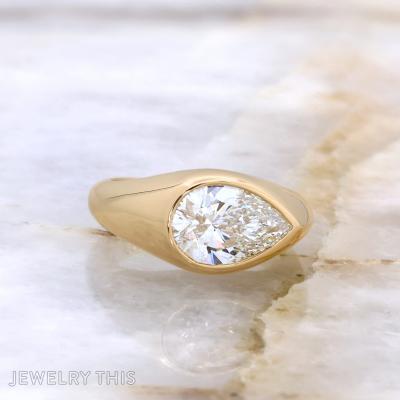
This ring centers a large pear-shaped lab diamond set sideways in a sculptural bezel of ...

Crafted with deep sentiment, this custom men’s ring crafted in 10k yellow gold pays homage ...

This men’s wedding band was built to bring back a ring that had been lost ...

This enchanting rose gold engagement ring features a mesmerizing center stone embraced by a band ...

This timeless three stone engagement ring is crafted in 14k white gold and features a ...

This exquisite platinum engagement ring showcases a captivating radiant-cut yellow diamond at its center, set ...

This white gold engagement ring features a stunning oval-shaped jade cabochon as the center stone, ...

This 14karat rose gold ring was a remake of the client’s original costume version. At ...