


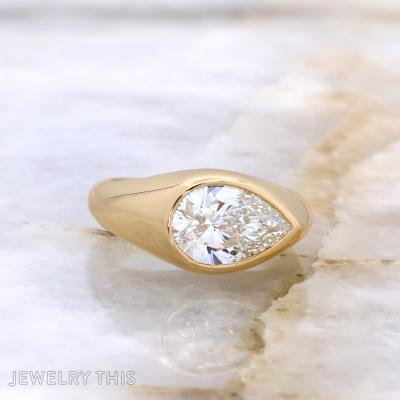


East-West Pear Diamond Signet Ring in 14k Yellow Gold
$$$
14k yellow gold, lab diamond
A client came to us wanting a bold ring to mark her 30th birthday, with a large pear diamond set sideways in a sculptural bezel. She pushed back on the first render, sending reference images until the bezel's profile matched exactly what she had in mind — a rounded curve on one side, a knife-edge point on the other. Inside the band she had us inscribe "30, flirty, & thriving." When it arrived, she wrote: 'I love it! It's so fantastic!'
'I love it! It's so fantastic!' — on delivery
Quick specs
Primary Metal
Shape / Cut
Primary Stone
Accent Stones
Design Complexity
Intent: Certainty
Size
Ring size 4.75 US. Center stone approximately 2.02 carats, pear cut, set east-west.
How they made it distinctive
-
01
East-west set pear diamond gives the ring a directional, modern look instead of the traditional point-up orientation
-
02
Bezel shaped asymmetrically — rounded on the curved side of the pear, knife-edge on the pointed side — to follow the stone's natural silhouette
-
03
Interior engraving marks a specific birthday milestone in the client's own words
-
04
Bezel lip is hammered flush rather than left raised, giving a cleaner, more finished look than the design render suggested
-
05
High-polish finish throughout lets the sculpted bezel and diamond read as one continuous form
How you'd make it yours
Stone type: this piece uses a lab diamond — a new commission could use a natural diamond or moissanite for a similar look at a different price point
Stone shape: this piece uses a pear cut set east-west — the same bezel language could be adapted to an oval or marquise stone
Metal: this piece is 14k yellow gold — the same sculpted bezel works in white or rose gold, or platinum
Finish: this piece is fully polished — a new commission could contrast a matte band with a polished bezel
Engraving: the interior of the band can carry a different phrase, date, or initials on a new piece
One of a kind: this exact ring was designed for one client's 30th birthday and is not reproduced — a new commission is an original piece inspired by this one, not a copy
Design changes made
The bezel was reshaped after the client felt the first render looked too bulbous and rounded — the side walls were straightened and the lip was adjusted to match a rounded contour on the curved edge and a knife-edge on the pointed edge, per reference images she provided. The engraving punctuation was also corrected to include a comma after "flirty."
Who this is for
This is for someone who wants a statement ring that still feels current rather than traditional — a large center stone set in a way that feels sculptural and directional. It's especially right if you're marking your own milestone and want the piece to carry a personal message only you can see.
How it's made
Once the design was finalized, a wax model was produced using a 3D printer and mounted to a wax tree inside a flask. The flask was placed in a kiln to burn out the wax, leaving a hollow mold, and molten 14k yellow gold was cast into that mold. After cooling, the piece was extracted from the mold, cleaned, and prepared for hand-finishing.
The pear diamond was set into the bezel by hand-hammering the metal lip down around the stone's girdle, then smoothing the lip flush against the surface so no raised edge remained. The bezel profile was shaped asymmetrically to the stone — a rounded wall following the curved side of the pear and a straightened, knife-edge wall along the pointed side. The entire ring was then polished to a high shine, and the inscription was engraved on the interior of the band as a final step.
Key note
The bezel appears to have a raised lip in the design render, but that lip is intentionally hammered flat during stone-setting — the finished bezel has no raised edge at all.
Pricing guidance
A substantial 14k gold signet-style ring with a 2-carat lab diamond in a sculpted bezel sits toward the upper end of the range for lab-diamond statement rings. Most of the cost is driven by the diamond's carat weight and clarity grade rather than the metalwork, though the sculpted, asymmetrical bezel adds meaningful hand-finishing time compared to a standard round bezel. Engraving and finish choices have a smaller effect on the total.
Moves price up ↑
- ↑ Upgrading to a natural diamond instead of lab-grown at the same carat and clarity
- ↑ Increasing carat weight beyond 2 carats
- ↑ Selecting a higher clarity or color grade (e.g. D color, VVS1)
- ↑ Adding pave or accent diamonds along the shoulders of the band
- ↑ Switching to platinum instead of 14k gold
Moves price down ↓
- ↓ Reducing the center stone to 1 to 1.5 carats
- ↓ Choosing a lower clarity grade (SI1 or SI2) with no visible inclusions
- ↓ Simplifying the bezel to a symmetrical round profile instead of the asymmetrical knife-edge design
- ↓ Choosing 10k gold instead of 14k
- ↓ Omitting the interior engraving
Questions people ask
Yes, this is called an east-west setting, where the stone is rotated 90 degrees from the traditional vertical orientation. It's a popular way to give a pear or marquise stone a more modern, directional look. The setting still needs to be engineered carefully so the bezel holds the stone securely at each of its distinct edges. This design uses a bezel that's shaped differently on the rounded side versus the pointed side of the pear to follow the stone's natural silhouette.
Lab-grown and natural diamonds are chemically and optically identical — same hardness, same brilliance, same fire. The only difference is origin: one is grown in a controlled lab environment, the other is mined from the earth. At larger carat weights, like 2 carats, this becomes a significant factor in overall cost while the visual result stays the same. Both are genuine diamonds, not simulants like cubic zirconia or moissanite.
During the design phase, the render often shows a slightly raised lip around the bezel edge so it's easier to visualize. Once the stone is actually set, that lip is hammered down flush against the stone to hold it mechanically in place, then smoothed and polished. The finished bezel typically has a cleaner, flatter profile than what appears in the pre-production render. This is a normal part of the stone-setting process for bezel-set stones.
A 2-carat lab diamond ring in 14k gold with a bezel setting typically falls toward the higher end of the mid-range for custom lab-diamond pieces. The diamond's carat weight and clarity grade are the primary cost drivers, with color grade playing a secondary role. Setting style and metal choice have a smaller but still noticeable effect on the final price. Lab diamonds generally cost significantly less than natural diamonds of the same size and grade.
The design phase — sketch, 3D model, and rendered approval — typically takes about a week, sometimes longer if revisions are needed to get proportions and setting details right. Once the design is approved, production including casting, stone setting, and finishing generally takes another four to five weeks. Rings with more complex or asymmetrical settings, like an east-west bezel shaped differently on each side, may need extra rounds of design revision before production starts. Total timeline from deposit to delivery is usually five to six weeks under standard scheduling.
Yes, bezel-set rings can generally be resized, though the process requires more care than with a plain band because the bezel and stone need to be protected during resizing. A jeweler will typically cut and stretch or compress the band on the side opposite the stone setting to avoid disturbing the bezel. Larger or more structural bezels, especially asymmetrical ones, may have some limits on how many sizes up or down they can go. It's best to have this done by the maker or a jeweler experienced with bezel settings specifically.
Yes, interior engraving is a common and straightforward addition to a ring like this. Short phrases, initials, or dates fit well on the interior of a substantial band. It's worth double-checking punctuation and wording carefully before the engraving is finalized, since correcting it afterward requires an additional production step. Engraving does not typically have a significant impact on the overall cost.
It depends on personal preference and hand size, but a 2-carat pear stone in a low-profile bezel setting wears more comfortably day-to-day than the same size stone in a high prong setting, since the bezel has no prongs to catch on clothing or hair. The bezel also protects the stone's edges, which matters especially for a pointed shape like a pear cut. Many wearers find a bezel-set pear this size works well for daily wear as long as the band itself is sized comfortably.
Explore Similar Creations
Every masterpiece starts with a spark. Explore how our clients raw ideas - sketches, heirlooms, inspirations - were transformed into bespoke works of arts.
This signet ring merges two professions into one design: pharmacy and information technology. A black ...

A petite vintage signet ring crafted in 10k yellow gold and set with VS1 diamonds

Crafted as a tribute to the writer’s legacy, our custom signet ring encapsulates the essence ...

This set of four signet rings recreates a single silver original in solid 24 karat ...

This exquisite sterling silver signet-like ring features a rectangular shaped bright blue turquoise which has ...


This heartfelt custom signet ring is crafted in luminous 10K yellow gold. This special ring ...

This sterling silver ring is a proud symbol of achievement for anglers who have conquered ...

This classic14k yellow gold ring is a recreateion of a beloved family heirloom. The ring ...

Sterling silver horseshoe ring featuring horse in center of horseshoe. Accented by small colorless and ...

This classic signet ring is crafted from Yellow gold and features a circular top which ...

Bold and refined, this sterling silver signet ring features a striking 15 mm round top ...



