

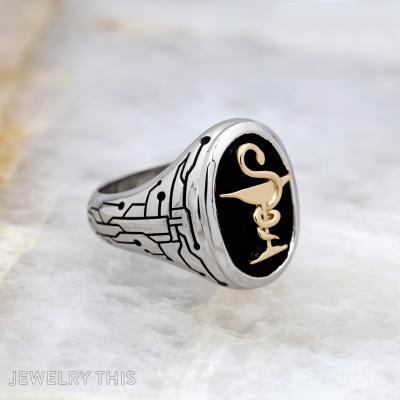


Bowl of Hygeia Signet Ring with Circuit Board Engraving
$$$
14k white gold, yellow gold accent, black onyx
A pharmacist working in information technology wanted a ring that represented both careers at once. He worked through three design rounds — sketch, render, and material choice — landing on a black onyx face with the Bowl of Hygeia in yellow gold and a circuit-board pattern engraved around the band. When he picked it up, he wrote: "It looks great! Thank you so much for everything you did to produce this amazing piece."
'It looks great! Thank you so much for everything you did to produce this amazing piece.' — on delivery
Quick specs
Primary Metal
Secondary Metal
Shape / Cut
Primary Stone
Accent Stones
Design Complexity
Intent: Certainty
Size
Ring size 9.5 US.
How they made it distinctive
-
01
Bowl of Hygeia rendered as a separate riveted piece rather than engraved — creates a raised, dimensional emblem rather than a flat image
-
02
Circuit-board engraving pattern chosen specifically to represent the wearer's work in information technology alongside his pharmacy career
-
03
Two-tone metal combination selected to complement the wearer's existing white-gold wedding band and a pewter family heirloom ring
-
04
Penny-sized signet face chosen as a middle ground between two initially proposed sizes
-
05
Black onyx cut with a center hole specifically to receive the emblem's mounting tube, a technique distinct from standard prong or bezel setting
How you'd make it yours
Center emblem: this piece uses the Bowl of Hygeia; a new commission could use another professional or personal symbol in the same raised, riveted format
Stone: this piece uses black onyx; a new commission could use a different opaque stone such as lapis lazuli or malachite for the cutout setting
Metal: this piece is 14k white gold with a yellow gold emblem; the same two-tone approach works in other metal pairings such as rose and white gold
Band engraving: the circuit-board motif can be replaced with a different pattern relevant to a different profession or interest on a new piece
One of a kind: this exact ring was designed for one client's dual career identity and is not reproduced — a new commission is an original piece inspired by this one, not a copy
Design changes made
The client chose the black onyx version over a plain raised-metal option after asking how the stone-setting would work, then selected a two-tone finish — black enamel band details with a yellow gold Bowl of Hygeia — over an all-white-gold alternative shown in the render.
Who this is for
This piece is for someone whose sense of identity spans more than one world and wants a single object that holds both without diminishing either. It suits someone who thinks carefully through design decisions and wants a ring substantial enough to read as a signet, not a subtle accent piece.
How it's made
Once the design was approved, a wax model was produced on a 3D printer and shared with the client as a resin preview before any metal was committed. The resin was then invested in plaster and fired in a kiln to burn out the model, leaving a hollow mold. Molten 14k white gold was cast into the mold under pressure to form the raw ring, which was then cleaned, extracted from its tree, and prepared for finishing.
A black onyx piece was sourced and cut with a center hole to fit the ring face, then set into the band. The circuit-board pattern engraved into the band was filled with black enamel to make the lines stand out against the polished white gold. The Bowl of Hygeia was cast separately in 14k yellow gold with a tube extending from its back, passed through the hole in the onyx, and riveted into place on the underside of the ring.
Key note
The Bowl of Hygeia is not set into the onyx at all — it's a separate yellow gold piece with a tube on the back that passes through a hole cut in the stone and is riveted flat against the underside of the ring.
Pricing guidance
A two-metal signet ring with a cut stone and a hand-set dimensional emblem sits toward the higher end for custom signet work. Most of the cost comes from the labor of sourcing and cutting the onyx to fit, casting and riveting a separate emblem piece, and hand-filling the engraved band pattern with enamel. Metal choice and the complexity of the engraving are the biggest levers on price from there.
Moves price up ↑
- ↑ Adding gemstone accents around the onyx or within the Bowl of Hygeia detail
- ↑ Upgrading the band metal from 14k to 18k gold
- ↑ Extending the circuit-board engraving to cover more of the band surface
- ↑ Using a larger onyx face and emblem for a bigger overall ring size
- ↑ Adding a third metal tone or additional enamel colors
Moves price down ↓
- ↓ Using a single metal throughout instead of a two-tone white and yellow gold combination
- ↓ Choosing a flat engraved or printed emblem instead of a separate riveted piece
- ↓ Skipping the enamel fill on the circuit-board engraving
- ↓ Using a smaller signet face
- ↓ Substituting the onyx with a lower-cost material such as resin or acrylic
Questions people ask
Black onyx rates about 7 on the Mohs hardness scale, which makes it reasonably durable for daily wear but still softer than sapphire or diamond. It can chip if struck directly against a hard surface, so it is best suited to a signet-style setting like this one where the stone is protected by a surrounding metal rim. With normal wear it holds its polish and color well for years. It is not recommended for situations involving heavy impact, like manual labor without a protective ring.
The Bowl of Hygeia is a traditional symbol of the pharmacy profession, showing a snake coiled around a cup or bowl. It references Hygeia, the Greek goddess of health, and has been used internationally as a pharmacy emblem for over a century. In custom jewelry, it is a common choice for pharmacists who want a professional identity piece rather than a generic ring design. It can be rendered flat, engraved, or as a raised three-dimensional element depending on the design.
Two-tone gold rings are structurally the same as single-metal rings — the different colors come from the gold alloy composition, not a plating layer, so the color is permanent and will not wear off. Each section is cast or set separately and then joined, which is a standard jewelry technique. Regular cleaning and occasional polishing will keep both tones looking sharp. The white gold portion may need re-rhodium plating every couple of years if it was rhodium finished, while the yellow gold portion needs no such maintenance.
A signet ring combining two metals, a cut stone, engraved detailing filled with enamel, and a separately cast raised emblem sits toward the higher end of custom signet pricing. The primary cost driver is labor — sourcing and shaping the stone, engraving and enamel-filling the band, and casting and riveting the emblem as its own piece. Simpler signet designs in a single metal without a separate raised element cost meaningfully less.
The full process typically runs about five to six weeks from approved design to delivery. The first week covers sketch and 3D render approval, and production takes roughly four to five weeks after that, covering wax modeling, casting, stone sourcing and fitting, engraving, enamel work, and final assembly of the raised emblem. Complex two-metal pieces with a separately set emblem tend to fall on the longer end of that range because of the additional assembly step.
Yes, a circuit-board style pattern can be engraved into a metal band and filled with enamel to make the lines and nodes stand out clearly against the polished metal. This kind of detailed line engraving works well on a wider band, since there needs to be enough surface area for the pattern to read clearly. The engraving is typically done after casting and before the final polish, so the enamel fill can be cleaned flush with the surrounding metal.
Yes, a new ring can be designed with the same metal tones, finish, or design language as pieces you already wear so they feel cohesive as a set. This might mean matching a white gold base to an existing wedding band, or picking up an accent color used elsewhere. It works best when you can share photos of the existing pieces during the design phase so the team can match undertones and finish accurately.
Yes, stones can be set using methods other than prongs, including bezel settings or a cut-and-rivet method where a shaped piece is passed through a hole in the stone and secured from the underside. This approach works well for flat-faced stones like onyx where a raised emblem or symbol needs to sit directly on the stone's surface. It requires precise cutting of the stone to fit the emblem's tube exactly, which adds a sourcing and fitting step to production.
Explore Similar Creations
Every masterpiece starts with a spark. Explore how our clients raw ideas - sketches, heirlooms, inspirations - were transformed into bespoke works of arts.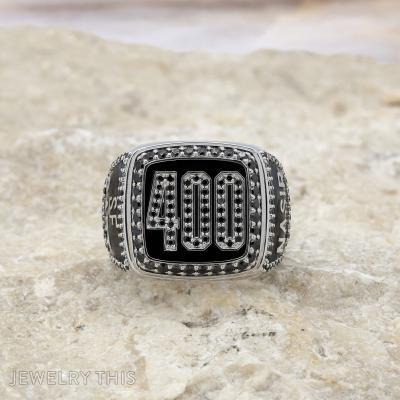
This signet-style ring centers on the number 400 set against a black enamel background and ...
This Sterling Silver ring is perfect for the individual who wants to show off their ...

This large-format signet ring turns a smoke shop’s brand mark into a wearable piece, with ...

Sterling silver ring with geometric design. Rose gold plated top with silver accents. Personalized engraving ...

Crafted as a tribute to the writer’s legacy, our custom signet ring encapsulates the essence ...


This ring harmoniously blends bold design with personalized symbolism. Crafted from black rhodium plated silver, ...
This is a men’s wedding band built around a signet-ring silhouette: an oval face with ...

Custom made sterling silver ring featuring a family name, symbolic detailing and colored enamel.


This custom 14k yellow gold signet style ring is a beautiful replica of an original ...