

Signet-Style Wedding Band with Horizontal Marquise Diamond
$$$
10k white gold, lab-grown diamond
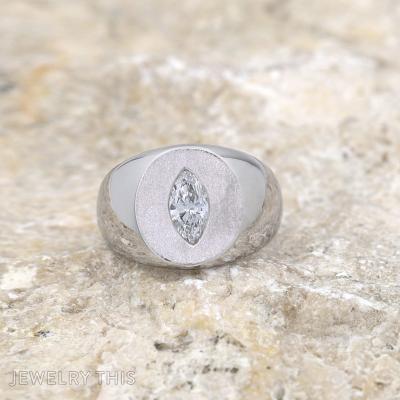
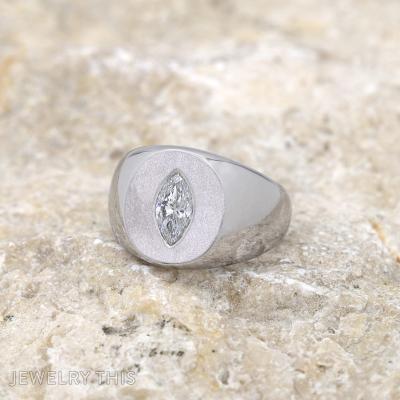
A groom wanted his wedding band to feel connected to his partner's engagement ring without being a direct match — something bold and masculine that still read as part of the same set. After an early design didn't feel like the right fit in person, he found the direction in a signet-style silhouette: an oval face, a flush-set marquise diamond, and a taper toward the back for comfort. When it arrived, he wrote: 'It looks AMAZING! Exactly my vision.'
'The model is perfect, we both absolutely love it.' — on trying the second resin fit model
'It looks AMAZING! Exactly my vision.' — on delivery
Quick specs
Primary Metal
Shape / Cut
Primary Stone
Accent Stones
Design Complexity
Intent: Certainty
Size
Ring size 9 US (18.95mm). Face 11x16mm oval, tapering to 5mm at the back.
How they made it distinctive
-
01
Signet-ring silhouette reimagined as a wedding band — an oval face rather than a traditional round or square signet top
-
02
Marquise diamond set flush into a bezel so the pointed tips are fully protected during daily wear
-
03
Matte-textured face paired with a polished shank, so the two finishes visually separate the focal point from the rest of the band
-
04
Taper toward the back of the band for a more comfortable, lower-profile fit on the hand
-
05
Designed as a deliberate visual pair to a partner's engagement ring without duplicating its design outright
How you'd make it yours
Stone shape: this piece uses a marquise diamond; a new commission could use an oval, pear, or round stone in the same flush bezel setting
Metal: this piece is 10k white gold; the same design language works in 14k white gold, yellow gold, or rose gold
Face shape: this piece uses an 11x16mm oval; a new commission could use a rounder or more elongated face depending on hand size
Finish: this piece pairs a matte face with a polished shank; a new commission could reverse this or use a fully brushed or fully polished finish
Underside: this piece has a plain hollowed-out underside for weight reduction; a new commission could add a decorative pattern for a higher-labor variation
One of a kind: this exact ring was designed for one client's hand and proportions and is not reproduced — a new commission is an original piece inspired by this one, not a copy
Design changes made
The design shifted from an early floating-solitaire concept with a hollowed-out band to a solid signet-style ring with an oval face after the first resin model felt too delicate and narrow in person. The oval face proportions were also refined multiple times — from a smaller round shape to an 11x16mm oval — to better balance boldness with fit on the hand.
Who this is for
This piece is for someone who wants a wedding band with real presence — bold, masculine, and a little unconventional — without abandoning the idea of pairing with a partner's ring. It's especially right for anyone who has a strong, specific vision they're still learning to put into words, and who values getting the proportions exactly right over settling for the first version that's close enough.
How it's made
Once the design was approved, a resin model was 3D printed and mailed to the client so he could confirm proportions and fit on his own hand before any metal was committed — a step used twice in this project as the design evolved. After sign-off, the model moved to production: a wax version was arranged on a casting tree, invested in plaster, and fired in a kiln to burn out the wax. Molten 10k white gold was then cast into the resulting mold to form the raw ring.
After casting, the ring was cleaned up and finished in two distinct zones: the flat oval face was given a matte texture to set it apart visually from the rest of the ring, while the shank was brought to a high polish. The marquise lab-grown diamond was then bezel-set into the oval face, sitting flush with the surrounding metal so the stone has no raised edges to catch on daily wear.
Key note
The oval face and the polished shank were deliberately finished in two different textures — matte and polished — so the flush-set diamond reads as its own focal element rather than blending into the rest of the band.
Pricing guidance
A signet-style men's wedding band with a custom oval face and a bezel-set fancy-shaped diamond sits in the mid range for custom bands of this complexity. Most of the cost comes from the labor of iterating a fully custom shape through multiple 3D models and resin fit tests, rather than from the diamond itself. Metal choice and face size are the two variables that move the price most from there.
Moves price up ↑
- ↑ Increasing the oval face dimensions beyond 11x16mm, which requires more metal and more hand-finishing on the matte texture
- ↑ Upgrading from 10k to 14k or 18k white gold
- ↑ Choosing a larger center diamond, which also affects the bezel dimensions
- ↑ Adding a hollowed-out underside with a decorative pattern rather than a plain hollow
- ↑ Requesting additional rounds of resin models to fine-tune proportions
Moves price down ↓
- ↓ Using a smaller, simpler oval face rather than a fully custom elongated shape
- ↓ Choosing a round diamond instead of a fancy marquise cut, which simplifies the bezel setting
- ↓ Selecting a lighter metal like sterling silver in place of white gold
- ↓ Reducing the band taper detail and keeping a uniform width throughout
- ↓ Skipping the hollowed-out underside and keeping the band solid
Questions people ask
Yes. A bezel setting wraps a continuous rim of metal around the stone's girdle, which is actually one of the most secure ways to hold a pointed shape like a marquise. The pointed tips of a marquise are the most vulnerable part of the stone, and the bezel's continuous metal wall protects them from chips and snags far better than prongs would. This setting style also sits flush with the surrounding surface, which reduces the chance of catching on clothing or gloves during daily wear. It does require precise metalwork to get a clean, even wall around a curved and pointed outline, which is part of what makes this style more labor-intensive to produce.
The main differences are gold content, hardness, and cost. 10k gold contains about 41.7% pure gold compared to 14k's 58.3%, which makes 10k slightly harder and more scratch-resistant but also more brittle. For a flush or bezel-set stone like a marquise, the brittleness of 10k is less of a concern than it would be with prong settings, since there are no thin prongs to risk cracking. 10k is also more budget-friendly than 14k while still being a genuine precious metal, unlike gold-plated alternatives. Either karat will hold up to daily wear, though 14k has a slightly warmer, richer color due to its higher gold content.
A fully custom design like this one, built from scratch rather than a template, typically takes several weeks longer than a standard band because it goes through multiple rounds of digital 3D modeling and physical resin fit tests before production starts. Once the final design is approved, casting and finishing generally takes around four to five weeks. Resin models are often mailed to the client to confirm proportions and comfort on their actual hand, which adds time but significantly reduces the risk of an ill-fitting final piece. Complex custom shapes, like a fully bespoke oval face, take longer to finalize than a standard round or square signet.
A band like this, with a fully custom oval face, a bezel-set fancy-cut diamond, and multiple rounds of design refinement, falls in the mid range for custom work of this complexity. The bulk of the cost is in the labor of iterating the 3D model and resin fit tests, not the diamond, which is a small part of the total. Metal karat and the size of the face are the two factors that most affect where a piece like this lands within that range.
Yes, and this is a common request for a groom's band that pairs with a partner's engagement ring. Rather than copying the engagement ring's design exactly, a shared element — like a matching diamond shape or a complementary silhouette — can tie the two pieces together while keeping each ring's overall look distinct and appropriately scaled for each wearer. This approach lets both rings feel like part of a set without either one reading as a smaller or larger copy of the other. The key is picking one or two visual threads to carry across both designs rather than trying to match everything.
A matte finish will change with wear over time, the same way any finish does on a ring worn daily. Unlike a polished finish, which tends to dull down with wear, a matte or brushed texture typically develops a slight sheen and softens slightly with regular use, giving it a natural, personal patina. It is not more or less durable in terms of scratch resistance than a polished finish on the same metal, but scratches tend to be less visually obvious on a matte surface than on a mirror-polished one. Most wearers find a matte finish requires less frequent re-polishing to look intentional over time.
Yes, hollowing out the underside of a ring's top is a standard technique used to reduce metal weight, particularly on rings with a larger or thicker face like a signet style. This is typically done as a plain hollow rather than an additional decorative pattern underneath, since adding decoration to the hollowed area significantly increases labor and cost. The technique affects the final weight and, in some cases, the price, but has no impact on the durability or appearance of the visible top of the ring. It's a common request for anyone concerned about a larger ring feeling too heavy on the hand.
Yes, lab-grown diamonds are available in the same range of shapes as natural diamonds, including marquise, and are chemically and optically identical to their natural counterparts. The main difference is origin and cost — lab-grown diamonds are typically less expensive than natural diamonds of comparable size and quality. A marquise cut in particular has pointed ends that benefit from a protective setting style like a bezel, regardless of whether the diamond is lab-grown or natural. Choosing lab-grown is a straightforward way to get a larger stone size within a given budget.
Explore Similar Creations
Every masterpiece starts with a spark. Explore how our clients raw ideas - sketches, heirlooms, inspirations - were transformed into bespoke works of arts.

A pair of matching 14k yellow gold signet rings featuring a family crest that includes ...

This classic signet ring is crafted from Yellow gold and features a circular top which ...

This sterling silver signet ring was customized to perfection. The top surface of the ring ...

Bold and refined, this sterling silver signet ring features a striking 15 mm round top ...


This distinctive pair of yellow gold signet-style rings blends personal significance with timeless style. The ...

Custom made sterling silver ring featuring a family name, symbolic detailing and colored enamel.

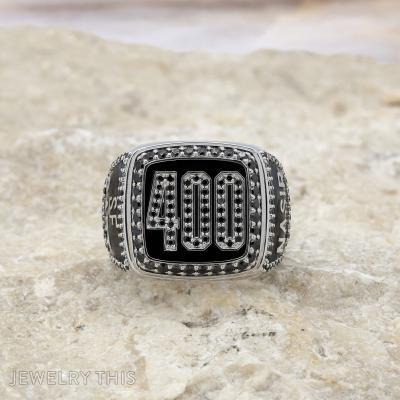
This signet-style ring centers on the number 400 set against a black enamel background and ...
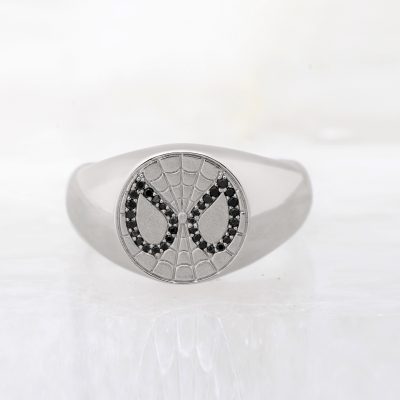
This Sterling Silver ring is perfect for the individual who wants to show off their ...
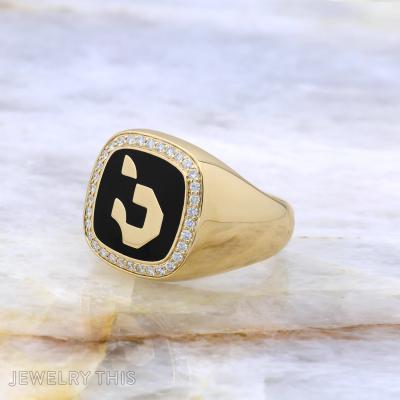
This signet-style ring was designed around a company’s logo, rendered in raised 14k yellow gold ...