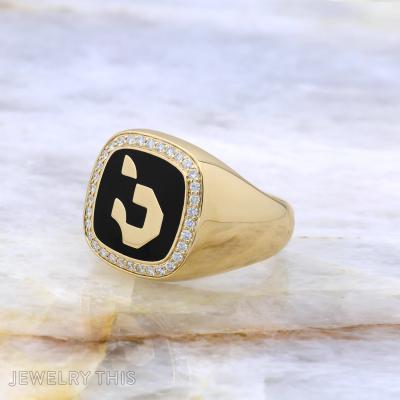
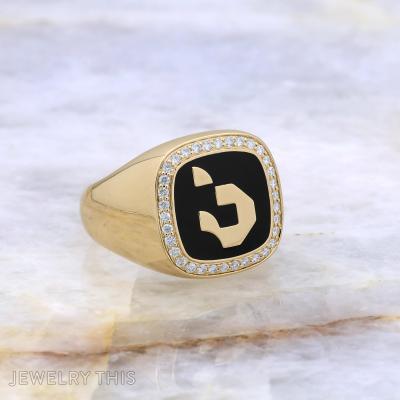
Custom Logo Signet Ring — Gold, Enamel & Diamonds
$$$$
14k yellow gold, black enamel, lab-grown diamonds
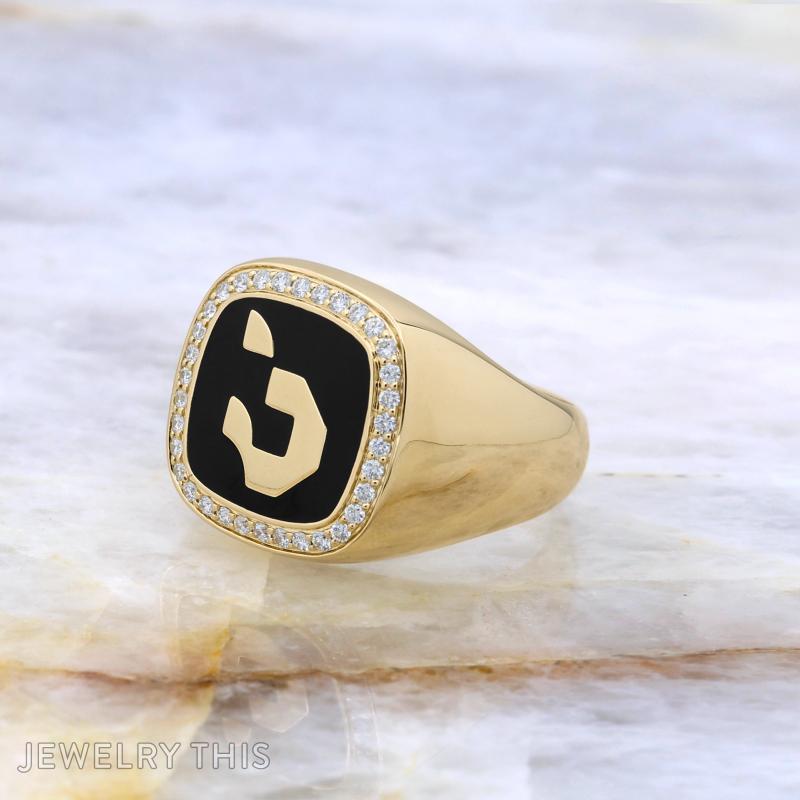
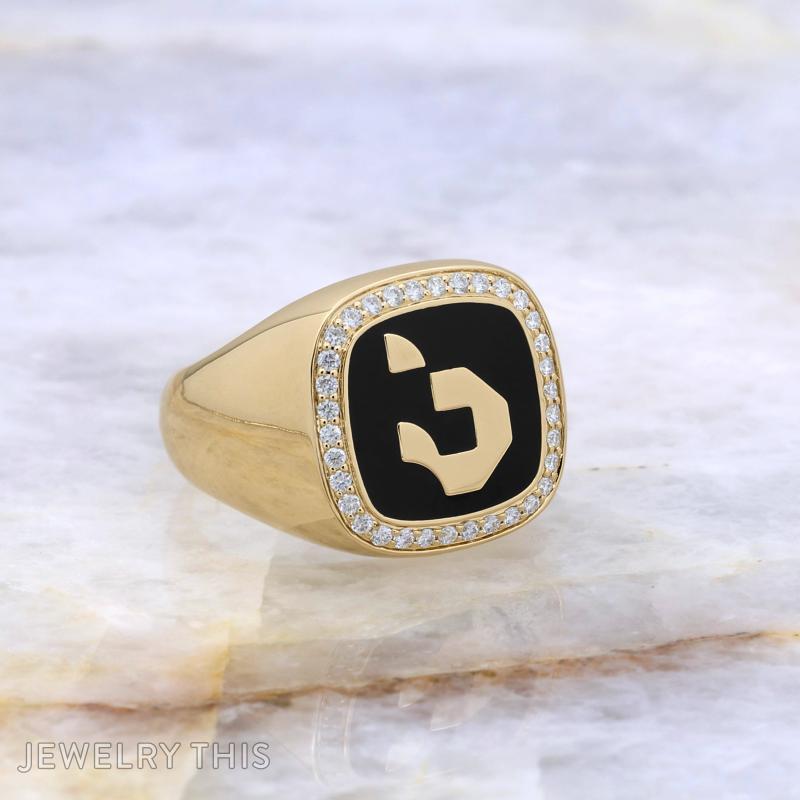
A founder wanted a ring made from his own company's logo to mark a major milestone for the business. He worked through the design over several months — weighing onyx against black enamel, gold against diamonds for the center letter mark, and ultimately deciding to keep the band's shoulders plain rather than repeating the logo. Getting the fit right took real patience, with several resin try-ons before landing on a size that felt secure without being uncomfortable.
Quick specs
Primary Metal
Shape / Cut
Primary Stone
Accent Stones
Design Complexity
Intent: Certainty
Size
Ring size 14 US. Top face approximately 19mm.
How they made it distinctive
-
01
Enamel chosen over onyx specifically because the logo's angular shape would have been extremely difficult to custom-cut in stone
-
02
Plain shoulders selected after the client saw the resin model and decided the repeated logo detail wasn't needed
-
03
Oversized top (19mm) sized to a substantial finger to make the piece a visible, conversation-starting statement piece
-
04
Raised gold logo cast proud of the surface rather than flush, so it reads as a clean silhouette against the black enamel
-
05
Ring size finalized only after multiple resin fit tests to balance security on the finger with everyday comfort
How you'd make it yours
Center motif: this piece uses a raised gold logo — a new commission could set diamonds directly into the center shape instead
Background material: this piece uses black enamel — a new commission could use custom-cut onyx for a natural-stone look
Metal: this piece is 14k yellow gold — the same design language works in 18k gold or white gold
Shoulders: this piece has plain polished shoulders — a new commission could repeat the center motif or add engraving there
Top size: this piece has a substantial 19mm top — a new commission could scale the size up or down to suit the wearer
One of a kind: this exact ring was designed around one company's logo for one client and is not reproduced — a new commission is an original piece inspired by this one, not a copy
Design changes made
The logo motif was removed from both shoulders, leaving the band plain — the client found the repeated side detail unnecessary once he saw it in the resin model. Black enamel replaced onyx as the background material, chosen for durability and a cleaner fit around the logo's angular shape.
Who this is for
This piece is for someone who wants a milestone marker they can wear every day rather than display on a shelf. It's especially right for a founder or business owner who wants their work to show up literally on their hand, in a piece substantial enough to prompt the question, 'what is that?'
How it's made
Once the design was approved in 3D, a resin model was produced and sent to the client to confirm fit and proportions before any metal was committed — a step repeated several times here to dial in the sizing. The approved resin was then grouped onto a wax tree, invested in plaster, and fired in a kiln to burn out the wax, leaving a hollow mold. Molten 14k yellow gold was cast into that mold under pressure, producing the raw ring.
After casting, the piece was cleaned up and the logo's outline was refined by hand to fully separate it from the surrounding field before the black enamel was applied to the recessed background. The band and shoulders were finished to a high polish, left smooth and free of detail. Thirty-four round lab-grown diamonds were then set by hand into the outer frame surrounding the enamel panel, completing the halo.
Key note
The gold letter-mark sits proud of the enamel rather than being painted on — it's cast as a raised element, then the recessed field around it is filled with enamel so the logo reads as a clean silhouette rather than a printed image.
Pricing guidance
A solid gold signet-style ring with an enamel top and a diamond halo sits toward the higher end for custom rings of this scale, largely because of gold weight — a top this size at roughly 19mm requires a substantial amount of metal. Labor for a custom logo shape, the black enamel work, and hand-setting over thirty small diamonds all add to the baseline. Metal choice and top size are the biggest levers on price after that.
Moves price up ↑
- ↑ Increasing the top size beyond 19mm, which adds significant gold weight
- ↑ Upgrading from 14k to 18k gold given the substantial weight of this design
- ↑ Setting diamonds directly into the center logo rather than gold-only
- ↑ Choosing custom-cut onyx instead of enamel, which requires precision stone-cutting labor
- ↑ Adding engraved or enameled detail back onto the shoulders
Moves price down ↓
- ↓ Reducing the top size to lower the overall gold weight
- ↓ Using a lighter-weight band profile
- ↓ Reducing the diamond count in the outer frame
- ↓ Choosing a smaller, simpler logo shape with less hand-finishing
- ↓ Using sterling silver with gold plating instead of solid 14k gold
Questions people ask
Yes, a business logo can be recreated as a raised gold design set against a contrasting background like black enamel or onyx. The logo's outline typically needs to be simplified or cleaned up so it reads clearly at a small scale and so any thin sections aren't fragile once cast. The process starts with a sketch, moves to a 3D model, and then a photorealistic render for approval before anything is cast. Complex logos with fine detail may need adjustments to hold up structurally in metal.
Onyx is a natural stone that has to be custom cut to fit precisely around a design, which is a difficult and labor-intensive process, especially around irregular shapes like a logo. Black enamel is a durable colored material applied directly into a recessed area of the metal, and it can be finished tighter and cleaner around fine details than a cut stone can. Visually, most people can't tell the difference from a normal viewing distance. Enamel is generally the more practical choice for intricate custom shapes.
Lab-grown diamonds are chemically and optically identical to natural diamonds — same hardness, same brilliance, same durability for daily wear. The only real differences are origin and price, with lab-grown typically costing less than a natural diamond of the same size and quality. A ring like this used lab-grown diamonds in VS clarity and F-G color, which is a bright, eye-clean grade. There's no difference in how they wear or how they need to be cared for.
A solid gold signet ring with an enamel top and a diamond-set frame sits toward the higher end for custom rings, driven mainly by the amount of gold used in a larger top design. Labor for cleaning up a custom logo shape and hand-setting dozens of small diamonds around the frame adds to that baseline. Reducing the top size, using a lighter band, or setting fewer diamonds are the main ways to bring the cost down. Metal market prices also affect the final number, since gold weight is a major cost driver.
Standard production once a design is finalized and paid for typically runs three to four weeks from sourcing materials to a finished piece. Before that, the design phase — sketch, 3D model, and render approval — usually takes about a week, though it can take longer if the client wants to test multiple resin models for fit or design changes. Fit adjustments, like trying different ring sizes with physical resin models, can add additional time beyond the standard schedule. Once the design and size are both locked in, production moves fairly quickly.
A solid, substantial ring like this can generally be resized within a limited range, though a design with a wide top and enamel work has more constraints than a plain band. Getting the size right before casting is strongly preferred, which is why resin fit models are used to test comfort and circulation on the actual finger before any metal is committed. Larger tops can feel different on different fingers because of how much space they take up at the base, so testing fit on the specific finger you plan to wear it on matters. Significant resizing after casting risks disturbing the enamel or the stone setting.
A ring with a wide or substantial top takes up more space at the base of the finger than a plain band of the same marked size, so it can feel tighter than expected, especially on the index finger where there's less available real estate. Comfort also depends on where on the hand the ring is worn — fingers vary significantly in width and shape from person to person and hand to hand. This is why trying on a physical resin model before casting is valuable: it lets you test real fit and circulation rather than relying on a size number alone. A ring that fits well on one finger may not fit the same way on another.
Yes, the shoulders of a signet-style ring can be left plain and polished or can carry additional design elements like a repeated motif, engraving, or enamel work. Plain shoulders create a cleaner, less busy look and can also affect how the ring sits against the hand, since less surface detail means fewer raised edges. Some clients choose to repeat a central design element on the shoulders for symmetry, while others prefer the simplicity of a smooth band. This is one of the more flexible elements of a signet design and can be adjusted late in the design process.
Explore Similar Creations
Every masterpiece starts with a spark. Explore how our clients raw ideas - sketches, heirlooms, inspirations - were transformed into bespoke works of arts.
10k yellow gold signet-style ring with round top featuring pierced cross. Top of ring: 15mm

A heartfelt gesture of sisterly love, this petite ring symbolizes their unbreakable bond. Crafted in ...

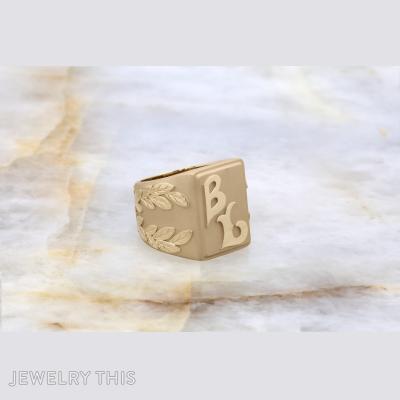
This bold and unique signet ring is a true statement piece, crafted in warm 10k ...

Personalized signet ring featuring enamel filled symbol inlayed into the top of the ring which ...

This 14k yellow gold Harley ring is the perfect personalized accessory for any Harley Davidson ...

This custom ring is a heartfelt recreation of a cherished class ring. Fashioned from gold-plated ...


This ring’s round signet style top features the symbol 朱 (Shu) in stunning detail, against ...

14k white gold men’s wedding ring. Channel set through center with vertically set baguette moissanite ...

This sterling silver signet ring was customized to perfection. The top surface of the ring ...

Sterling silver ring with geometric design. Rose gold plated top with silver accents. Personalized engraving ...