

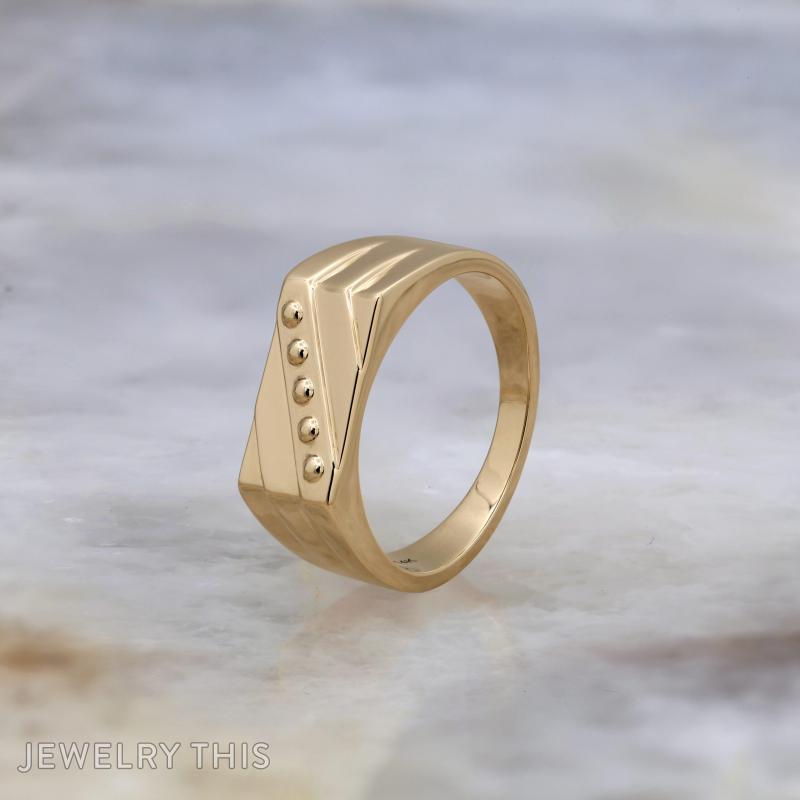


Chunky Gold Signet Ring — Upgraded From a Keepsake Original
$$$
14k yellow gold
A. wanted to turn a plastic ring her son had given her into something she could actually keep and wear. She sent in the original as a physical reference so the proportions and details could be matched closely, and when she saw the render she wrote back: 'Wow love it!!!!'
'Wow love it!!!!' — on seeing the first render
Quick specs
Primary Metal
Primary Stone
Accent Stones
Design Complexity
Intent: Certainty
Size
Ring size 7 US (17.32mm). Top surface width approximately 1/3 inch.
How they made it distinctive
-
01
Modeled directly from the client's own plastic ring sent in as a physical reference, not just photos
-
02
Diagonal chevron grooves chosen to mirror the exact line pattern of the original design
-
03
Row of five raised beads recreated individually so each bead reads distinctly rather than as a blurred ridge
-
04
Rendered in solid 14k yellow gold specifically because the client wanted a permanent, non-plated version of a piece she already loved
How you'd make it yours
Karat: this piece is 14k yellow gold — a new commission could use 10k for a softer color at lower material cost, or 18k for a richer tone
Beads: this piece uses solid raised gold beads — a new commission could set small stones in their place
Groove pattern: this piece uses multiple parallel diagonal grooves — a new commission could simplify to a single line or add more
Engraving: the inside or underside of the band can carry a new inscription on a fresh commission
One of a kind: this exact ring was designed to match one client's own reference piece and is not reproduced — a new commission is an original piece inspired by this one, not a copy
Design changes made
Design matched the initial brief without major changes — the team worked directly from the client's physical reference ring to match its proportions and detail.
Who this is for
This piece is for someone who has a beloved but cheaply made item they wish had been made to last. It's especially right if you have a specific design already in hand and want it recreated faithfully in solid gold rather than starting from a blank concept.
How it's made
Once the client's original ring arrived and the design was approved, the team built a 3D CAD model matching its proportions, then printed a wax model of the piece. That wax model was attached to a tree and invested in plaster, which was fired in a kiln to burn out the wax and leave a hollow mold. Molten 14k yellow gold was then cast into the mold under pressure to form the raw ring.
After casting, the ring was cut from the tree, cleaned, and finished. The flat top surface was polished to a high shine, and the diagonal chevron grooves were cleaned up by hand to keep their lines crisp against the polished field. The row of five raised beads was refined individually so each bead reads distinctly rather than blurring into a single ridge, then the whole piece received a final polish pass.
Key note
The ring was built from the client's own plastic original sent in as a physical reference, rather than from photos alone, which is what allowed the proportions of the chevron grooves and bead row to be matched so closely.
Pricing guidance
A solid gold signet-style ring with surface detailing like chevron grooves and a raised bead row sits in the mid range for custom band work. Most of the cost comes from the gold weight in a chunky, rectangular-top design plus the hand-finishing needed to keep the grooves and beads crisp after casting. Karat choice and metal weight are what move the price most from there.
Moves price up ↑
- ↑ Upgrading from 10k to 14k or 18k gold increases material cost significantly at this ring's weight
- ↑ Adding stones to the setting where the beads currently sit
- ↑ Increasing the width or height of the rectangular top, which adds more gold weight
- ↑ Adding engraving to the inside or underside of the band
Moves price down ↓
- ↓ Choosing 10k gold instead of 14k, which is less expensive though a softer yellow color
- ↓ Reducing the width of the top surface to use less metal
- ↓ Simplifying the chevron groove pattern to a single line rather than multiple parallel grooves
- ↓ Removing the raised bead row and keeping the design flat
Questions people ask
Yes. Sending in the original piece as a physical reference lets the design team measure and copy its proportions directly, which produces a closer match than working from photos alone. The team builds a 3D model based on those exact measurements, and you review a photorealistic render before anything is cast. This process works whether the original is plastic, costume metal, or a worn-out precious metal piece.
10k gold contains a lower percentage of pure gold, which makes it more affordable and slightly harder, but it has a noticeably softer, paler yellow color. 14k gold has a richer, more saturated yellow tone and is the more common choice for solid gold rings. Both are durable enough for daily wear. The choice mostly comes down to budget and color preference rather than durability.
A chunky, solid gold ring with surface detailing like grooves or raised texture typically falls in the mid range for custom band work, largely because of the gold weight involved in a wide, rectangular-top design. Karat choice (10k versus 14k or 18k) is one of the biggest levers on price. Hand-finishing to keep engraved lines and raised details crisp after casting also factors into the cost.
Once the original reference piece and deposit are received, the design phase typically takes about a week to produce a render for approval. After the design is approved and moved into production, casting and finishing usually take another three to four weeks. The total timeline from sending in the reference to receiving the finished ring is typically five to six weeks.
The overall design and proportions will match the approved render closely, but the exact color and luster of yellow gold can vary slightly from how it appears on a screen. This is normal across all custom gold pieces and isn't a defect. Lighting and monitor calibration are the biggest factors in how gold appears in a digital render versus in person.
Yes, a row of raised gold beads like the one on this ring could be adapted to hold small stones instead, such as diamonds or colored gemstones, in a new commission. This would change the setting method from solid cast beads to prong or bezel settings sized for each stone. It would also increase the cost due to the added stone-setting labor and the stones themselves.
The standard process is to use the original piece as a reference for measurements and design during the 3D modeling stage. Whether the original piece is returned depends on the specific arrangement made with the design team, so it's worth confirming this detail directly before shipping in a sentimental or borrowed original. It's a good idea to ask about this upfront if keeping the original matters to you.
A solid band ring like this can generally be resized within a reasonable range using standard jewelry resizing techniques, since the design doesn't include a full-coverage stone setting that would restrict stretching or cutting the band. Larger resizing needs may require additional metal to be added rather than simply stretched. It's best to confirm your size as precisely as possible before production to avoid needing a resize later.
Explore Similar Creations
Every masterpiece starts with a spark. Explore how our clients raw ideas - sketches, heirlooms, inspirations - were transformed into bespoke works of arts.
This set of four signet rings recreates a single silver original in solid 24 karat ...

This ring’s round signet style top features the symbol 朱 (Shu) in stunning detail, against ...

10k yellow gold signet-style ring with round top featuring pierced cross. Top of ring: 15mm

This signet-style logo ring combines classic elegance with modern design. The ring features a round ...

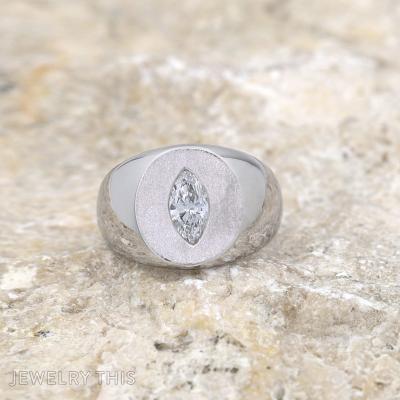
This is a men’s wedding band built around a signet-ring silhouette: an oval face with ...

This signet ring merges two professions into one design: pharmacy and information technology. A black ...

This custom signet boxing ring is crafted in sterling silver and adorned with yellow gold ...

A petite vintage signet ring crafted in 10k yellow gold and set with VS1 diamonds

Sterling silver ring with geometric design. Rose gold plated top with silver accents. Personalized engraving ...

Personalized signet ring featuring enamel filled symbol inlayed into the top of the ring which ...

This exquisite sterling silver signet-like ring features a rectangular shaped bright blue turquoise which has ...



