


Centered Enamel Stripe Wedding Band in White Gold
$$
10k white gold, blue and green enamel
A bride designing her fiance's wedding band wanted something personal that would match her own ring in look and feel. The design went through small, deliberate adjustments — centering the two enamel stripes with space between them, and switching from a grooved edge to a smooth rounded one, until it matched the picture in her head. When it arrived, she wrote that the pricing and service had been the best part of the experience.
'That works! I love it, let's head into production!' — on design approval
'Yes, thank you so much for your quick work and delivery! Your pricing and customer service was the best!' — on delivery
Quick specs
Primary Metal
Primary Stone
Accent Stones
Style
Design Complexity
Intent
Intent: Certainty
Size
Ring size 10 US (19.76mm). Band width 7mm.
How they made it distinctive
-
01
Two enamel stripes deliberately centered with a visible gap between them, per the wearer's specific preference against them touching
-
02
Edge profile changed from grooved to smooth and rounded after the client requested a more comfortable, beveled feel
-
03
Inside engraving kept intentionally simple and legible rather than ornate, per the client's direct request
-
04
10k white gold chosen to coordinate with the client's own wedding ring in matching metal and finish
How you'd make it yours
Metal: this piece is 10k white gold; a new commission could use 14k white gold, sterling silver, or yellow or rose gold
Enamel colors: this piece uses blue and green; a new commission could use any two (or more) colors with the same centered, spaced layout
Band width: this piece is 7mm; a new piece can be made narrower or wider depending on fit preference
Edge profile: this piece has a smooth rounded edge; a new commission could use a grooved, flat, or beveled profile instead
Engraving: the inside of this band carries a short phrase; a new piece can carry a different inscription or font in the same simple, legible style
One of a kind: this exact ring was designed for one client's fiance and is not reproduced — a new commission is an original piece inspired by this one, not a copy
Design changes made
The edge profile was changed from grooved to smooth and rounded after the client requested a beveled look, and the two enamel stripes were centered with a gap between them per her fiance's preference. These were the two meaningful changes from the initial brief.
Who this is for
This piece is for someone who wants a wedding band that carries a private, personal detail without shouting about it — a hidden engraving, a quiet color choice, nothing ornate. It's especially right for a couple who want coordinated but not identical rings, where the meaning is built into the small details rather than the size or flash of the piece.
How it's made
Once the rounded-edge design was approved, the piece was 3D printed in wax and attached to a wax tree inside a flask. The flask was placed in a kiln to burn out the wax, leaving a hollow mold, and molten 10k white gold was poured into that mold under pressure. After cooling, the raw band was removed from the mold and prepared for cleaning and finishing before the enamel and engraving work began.
The band was polished to a bright finish across the rounded profile, and two parallel channels were created to hold the blue and green enamel, each color set in sequence and cured separately so the lines stayed crisp and evenly spaced. The inside of the band was then engraved with the personal inscription in a simple, legible script, finished last so the engraving depth and clarity could be checked against the polished surface.
Key note
The two enamel colors are set and cured in separate steps rather than together, which is what keeps the blue and green lines sharply defined instead of bleeding into each other.
Pricing guidance
A simple enamel-striped wedding band in precious metal sits toward the lower end of custom work of this complexity. Most of the cost comes from the metal choice and the enamel application rather than elaborate shaping, since the design itself is a clean, minimal band. Upgrading the metal karat or adding more design elements is what moves the price from there.
Moves price up ↑
- ↑ Upgrading from sterling silver to 10k, 14k, or 18k white gold
- ↑ Adding a third enamel color or additional stripes
- ↑ Widening the band beyond 7mm, which uses more metal
- ↑ Adding stone accents alongside the enamel stripes
- ↑ Engraving on both the inside and outside of the band
Moves price down ↓
- ↓ Choosing sterling silver with rhodium plating instead of white gold
- ↓ Narrowing the band width to use less metal
- ↓ Reducing to a single enamel color instead of two
- ↓ Skipping the engraving altogether
- ↓ Keeping the edge profile simple rather than adding bevels or grooves
Questions people ask
Enamel used in jewelry like this is a hard, kiln-cured material that resists chipping under normal daily wear, but it is not indestructible. It can chip or crack from a hard direct impact against a sharp edge, similar to how a ceramic coating would react. Most enamel bands hold their color well for years with normal wear and occasional gentle cleaning. If it does chip, the enamel channel can typically be refilled and recured by a jeweler.
Both are gold alloyed with white metals and rhodium plated for a bright white finish, but 10k contains less pure gold (41.7%) compared to 14k (58.3%), which makes 10k slightly harder and more scratch-resistant while 14k has a richer color base under the plating. For a daily-wear band, 10k is a practical, more affordable choice that still holds up well. The main tradeoff is that rhodium plating on either metal will need occasional reapplication over time as it wears, regardless of karat.
Yes, when sterling silver is rhodium plated it has a very similar bright white appearance to white gold. The difference over time is durability and how the plating wears, since silver is a softer base metal than gold alloys. Both metals need the rhodium layer refreshed periodically to maintain that bright white look. Visually, most people cannot tell the difference between rhodium-plated silver and rhodium-plated white gold once finished.
Yes, edge profile is one of the most flexible parts of a band design. A grooved edge has a visible channel cut into the surface, while a beveled or rounded edge creates a smooth, comfort-fit curve across the same band. This kind of change can typically be made during the design phase before production starts, as it affects the 3D model rather than requiring different materials.
The design phase typically takes about a week, during which a 3D render is created and refined based on feedback. Once the design is approved, production takes approximately two to three weeks, covering wax printing, casting, finishing, enamel application, and engraving. Rush timelines can sometimes be accommodated if a specific deadline, like a wedding date, is communicated early in the process.
A band like this sits toward the lower end of custom work, with sterling silver versions costing less than precious metal options like 10k or 14k white gold. The enamel application and metal choice are the primary cost drivers rather than the design complexity, since the stripe pattern itself is simple to produce. Widening the band, adding more colors, or upgrading the metal karat are what typically increase the price from there.
Yes, engraving font and style can be specified during the design process, and most studios can accommodate a simple, easy-to-read script or a more decorative one depending on preference. If you have a specific script style in mind, such as one already used on another piece you own, it's worth mentioning early since matching an exact existing font may or may not be fully achievable depending on the engraving equipment used. The engraving is typically done as one of the final production steps after the metal band itself is finished.
Rhodium plating is applied to white gold and silver to give it a bright white color and to help protect the base metal from tarnishing. It is not strictly necessary for the ring to function, but without it white gold would show more of its natural slightly yellow-grey tone and silver would tarnish faster. Most people find they need the plating refreshed every one to two years with regular daily wear, and it's a straightforward service most jewelers can perform.
Explore Similar Creations
Every masterpiece starts with a spark. Explore how our clients raw ideas - sketches, heirlooms, inspirations - were transformed into bespoke works of arts.
This custom ring is a timeless tribute to family heritage and tradition. Crafted in 14k ...
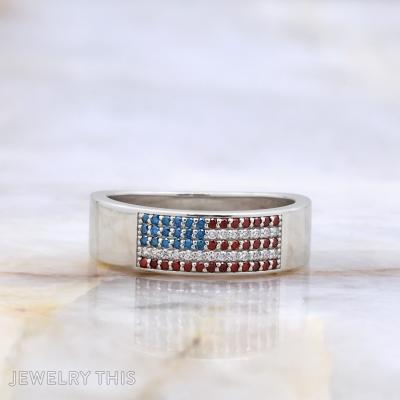
This wide 14k white gold band carries a pave-set American flag across its face, built ...

Crafted for the adventurous soul, this sterling silver ring features a captivating eagle with intricate ...

his personalized signet ring is a symbol of individuality and character. Its square top boasts ...

This men’s wedding band was built to bring back a ring that had been lost ...

This men’s wedding band takes an octagonal, faceted profile rather than a traditional rounded band, ...
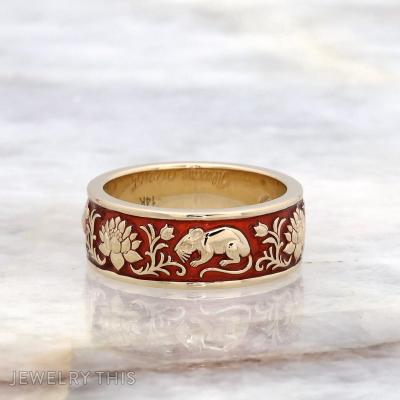
This wide men’s band was built around a Chinese zodiac rat and lotus flower motif, ...
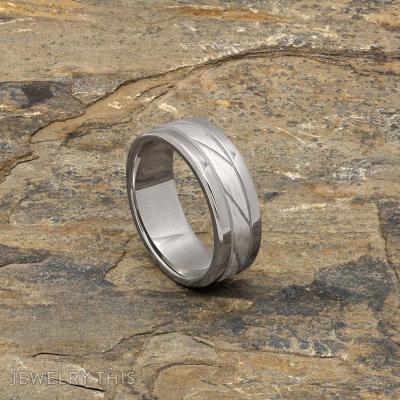
This custom wedding band is a thoughtfully recreated piece, transformed from an alternative metal design ...

This wedding band is a beautifully remade version of a cherished piece that originally symbolized ...

A deeply personal and symbolic expression of love, this wedding band embodies the unique connection ...
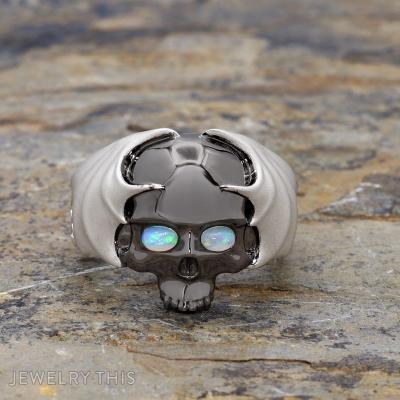
This sterling silver ring centers on a dimensional skull motif finished in black rhodium plating, ...

This 14k yellow gold band recreates a ring originally purchased overseas decades ago and passed ...



