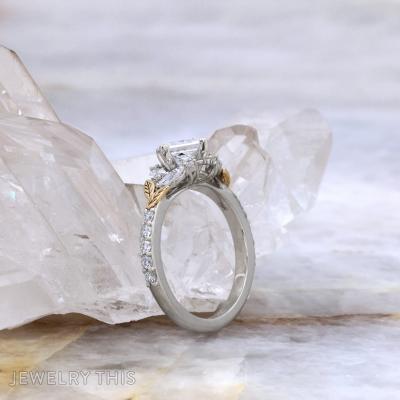
Delicate Princess-Cut Ring With Gold Leaf Accents
$$$
14k white gold, 14k yellow gold, lab diamond, diamonds
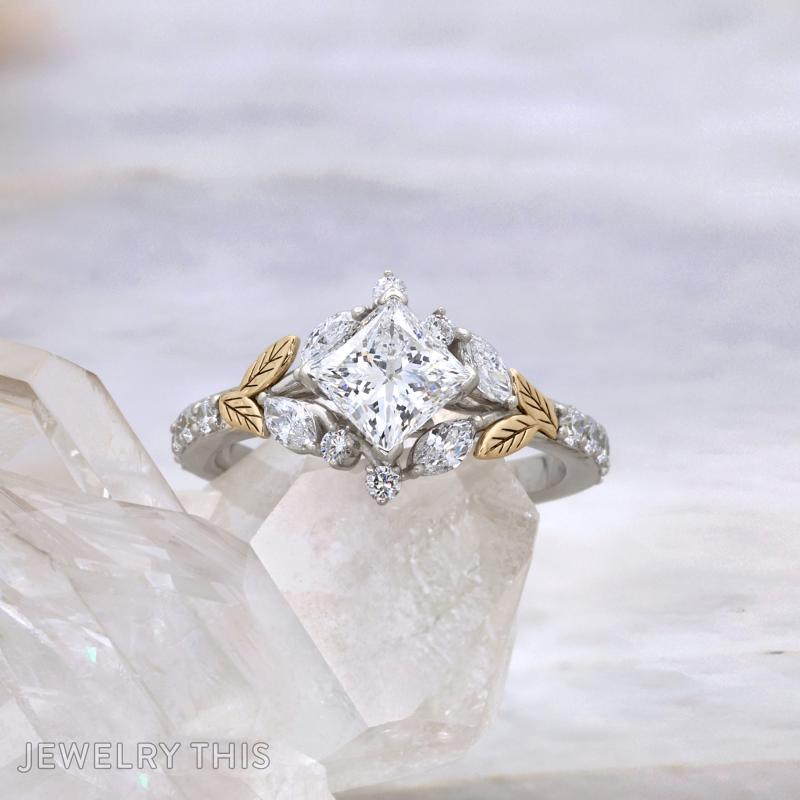
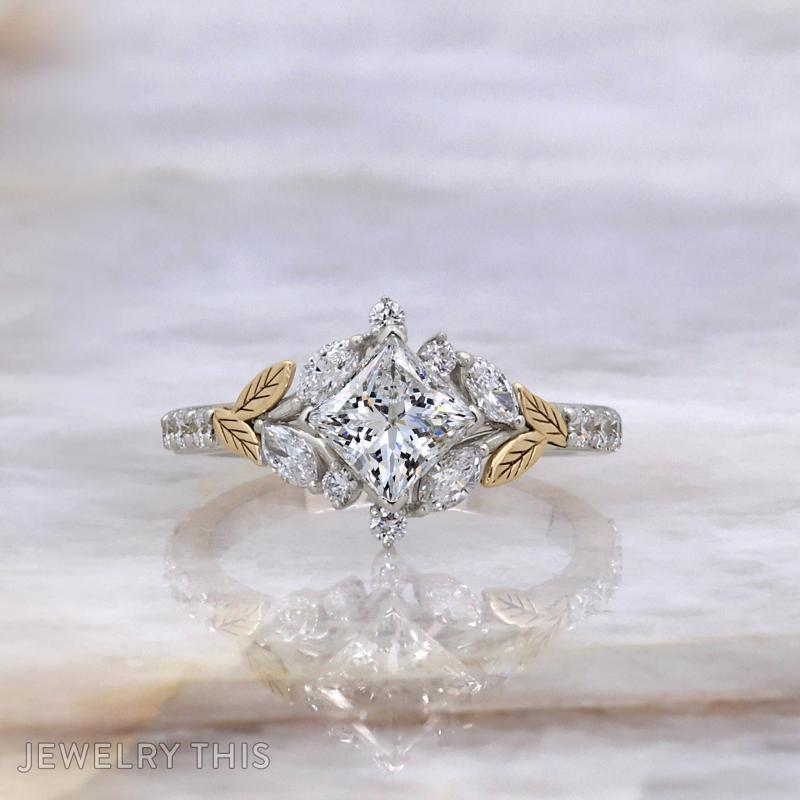
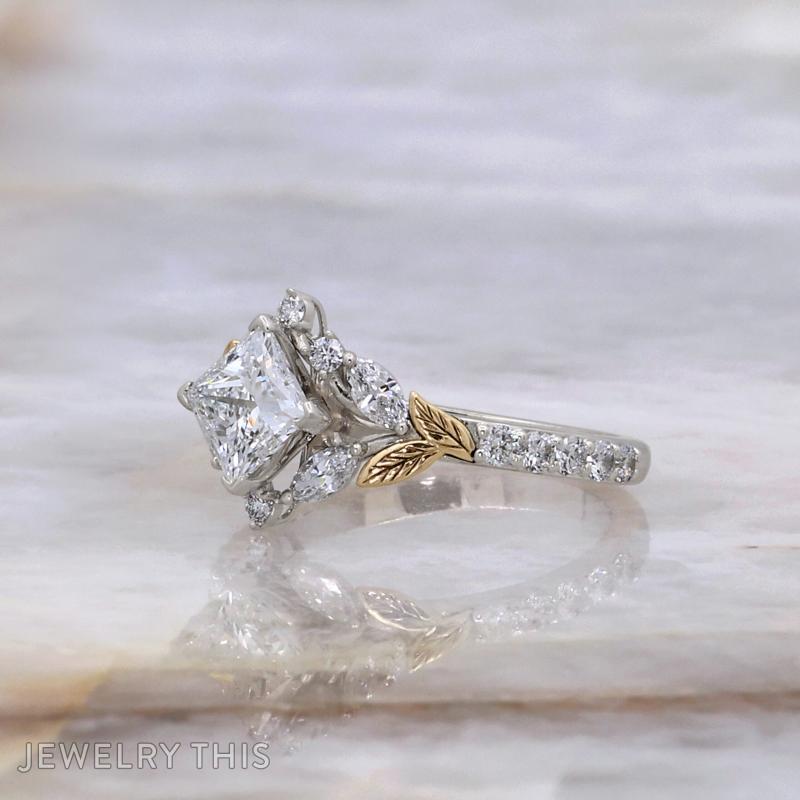
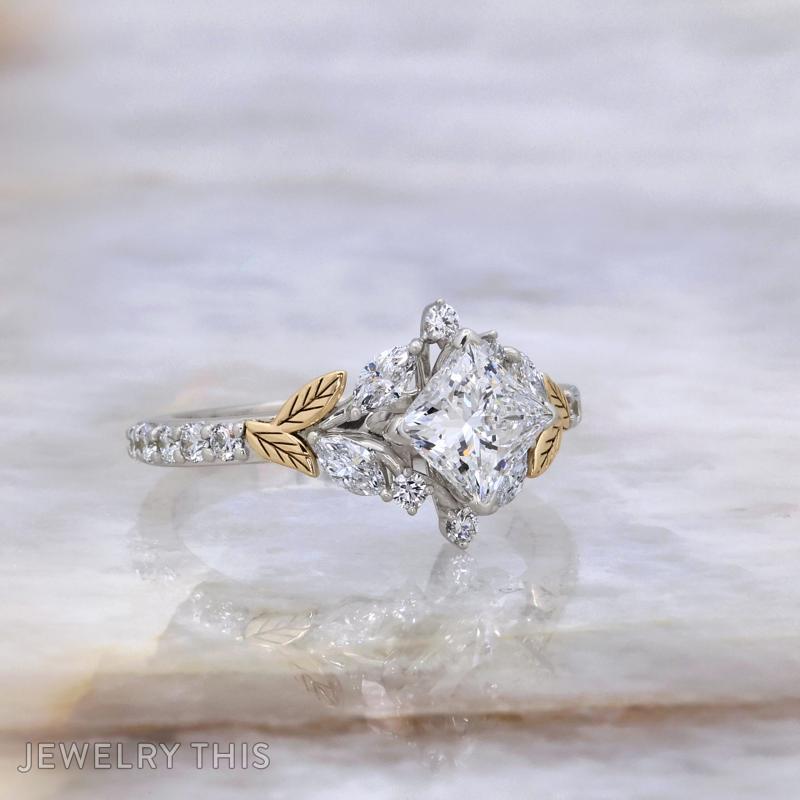
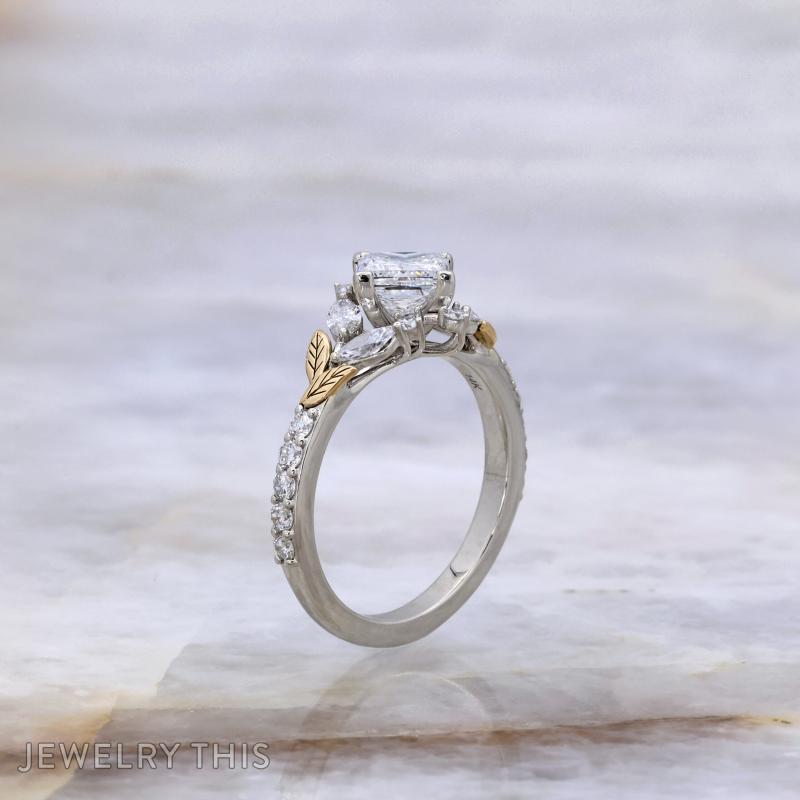
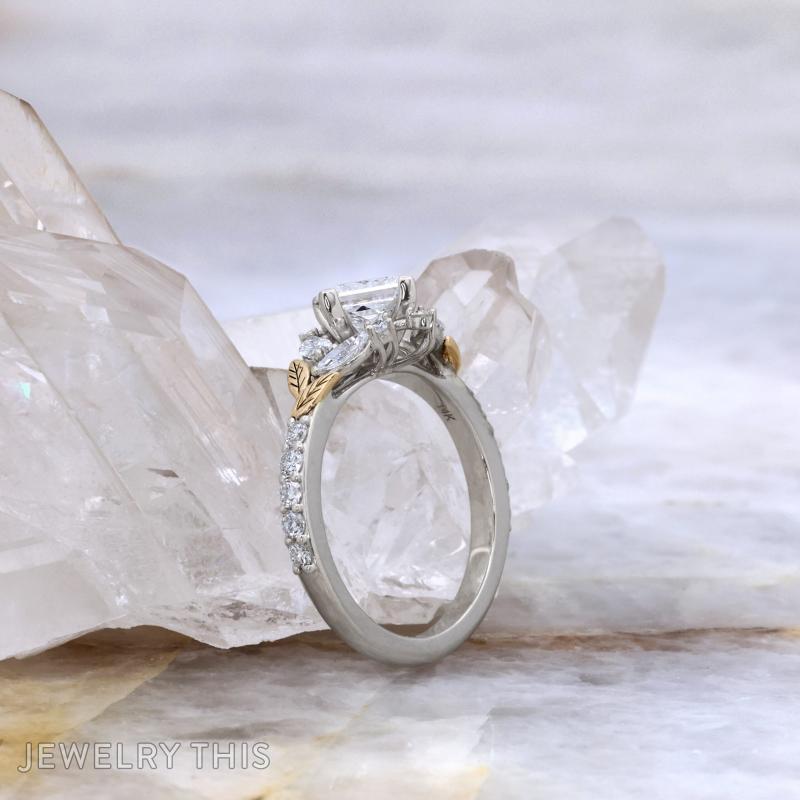
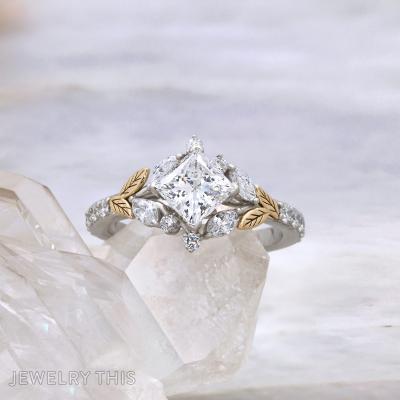
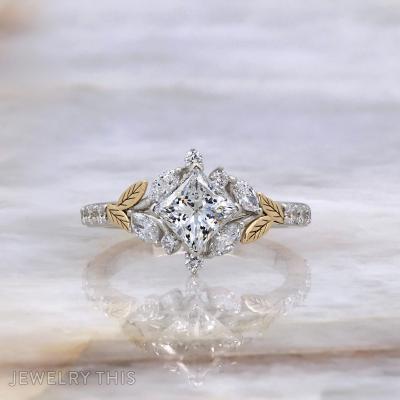
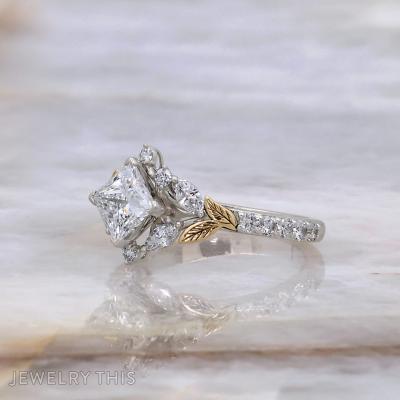
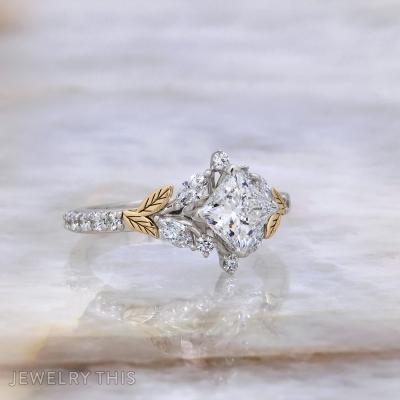
N. and her husband married without rings, and she'd been wearing a placeholder that never felt like hers — the stone too large, the ring "wearing her" instead of the other way around. She wanted something delicate: floral, filigree, pave, a cathedral setting that would hold a smaller stone with room to breathe. Working through several rounds of feedback on leaf placement and stone scatter, the design came together as a princess-cut diamond set on point with gold leaves reaching out from the shoulders. When it arrived, she wrote that it was "beyond gorgeous."
'Wow! I think that looks fabulous and way better than I could ever imagine!' — on seeing the first render
'Thank you so much, I received my ring and its beyond gorgeous!' — on delivery
Quick specs
Design type
Primary Metal
Secondary Metal
Shape / Cut
Primary Stone
Accent Stones
Design Complexity
Intent: Certainty
Size
Ring size 6 US (16.51mm). Band width 2mm at base, wider at shoulders. Center stone 5.54x5.51x3.88mm, 1.01ct.
How they made it distinctive
-
01
Princess cut center stone set on point — rotated for a more elongated silhouette than a standard princess setting
-
02
V-shaped prongs on all four corners specifically requested for added structural security
-
03
Gallery rail added beneath the setting at the client's request, for extra reinforcement under the center stone
-
04
Yellow gold leaves cast as a separate solid piece and assembled onto the white gold band, rather than plated, so the color is permanent
-
05
Leaf placement and stone scatter refined over several rounds of feedback to keep the design delicate rather than busy
-
06
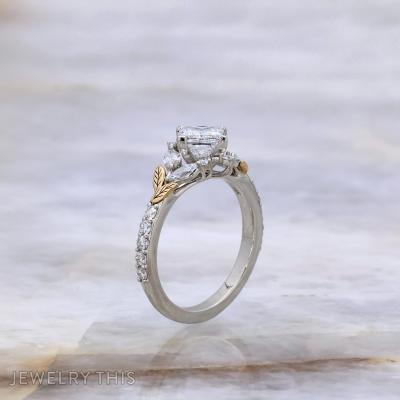
Pave diamonds set only partway down the shank to keep the front of the ring as the visual focus
How you'd make it yours
Stone: this piece uses a lab princess-cut diamond; a new commission could use a natural diamond, moissanite, or a colored stone for a different look
Metal: this piece uses white gold with solid yellow gold leaf accents; the same two-tone approach works in other gold combinations, or could be simplified to one metal
Center stone size: this piece is set at approximately 1 carat; a new piece is sized to the wearer's preference
Pave coverage: this piece has pave partway down the shank; a new commission could extend it fully around or remove it for a plainer band
Engraving: the inside of the band can carry a new inscription on a fresh commission
One of a kind: this exact ring was designed for one client's hand and stone preferences and is not reproduced — a new commission is an original piece inspired by this one, not a copy
Design changes made
The client requested V-shaped prongs on all corners for added structure, then asked for a gallery rail underneath to further reinforce the center stone. She also switched the leaf accents from a single metal to solid yellow gold against a white gold band, which required modeling the leaves as a separate cast piece assembled onto the ring.
Who this is for
This piece is for someone who wants an engagement ring that feels delicate rather than dominant on the hand — a ring that fits naturally instead of overwhelming it. It's especially right if you've tried on rings that felt too heavy or too large and are looking for something with presence but not weight, with nature-inspired details that still read as refined rather than casual.
How it's made
Once the client approved the final render, the design was sent into production and a resin model was 3D printed as the first physical version of the ring, shared with the client for reference before casting. Because the leaves were specified in solid yellow gold rather than plating, they were modeled and cast as a separate piece from the white gold body. Each was invested in plaster, fired to burn out the resin, and cast in its respective 14k gold.
After casting, the white gold body and the yellow gold leaves were cleaned, refined by hand, and assembled together so the leaves extend outward from the shoulders. The princess-cut center stone was set on point using V-shaped prongs at each corner, with a gallery rail added beneath for extra support. The marquise and round accent diamonds were then hand-set around the center, and pave diamonds were set partway down the shank to complete the design.
Key note
The yellow gold leaves were cast as a completely separate piece from the white gold band and then assembled together, rather than plated, so the two-tone color is permanent rather than a surface coating.
Pricing guidance
A two-tone engagement ring with a princess-cut center stone, cathedral setting, and hand-set floral leaf accents sits in the mid range for custom engagement work of this complexity. Most of the added cost comes from the two-piece construction required for solid two-tone metal and the labor of hand-setting the scattered marquise and round accents. Center stone size and diamond origin are the other major variables.
Moves price up ↑
- ↑ Increasing the center stone size beyond 1 carat
- ↑ Choosing a natural diamond center stone instead of lab-grown
- ↑ Extending the pave setting fully around the band instead of halfway
- ↑ Adding more marquise or round accent stones around the center
- ↑ Upgrading the accent diamonds to a higher clarity or color grade
Moves price down ↓
- ↓ Choosing a single metal throughout instead of separately cast two-tone leaves
- ↓ Reducing the center stone size below 1 carat
- ↓ Simplifying the leaf accents to plating rather than solid cast gold
- ↓ Using moissanite in place of a lab diamond center stone
- ↓ Reducing the pave coverage on the band
Questions people ask
A princess cut is a square-shaped diamond, and setting it 'on point' means rotating it 45 degrees so one corner points up rather than a flat edge. This creates a more elongated, diamond-like visual silhouette compared to a standard princess cut setting. It's a deliberate styling choice rather than a different cut of stone. V-shaped prongs are typically used at each corner to protect the vulnerable points of the stone in this orientation.
Yes. Lab-grown and natural diamonds are chemically and structurally identical, both rating a 10 on the Mohs hardness scale, which is the hardest natural material. There is no difference in how they wear, scratch, or hold up to daily use. The only difference is origin — one is grown in a controlled lab environment, the other is mined — and lab diamonds are typically available at a lower cost for the same size and quality.
Yes, two-tone designs are achievable in a few different ways. One option is to cast the entire ring in one metal and then plate certain elements in a second color, which is more affordable but will wear over time. The other option, used on this ring, is to cast the two color elements as separate pieces in solid metal and assemble them together, which is more labor-intensive but permanent. The right approach depends on how much of the design is in the second color and the client's budget.
A cathedral setting refers to a style where the band arches or rises up on either side of the center stone, similar to the arching lines of a cathedral ceiling, before meeting at the stone. It elevates the center stone and creates a more architectural, formal profile compared to a flush or low-set stone. It also provides structural support beneath the center stone. This style pairs well with both simple solitaires and more detailed designs with side accents.
The design phase — sketch, 3D model, and rendering for approval — typically takes about one to two weeks, though a design with unusual requirements like a custom cathedral setting or separately cast two-tone metal can take a bit longer to get right. Once the design is approved and full payment is made, production typically takes another three to five weeks, including sourcing the center stone, casting, and hand-finishing. Total turnaround from first approval to delivery is usually five to eight weeks for a design of this complexity.
A ring with a one-carat lab diamond center stone, cathedral setting, and separately cast two-tone gold leaf accents falls in the mid range for custom engagement rings. The cost is driven primarily by the two-piece metal construction and the hand-setting labor required for the scattered marquise and round accent stones around the center. Choosing a single metal or a smaller center stone would bring the cost down, while a larger or natural diamond would push it up.
Yes, leaf and vine motifs extending from the shoulders of a band work well on many engagement ring styles, not just this specific setting. The key design choice is how far the leaves extend and whether they're solid cast gold or plated onto a single-metal base. Solid cast leaves in a contrasting metal color hold their color permanently, while plated leaves are more affordable but will need re-plating over time.
V-shaped prongs are specifically designed to protect the vulnerable pointed corners of a princess cut diamond, especially when the stone is set on point. Because each V-prong wraps around a corner with two contact points instead of one, they generally distribute pressure more evenly than a single rounded prong would in the same position. Adding a gallery rail beneath the setting, as was done on this ring, provides further structural reinforcement. Overall, this combination is considered a secure setting method for a cornered stone shape.
Check what our clients say about us

Tasha Nicole
1 year ago
Sabrina has been nothing but helpful and so wonderful while designing my ring. I had so many requirements, so many likes and dislikes that I had a hard time peicing together what my ring should even look like. Their design team came back with a stunning design that I instantly fell in love with, no revisions needed to be made! I will absolutely use them for all my future custom jewlery I was so impressed. Thank you Sabrina and team for making my dream wedding/engagement ring come true.
Explore Similar Creations
Every masterpiece starts with a spark. Explore how our clients raw ideas - sketches, heirlooms, inspirations - were transformed into bespoke works of arts.
This stunning 14k white gold engagement set is the perfect blend of gothic and modern. ...
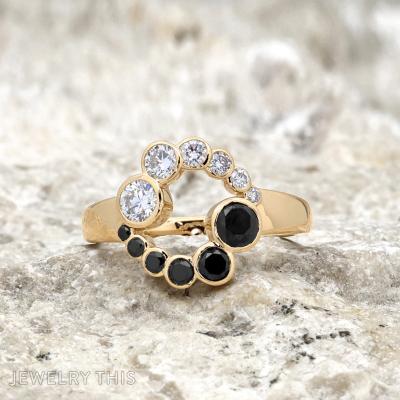
This engagement ring centers on an open circular motif built from seven graduated round stones ...
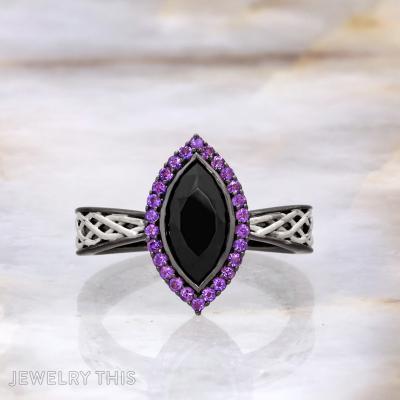
This white gold engagement ring offers a bold and symbolic design, highlighted by the striking ...
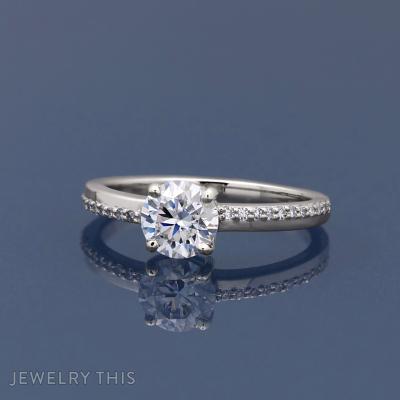
This timeless engagement ring features a brilliant round diamond at its center. The band offers ...
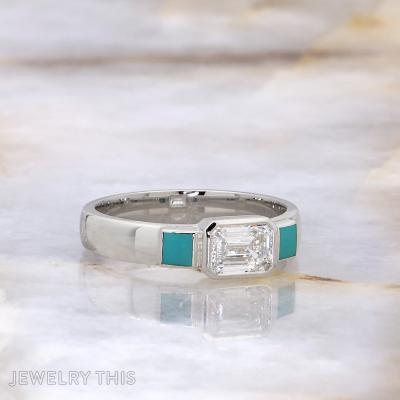
This elegant custom ring beautifully combines a .75 carat emerald cut lab diamond centerpiece with ...

This white gold ring draws you in immediately with the captivating 9 carat rose cut ...
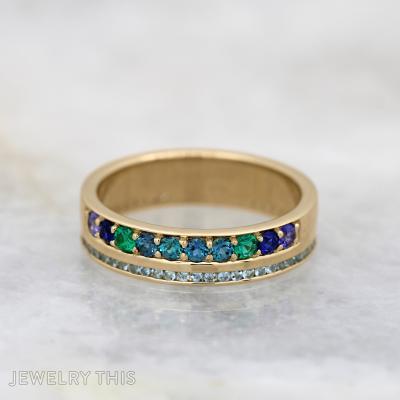
This stunning yellow-gold ring features two dazzling rows of stones. The top row showcases an ...

This custom wedding set is a celebration of everlasting love and elegance. The engagement ring ...

This extraordinary Yellow gold ring features a breathtaking 1 carat Round Moissanite stone set at ...

This beautiful 14karat Yellow gold wedding set is a stunning recreation of the original. The ...
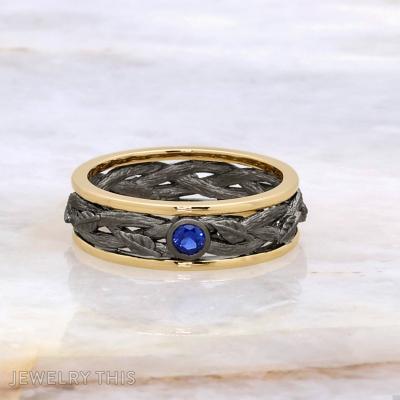
This engagement ring combines a dark, textured center band with two polished 14k yellow gold ...
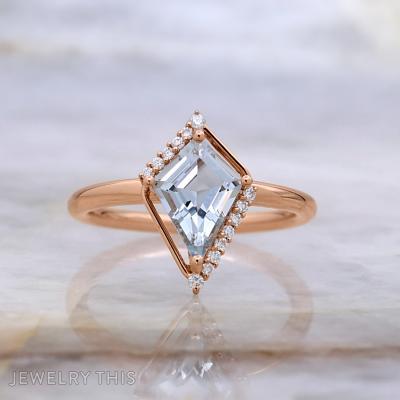
This engagement ring began with a client designing her own piece around a stone she ...