Kite-Cut Aquamarine Engagement Ring in Rose Gold
$$$
14k rose gold, natural aquamarine, lab-grown diamonds
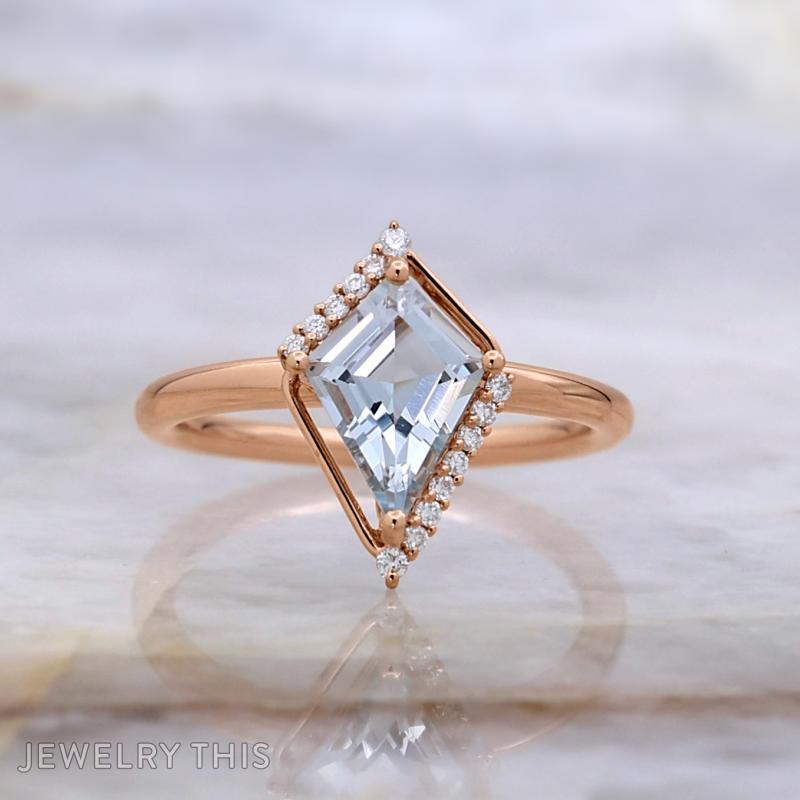
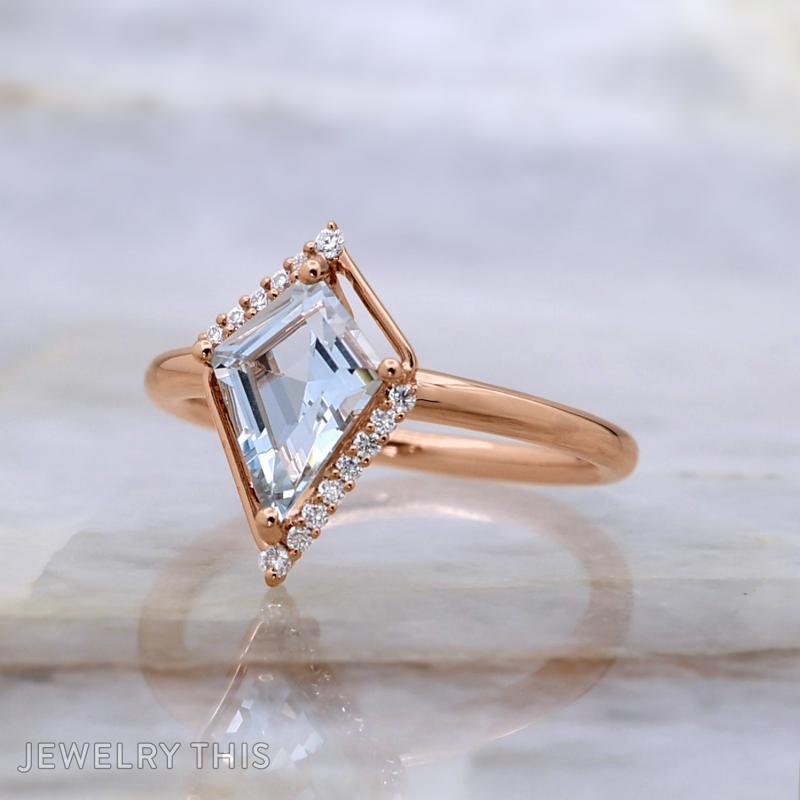
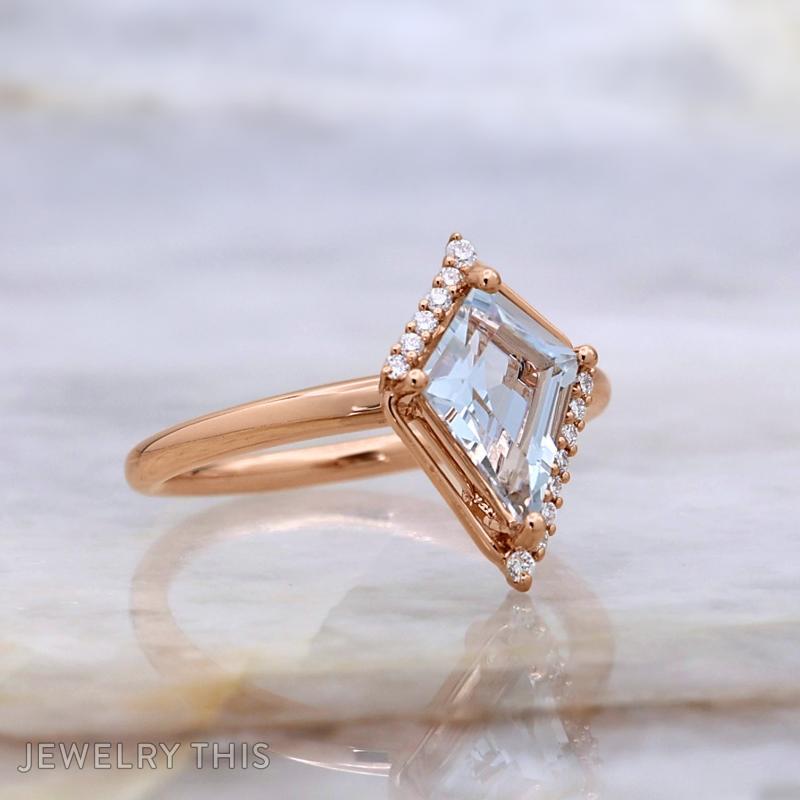
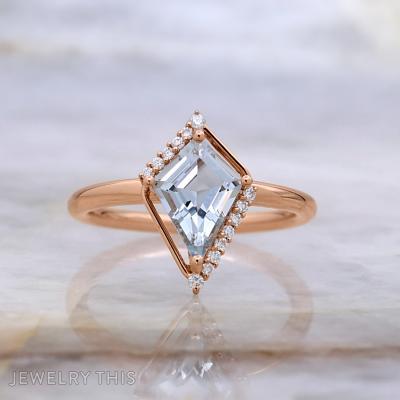
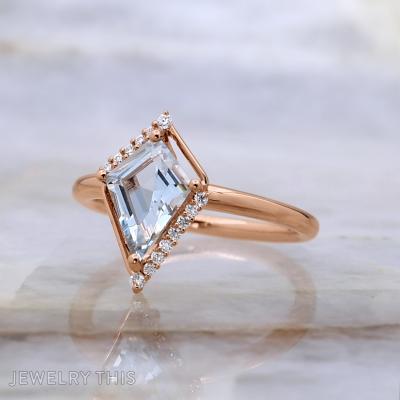
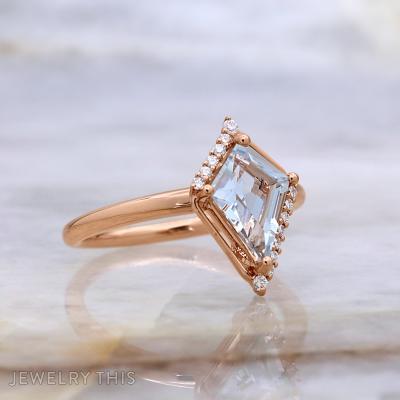
K. designed this engagement ring for herself, drawn to the kite-cut aquamarine simply for its color and uncommon shape rather than any birthstone meaning. Through the design process the metal moved from yellow to rose gold, the setting shifted from bezel to open prongs, and the diamond accents were rebuilt into a partial halo along two edges of the stone. When it arrived, she wrote: "it's absolutely beautiful!! i am soo in love with it!!"
'that looks so beautiful! i love it! thank you so much!' — on seeing the final revised render
"it's absolutely beautiful!! i am soo in love with it!! thank you so much!!" — on delivery
Quick specs
Design type
Primary Metal
Shape / Cut
Primary Stone
Accent Stones
Style
Design Complexity
Intent: Certainty
Size
Ring size 5½ US (16.1mm). Center stone 10×7.25mm kite cut.
How they made it distinctive
-
01
Kite-cut aquamarine chosen purely for its color and uncommon shape rather than birthstone significance or tradition
-
02
Partial diamond halo traces only the upper-left and lower-right edges of the stone, keeping the design asymmetrical and modern rather than fully framed
-
03
Band simplified to a single plain shank specifically to balance the added diamond accents without feeling busy
-
04
Open prong setting selected over a protective bezel so more light passes through the aquamarine
-
05
Rose gold chosen after reviewing yellow gold and white gold renders side by side
How you'd make it yours
Stone: this piece uses a kite-cut aquamarine; a new commission could use a different fancy cut like pear or marquise, or a different colored gem entirely
Metal: this piece is 14k rose gold; the same asymmetrical halo design works well in yellow or white gold
Halo coverage: this piece uses a partial two-edge halo; a new piece could extend the diamonds fully around the stone for more sparkle
Setting style: this piece uses open prongs; a bezel setting is available for a new commission for more stone protection
One of a kind: this exact ring was designed for one client and is not reproduced — a new commission is an original piece inspired by this one, not a copy
Design changes made
The metal was changed from yellow gold to rose gold after the client saw the first render, and the diamond accents were redesigned from two simple side stones into a partial halo along two edges of the stone, which required simplifying the band from a tri-band to a single plain shank. The setting was also changed from a full bezel to open prongs at the client's preference.
Who this is for
This ring is for someone designing her own engagement ring who wants a stone chosen purely because she loves it, not because tradition says so. It's especially right if you're drawn to fancy-cut colored stones and asymmetrical, modern framing over a classic round diamond solitaire, and you want to be closely involved in refining details like metal tone and setting style along the way.
How it's made
Once the final rose gold design with the partial diamond halo was approved, the piece moved into production with a design quality check to confirm every detail matched the approved render, alongside sourcing and confirming the aquamarine and diamond melee. A wax model was then built and connected to a wax tree, which was invested in plaster and fired in a kiln to burn out the wax entirely, leaving a hollow mold ready for casting.
Molten 14k rose gold was cast into the mold to form the ring in one piece, including the open prong basket for the kite-cut stone. After casting, the band was cleaned up and polished to its final shine, and the small round diamonds were hand-set in prongs along the upper-left and lower-right edges of the stone. The aquamarine was then set last, secured with prongs at its top and bottom points so the open sides let light pass through the stone.
Key note
The diamond halo was deliberately built along only two edges of the kite rather than fully surrounding it, so the setting reads as a halo from the front while keeping the band simple and low-profile.
Pricing guidance
A rose gold engagement ring with a fancy-cut colored center stone and a partial diamond halo sits in the mid range for custom engagement work of this complexity. The kite cut itself adds cost, since fancy-shaped stones require a custom-built prong basket rather than a standard round setting. Diamond accent count and metal karat are the next biggest levers on price.
Moves price up ↑
- ↑ Adding diamonds to fully encircle the stone rather than a partial two-edge halo
- ↑ Increasing the center stone size beyond 10mm length
- ↑ Upgrading the accent diamonds to a higher clarity or larger size
- ↑ Choosing platinum instead of 14k gold for the band
- ↑ Adding a matching wedding band designed to nest against the halo
Moves price down ↓
- ↓ Using a simpler round or oval stone shape instead of a custom kite cut
- ↓ Removing the diamond halo entirely for a plain prong solitaire
- ↓ Choosing a smaller center stone length
- ↓ Selecting lab-created diamonds already used here versus natural diamonds
- ↓ Simplifying to a full bezel setting, which uses less metal for a basket than prongs
Questions people ask
Aquamarine rates 7.5 to 8 on the Mohs hardness scale, which is durable enough for daily wear in an engagement ring, though it is softer than sapphire or diamond. A prong or bezel setting that protects the edges of the stone reduces the risk of chips from accidental knocks. Most aquamarine engagement rings hold up well for years with normal care, though it's wise to remove it before heavy manual work. Regular cleaning with mild soap and water is all that's typically needed to keep it looking clear and bright.
A kite cut is a four-sided elongated shape that's wider in the middle and comes to points at the top and bottom, distinct from a marquise (which curves on both sides) or a pear (curved on one end, pointed on the other). It's a less common shape that produces a distinctly geometric, modern look compared to round or oval stones. Kite cuts require a custom-built prong setting rather than a standard round setting, since the four straight edges and points need their own support structure. This makes them a bit more involved to set than a round stone but gives the ring a more distinctive silhouette.
Yes, a partial halo — diamonds tracing only one or two edges of the center stone rather than the entire perimeter — is a design choice that keeps the ring feeling lighter and less busy than a full halo. It also allows the band to stay simple, since a full halo often calls for a more elaborate shank to balance the design. The trade-off is that a partial halo draws the eye to specific edges of the stone rather than framing it evenly all around. This is a completely customizable choice depending on the stone shape and how much sparkle you want.
A custom engagement ring with a fancy-cut aquamarine center stone, diamond accents, and 14k gold sits in the mid range for custom engagement work. The cost is driven mainly by the custom prong basket required for a non-standard stone shape, plus the diamond accent count and metal karat. Simplifying the stone shape to round or oval, or reducing the diamond accents, are the most direct ways to bring the cost down.
The full process typically runs about five to six weeks from deposit to delivery: roughly one week for the design phase, including a render for approval, followed by four to five weeks of production. Design revisions, like changing metal color or adjusting a diamond layout, are done within that first design week before any metal is cast. Once the design is approved and production begins, the sourcing, casting, and stone-setting stages proceed in sequence. Rings with fancy-cut center stones may take slightly longer if the setting requires a custom-built basket.
Yes, metal color changes are a normal part of the design review stage and can be made before the design is finalized and moved to production. It's common for clients to request a rose gold or white gold render after initially choosing yellow gold, since color can look different in a render than expected. Each metal color change typically comes with an updated render so you can compare before committing. Once the final render is approved and production begins, the metal choice is locked in.
White gold is generally recommended over sterling silver for an engagement ring with a precious center stone, because silver is a softer metal that wears down faster with daily use and stone-holding prongs can loosen more easily over time. White gold offers more durability for a ring meant to be worn every day while still achieving a bright white metal look. Sterling silver is a reasonable choice for fashion jewelry worn occasionally, but it's not typically recommended for a piece expected to hold a valuable stone long-term. If a white metal look is the goal, white gold or platinum are the more durable choices.
Yes, both bezel and prong settings are options for a kite-cut or other fancy-shaped center stone, and the choice is typically made during the design review stage before production begins. A bezel setting wraps a wall of metal around the stone's edges, offering more protection against chips and knocks. A prong setting uses metal claws to hold the stone while leaving more of it exposed to light, often giving a more open, airy look. The trade-off is largely about protection versus visibility of the stone.
Explore Similar Creations
Every masterpiece starts with a spark. Explore how our clients raw ideas - sketches, heirlooms, inspirations - were transformed into bespoke works of arts.
This yellow gold engagement ring highlights the beauty of simplicity and precision with its refined ...

This vintage-style 14 karat yellow gold engagement ring showcases a horizontally set oval emerald nestled ...

This striking wide yellow gold engagement ring showcases a bold and sophisticated design, centered around ...
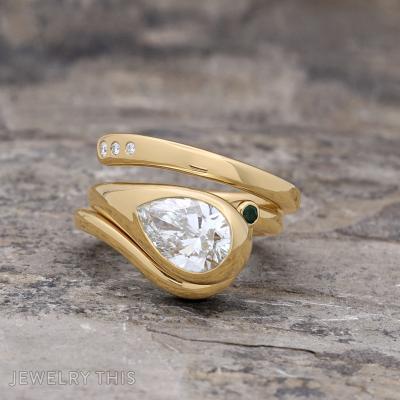
This breathtaking yellow gold wedding set is a masterclass in organic, bypass-style design. The engagement ...
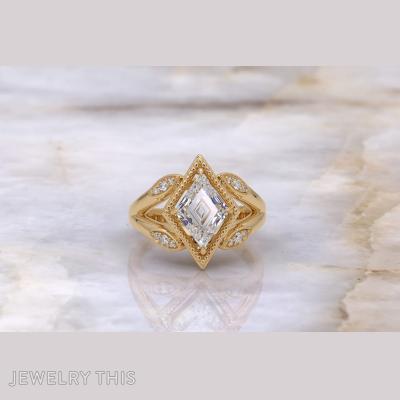
This engagement ring centers a 2.01-carat kite-shaped lab-grown diamond, set in a milgrain-edged bezel that ...
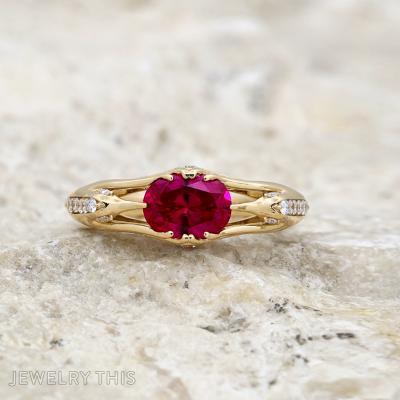
This engagement ring reimagines a hummingbird in flight, with sculpted wing forms wrapping around a ...

Celebrate your unique love story with this exquisite custom wedding set in radiant 14k yellow ...

This stunning rose gold ring features a captivating center oval-shaped opal cabochon that’s perfectly bezel ...
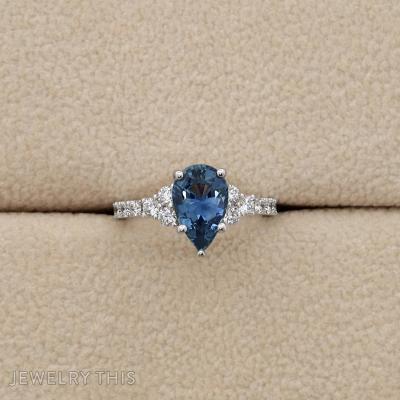
This exquisite white gold engagement ring captures the deep, enchanting beauty of the sea. The ...
This Platinum engagement ring is a testament to the everlasting beauty of love and nature. ...

This Cushion Cut Double Halo Double Diamond Band Engagement Ring is a stunning symbol of ...
This white gold wedding set was lovingly created to replicate an original set that was ...