


Jade Engagement Ring with Dragon Engraving & Family Stones
$$
14k white gold, jade, ruby, opal
M. wanted an engagement ring for his girlfriend built entirely around the people in their life together — a center jade stone for her name, and opal and ruby accents for their two children, Opal and Ruby. He asked for a dragon engraved on the inside of the band, kept simple enough to fit the narrow space available, and reviewed every stone and proportion decision along the way. When he saw the finished engraving before the center stone was set, he wrote back that it looked awesome — and after delivery, he called the finished ring absolutely beautiful.
'I think it looks incredible! I can't wait for the finished piece.' — on seeing the first render
'It's absolutely beautiful' — on delivery
Quick specs
Design type
Primary Metal
Shape / Cut
Primary Stone
Accent Stones
Design Complexity
Intent: Certainty
Size
Ring size 7 US (17.32mm). Band width approximately 2-2.5mm at top, widened on lower half for engraving clearance.
How they made it distinctive
-
01
Center jade stone chosen specifically to represent the names of the people in the client's life, not for its appearance alone
-
02
Opal and ruby accents selected to represent the couple's two children by name, despite opal's fragility requiring extra care
-
03
Dragon engraving placed on the interior of the band so the meaning stays private to the wearer
-
04
Band widened on the lower half specifically to leave enough surface for the engraving without crowding the design
-
05
White gold chosen over the originally requested silver after a durability conversation, since the fine stone settings needed a harder metal
How you'd make it yours
Center stone: this piece uses jade; a new commission could use jade in a different cut, or a different colored stone such as sapphire or emerald
Accent stones: this piece uses ruby and opal to represent specific people; a new commission could use any combination of birthstones or preferred colors
Metal: this piece is 14k white gold; the same design language works in 18k white gold or platinum
Engraving: the interior motif here is a dragon; a new commission could carry a different symbol, initials, or phrase in the same hidden placement
Band width and stone coverage: this piece keeps stones to the top half with a wider plain lower half; a new commission could extend or reduce stone coverage
One of a kind: this exact ring was designed around one couple's names and children and is not reproduced — a new commission is an original piece inspired by this one, not a copy
Design changes made
The ring was changed from a silver to a white gold band after the designer recommended it for durability on a piece with this much fine detail; the stones were also limited to the top half of the band so the lower half could be widened to leave room for the dragon engraving.
Who this is for
This piece is for someone who wants an engagement ring that looks quiet and uncluttered from a distance but carries real meaning in every detail up close. It's especially right for someone who wants to build a personal story — names, children, a hidden symbol — into a ring without broadcasting it outwardly.
How it's made
Once the design was approved as a photorealistic render, the team moved to a 3D-printed wax model, which was attached to a wax tree and invested in plaster inside a flask. The flask was fired in a kiln to burn out the wax, leaving a hollow mold, and molten 14k white gold was cast into that cavity under pressure to form the raw ring.
After casting, the band was cleaned, polished, and finished before the dragon motif was laser-engraved into the interior surface — completed before the center stone was set, since the narrow band left little room to work around a set stone. The oval jade was then bezel-set at the center, with the ruby and opal accents set by hand into the marquise-shaped clusters stepping down each side of the band.
Key note
The interior dragon engraving was completed before the center jade was bezel-set, since the narrow band geometry left too little clearance to engrave safely around an already-set stone.
Pricing guidance
A moderately detailed engagement ring with a bezel-set center stone, multiple small accent stones, and an interior engraving sits toward the mid range for custom rings of this complexity. Much of the baseline cost comes from the labor of setting several small stones in a fine, low-profile band and executing a detailed interior engraving. Metal choice and the number of accent stones are the biggest levers from there.
Moves price up ↑
- ↑ Upgrading from 14k to 18k white gold
- ↑ Using a larger or higher-grade center jade stone
- ↑ Adding more accent stones or extending them further down the band
- ↑ Switching the opal accents for diamonds, which are easier to set small but cost more per stone
- ↑ Adding a matching engraved detail to the exterior of the band as well as the interior
Moves price down ↓
- ↓ Reducing the number of ruby and opal accent stones
- ↓ Simplifying the dragon engraving to a smaller or less detailed motif
- ↓ Choosing a smaller center jade stone
- ↓ Using cubic zirconia in place of natural ruby accents
- ↓ Widening the stone-free portion of the band to reduce total setting labor
Questions people ask
Jade is a relatively tough stone, generally ranking around 6 to 7 on the Mohs hardness scale, which makes it reasonably suited to daily wear. It's more prone to chipping on a hard impact than a diamond or sapphire would be, since its toughness comes from its fibrous structure rather than raw hardness. A bezel setting, like the one used here, protects the stone's edges better than prongs would. With normal care, a bezel-set jade center stone holds up well in an engagement ring worn daily.
Opals are softer than most ring stones, typically around 5 to 6.5 on the Mohs scale, so they can chip or crack more easily than a diamond or ruby. In small accent sizes set into a protective shape, like the marquise clusters on this ring, the risk is lower than with a large exposed opal. Most jewelers recommend removing opal jewelry before heavy manual work, swimming, or activities with a high impact risk. They remain a popular choice in accent roles specifically because of their color and personal significance, even with the added care required.
A ring like this one, with a bezel-set center stone, several small accent stones, and a hand-laser engraving, falls in the mid range for custom engagement rings of this complexity. The cost is driven primarily by the labor of setting many small stones precisely and executing detailed engraving work, not by any single expensive material. Stone count, metal karat, and engraving complexity are the main variables that move the price up or down from a baseline like this.
The full process for a ring like this typically runs several weeks from initial design to delivery. The design phase, including a hand sketch, 3D model, and photorealistic render for approval, usually takes about a week. Once the design is approved and production begins, casting, stone setting, engraving, and finishing generally take another three to four weeks before the piece ships.
Yes, interior engraving is a common way to add personal meaning without changing the ring's exterior appearance. The main constraint is available space: a narrow band limits how much detail an engraving can include, so intricate designs sometimes need to be simplified to fit. Engraving is typically done with a laser for precision, and on a ring with stones already planned for the exterior, the engraving is usually completed before the final center stone is set to avoid risking damage to it.
Yes, white gold is generally a better choice than sterling silver for rings with fine stone-setting detail, because it's a harder, more durable metal. Sterling silver is softer and more prone to wear, scratching, and losing crisp detail over time, especially in a ring worn daily. White gold holds small prong and bezel work better over the long term and is a common upgrade recommendation for rings with intricate accent stone settings. The tradeoff is a higher cost than silver, though white gold remains less expensive than platinum.
Yes, the small ruby accents in a marquise-shaped cluster setting like this one could be swapped for diamonds, sapphires, or another durable small stone without changing the ring's overall structure. Diamonds are generally easier to source in very small, consistent sizes than colored stones, which can affect both cost and lead time. The accent stone choice is typically driven by personal meaning or color preference rather than any structural requirement of the setting itself.
White gold and platinum are the two most common alternatives for someone who prefers a cooler-toned metal over yellow gold. White gold is typically rhodium-plated to achieve its bright white finish and costs less than platinum, though the plating will need to be refreshed periodically over the years. Platinum is naturally white, more durable, and hypoallergenic, but it's heavier and more expensive. For a ring with fine detail work like bezel settings and small accent stones, both metals perform well.
Explore Similar Creations
Every masterpiece starts with a spark. Explore how our clients raw ideas - sketches, heirlooms, inspirations - were transformed into bespoke works of arts.
This 18karat white gold men’s ring is a masterpiece of refined elegance. At its heart ...
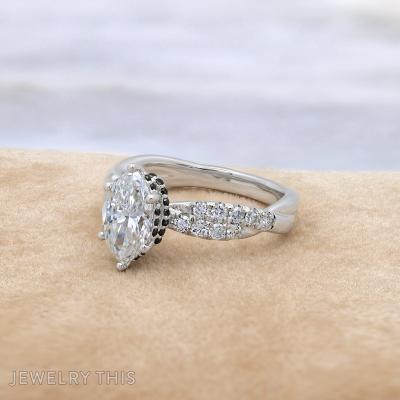
This striking white gold engagement ring features a captivating marquise-shaped diamond set at the center, ...

This white gold wedding band is a symbol of enduring love and unity. This exquisite ...

This custom 14k yellow gold engagement ring is a symbol of unique elegance and style. ...
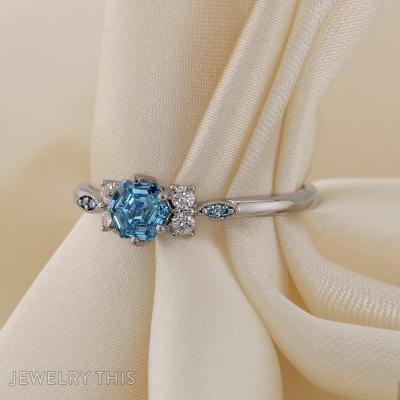
This engagement ring was designed to echo the look of a piece that belonged to ...
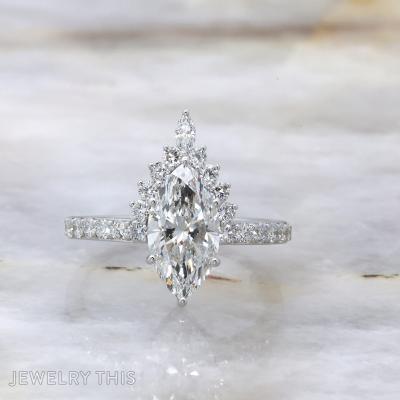
This stunning white gold engagement ring showcases a marquise-shaped center lab-grown diamond, striking in its ...

This unique engagement ring embodies contemporary elegance with its mesmerizing hexagonal black diamond center stone. ...
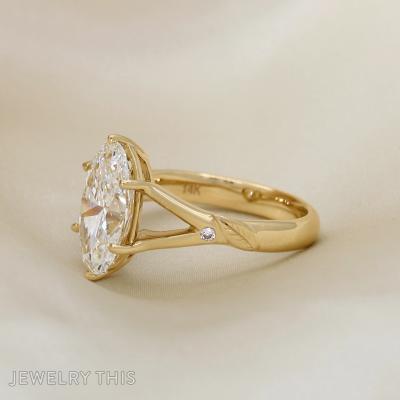
This engagement ring pairs a bold elongated oval center diamond with a softly split yellow ...
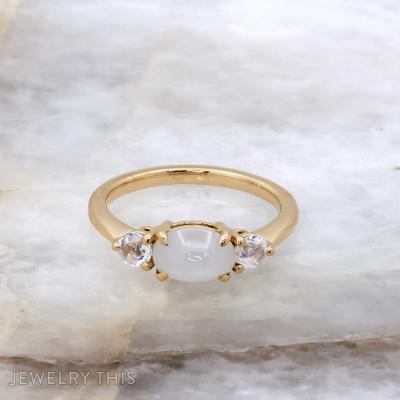
This elegant yellow gold ring features a mesmerizing oval white star sapphire cabochon set horizontally ...

Elegance meets heritage in this 14k white gold art deco-inspired ring. The centerpiece, a cherished ...

This engagement ring was built to closely follow the design of a costume piece the ...

This striking 18karat yellow gold ring features magnificent princess cut sapphires. At its heart lies ...



