


Birthstone Heart Engagement Ring in Rose Gold
$$$
14k rose gold, citrine, lab sapphire, amethyst, blue topaz, diamond accent
A client wanted an engagement ring built around a heart split between two custom-cut stones, each half representing something personal to him and his partner. Over several rounds of feedback he refined the halo color arrangement and chose to engrave the band with four meaningful dates instead of names. When he proposed, he wrote back simply: 'It was very beautiful and of course she said yes.'
'It was very beautiful and of course she said yes.' — on delivery, after the proposal
Quick specs
Design type
Primary Metal
Shape / Cut
Primary Stone
Accent Stones
Design Complexity
Intent: Certainty
Size
Ring size 9 US (18.95mm).
How they made it distinctive
-
01
Heart center custom-cut into two matching halves — citrine and lab sapphire — rather than using a single stone
-
02
Halo frame split between amethyst and blue topaz, reversed from the first render after client feedback to pair each color with its corresponding center half
-
03
Small accent stone placed at the heart's point specifically to break up the color transition between the two halo colors
-
04
Split shank band chosen to keep the band profile narrow while still visually supporting the scale of the heart frame
-
05
Inside-band engraving uses four numeric dates instead of names due to limited engraving space
How you'd make it yours
Stone pairing: this piece uses citrine and lab sapphire; a new commission could use any two durable stones capable of being custom-cut to match
Halo stones: this piece uses amethyst and blue topaz; a new design could use different birthstone colors for the halo
Metal: this piece is 14k rose gold; the same design language works in yellow or white gold
Engraving: the inside band can carry a new set of dates, initials, or a short phrase on a fresh commission
Accent stone: the single stone at the heart's point can be swapped for a different small gem or a decorative metal bead
One of a kind: this exact ring was designed for one client and is not reproduced — a new commission is an original piece inspired by this one, not a copy
Design changes made
After reviewing the first render, the client asked for the outer halo colors to be swapped — blue topaz moved next to the citrine side and amethyst next to the sapphire side — and chose engraved dates over names due to limited space inside the band. A small accent diamond was also added at the point of the heart frame to break up the color transition where an odd stone placement occurred.
Who this is for
This piece is for someone who wants an engagement ring built around specific personal meaning rather than a single center stone. It's especially right if you have multiple people or dates you want represented in one design, and you're drawn to color and symbolism over a traditional solitaire look.
How it's made
Once the design was approved, the center citrine and lab-grown blue sapphire were custom-cut to matching heart-half shapes, a process that took about a week and a half given the precision needed for the two stones to align seamlessly. A 3D model was then built around the finished stones to determine the halo layout and the metal weight needed. A wax model was 3D printed from that design, attached to a tree, invested in plaster, and burned out in a kiln before 14k rose gold was cast into the resulting mold.
Key note
The center stones were custom-cut before the 3D model was finalized, meaning the ring's entire halo layout and metal shape were designed around the stones' actual cut dimensions rather than the other way around.
Pricing guidance
A heart-shaped engagement ring with two custom-cut center stones and a mixed-stone halo sits toward the higher end of the complex custom-work range. Most of the added cost comes from the custom stone-cutting process, which requires precision matching between two separate stones rather than sourcing a single finished gem. Halo stone count, metal karat, and engraving add smaller increments on top of that baseline.
Moves price up ↑
- ↑ Using natural sapphire instead of lab-grown for the center stone
- ↑ Increasing the halo stone count or using larger round accents
- ↑ Upgrading from 14k to 18k rose gold
- ↑ Adding engraving on both the inside and outside of the band
- ↑ Requesting a larger center heart size than roughly 2 carats equivalent
Moves price down ↓
- ↓ Using a single uncut stone shape instead of two custom-matched heart halves
- ↓ Reducing the halo to a single stone type instead of two
- ↓ Choosing a plain band without the split-shank detail
- ↓ Omitting the engraving to simplify the band interior
- ↓ Using silver instead of 14k rose gold
Questions people ask
Yes, this is done by custom-cutting each stone to a precise half-heart profile so the two pieces align into a single heart shape once set. It requires a stone cutter to work from a matched template so the two halves meet cleanly along the center line. This process typically takes one to two weeks depending on the cutter's workload. It is more technically demanding than cutting a single stone, since both halves must match in size, angle, and symmetry.
Lab-grown sapphire is chemically, physically, and optically identical to natural sapphire — the only difference is that it is grown in a controlled environment rather than mined. Natural sapphire is one of the more expensive colored gemstones, so lab-grown is often chosen to get the same look and durability at a lower cost. Sapphire rates a 9 on the Mohs hardness scale, making it one of the most durable gemstones available for daily wear. Visually there is no difference detectable to the naked eye between the two.
A ring with two custom-cut center stones and a multi-stone halo falls toward the higher end of the complex custom-work price range, largely because of the stone-cutting labor involved. The cost is driven primarily by the custom cutting process, which requires more time and precision than setting a single finished gemstone. Halo stone count and metal karat are the next biggest variables. A simpler version using a single stone shape and fewer accent stones would land lower in the range.
For a ring like this, sourcing and custom-cutting the center stones typically takes one to two weeks before the 3D design phase can even begin. The 3D design and render process adds roughly another week. Once the design is approved and production begins, casting, stone setting, and finishing typically take four to six weeks. The custom-cutting step is the main reason this type of ring takes longer than a standard halo ring.
Yes, but space inside the band is limited, so you typically have to choose between fitting names or short dates rather than both. Dates in a numeric format (for example, 12.9.82) take up less space than spelled-out names or full sentences, so they are often the more practical choice when multiple pieces of text are wanted. The engraving is applied to the inside of the band after casting and setting are complete. If you want multiple dates or names, discussing the exact format with your jeweler early helps make sure everything fits.
Amethyst rates about 7 on the Mohs hardness scale and blue topaz rates about 8, both of which hold up reasonably well to daily wear when set as smaller halo accents rather than large exposed stones. They are softer than sapphire or diamond, so they are more prone to scratching over years of wear compared to the center stones. Because these are set low and surrounded by metal in a halo arrangement, they are better protected than a stone set higher and more exposed. Regular inspection of the prongs over time is recommended for any ring with multiple small accent stones.
Yes, a split-color heart design can be adapted to other gemstone pairings as long as the stones are suitable for custom cutting to match profiles. Harder stones like sapphire, ruby, or lab-created options tend to custom-cut more reliably than softer materials. The halo frame color choices are flexible and can be adjusted to use different birthstones or color combinations. The key constraint is finding two stones with compatible durability and cutting characteristics so they hold up well together over time.
A single small accent diamond, like one added at a transition point in a halo design, typically adds very little to the overall cost of a ring this size. Its purpose is often aesthetic — breaking up a color transition or adding a point of brightness — rather than being a focal stone. Because it is small and set among other stones, the setting labor is minor compared to the cost of the center stones. The bigger cost drivers in a design like this are custom-cut center stones and halo stone count, not a single small diamond accent.
Check what our clients say about us

Chris Quint
3 years ago
I had an idea and they helped bring it to life. They helped make a wonderful engagement ring and of course she said yes
Explore Similar Creations
Every masterpiece starts with a spark. Explore how our clients raw ideas - sketches, heirlooms, inspirations - were transformed into bespoke works of arts.
This is a custom-designed travel ring created to replicate the client’s original engagement ring. The ...
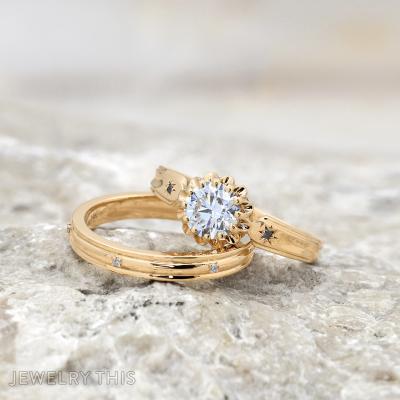
This 14k yellow gold engagement ring and wedding band set takes its cue from an ...

This elegant white gold ring features a timeless three-stone design centered around a brilliant 2.75 ...

This enchanting rose gold engagement ring features a pear-shaped center diamond set at a graceful ...

This exquisite platinum engagement ring showcases a captivating radiant-cut yellow diamond at its center, set ...

This engagement ring centers a 7x5mm oval amethyst in a four-prong setting, flanked on each ...
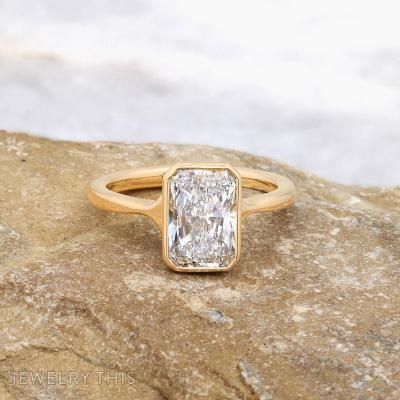
This engagement ring centers a 2.10-carat radiant-cut lab-grown diamond, set in a flat bezel that ...

This ring was built around a client-supplied oval aquamarine, set in 14k white gold with ...

This engagement ring centers a 1.5 carat emerald-cut moissanite, flanked on each side by a ...

This yellow gold engagement ring is a mesmerizing blend of grace and sophistication. The focal ...

This enchanting vine-inspired engagement ring showcases a nature-inspired design, with a 1ct pear-shaped moss agate ...

This engagement ring was built to closely follow the design of a costume piece the ...



