


East-West Sapphire Ring in Platinum — Anniversary Design
$$$
Platinum, lab-created sapphire
S. and her husband commissioned this ring to mark their 25th wedding anniversary, built around a lab-created sapphire she had been searching for the right setting for. She sent detailed feedback on the first render, asking to slim down the support structure around the stone, and the team reworked the transition between the shank and basket to simplify the line without weakening it. Her husband arranged for the ring to arrive just before their anniversary party, and quietly surprised her with it that weekend.
'Tricia! Its perfect! I really love it, thank you!' — on design approval
'It's arrived. Thank you! ... it looks great.' — on delivery
Quick specs
Design type
Primary Metal
Shape / Cut
Primary Stone
Accent Stones
Design Complexity
Intent: Certainty
Size
Ring size 8 US (18.14mm). Center stone 12.4 x 11.3mm, approximately 10.40 carats. Band tapers from 3mm at top to just under 2mm at bottom.
How they made it distinctive
-
01
East-west setting chosen specifically to showcase the width of the large cushion-cut sapphire rather than its length
-
02
Client-supplied 10.40ct sapphire meant the setting was built to the stone's exact scanned measurements rather than an estimate
-
03
Support bridge between shank and basket was refined and slimmed after client feedback, without compromising the stone's structural backing
-
04
Tapered band construction (3mm to under 2mm) keeps a large-stone ring from feeling heavy on the hand
-
05
Interior engraving added as a private surprise from her husband, arranged without her knowledge during production
How you'd make it yours
Stone: this piece uses a client-supplied lab sapphire; a new commission could use a studio-sourced sapphire, moissanite, or other colored gem in a similar cushion cut
Metal: this piece is platinum; the same tapered solitaire design works equally well in 14k or 18k white gold
Setting orientation: this stone is set east-west; a new commission could use a traditional north-south orientation depending on the stone's proportions
Engraving: the interior of the band can carry a new short inscription on a fresh commission
One of a kind: this exact ring was built around one client's own sapphire and is not reproduced — a new commission is an original piece inspired by this one, not a copy
Design changes made
The bridge between the shank and the stone's basket was slimmed and blended into the band after the client felt the initial render looked too bulky in that area. The jeweler confirmed the change would not compromise the stone's support before making the adjustment.
Who this is for
This piece is for someone who has a meaningful stone already in hand and wants a setting built specifically around it, not a generic mounting. It's especially right for a milestone celebration where the ring is meant to make a statement at the event itself, rather than serve as an everyday piece worn through every activity of daily life.
How it's made
Once the design was approved, the piece moved from a 3D CAD model into a resin model printed on a 3D printer, which was shared with the client as a preview of the ring's exact form before any metal was committed. The resin was then attached to a wax tree, invested in plaster, and fired in a kiln to burn out the pattern, leaving a hollow mold. Molten platinum was poured into that mold, then the raw casting was cut down from the tree and cleaned up for finishing.
After casting, the tapered band was polished to a mirror finish along its full length, from the 3mm section near the stone down to the narrower base. The client's own sapphire was set into a four-prong basket in an east-west orientation, chosen to showcase the stone's width rather than its length. A short inscription was hand engraved into the interior of the band as a final step before quality inspection.
Key note
The support bridging the shank and the stone's basket was deliberately kept substantial rather than slimmed further, since removing more material there would have left the 10+ carat center stone without adequate structural backing.
Pricing guidance
A large-stone solitaire ring in platinum with a client-supplied center stone sits toward the higher end for custom solitaire work, largely because of the metal choice and the scale of stone the setting must support. Most of the cost comes from the platinum itself and the hand-finishing needed to taper the band cleanly around a stone of this size. Because the center stone was supplied by the client, sourcing cost is not a factor here, which keeps the price lower than it would be if the stone had to be sourced.
Moves price up ↑
- ↑ Choosing platinum over white or yellow gold for the band
- ↑ Increasing the center stone size beyond 10 carats, requiring a larger and more robust setting
- ↑ Adding pave accent stones along the shank or basket
- ↑ Requesting a fully custom engraved pattern rather than a short text inscription
- ↑ Sourcing the center stone rather than using a client-supplied stone
Moves price down ↓
- ↓ Choosing 14k white gold instead of platinum
- ↓ Using a smaller center stone that requires less structural metal in the basket
- ↓ Setting the stone north-south in a simpler standard basket rather than a custom east-west build
- ↓ Omitting the engraving
- ↓ Using a lab-created stone sourced by the studio in a smaller carat weight
Questions people ask
Yes, client-supplied stones are a common way to build a custom ring, especially for a stone that already has sentimental or practical significance. The stone is shipped in, then scanned and measured so the setting can be designed to its exact dimensions rather than an estimate. This is especially important for large or unusually shaped stones, since a setting built to the wrong measurements won't seat the stone securely. The design phase doesn't begin until the physical stone has been received and measured.
An east-west setting rotates the stone 90 degrees from the traditional orientation, so it sits sideways across the finger rather than running lengthwise down the band. For a cushion cut, this emphasizes the stone's width and can make a large stone feel more balanced on the hand. It's a deliberate style choice rather than a structural requirement, and it does change how the prongs and basket need to be angled to hold the stone securely.
Both can securely hold a large stone, but they differ in maintenance and feel over time. Platinum develops a soft grey patina with wear and doesn't require replating, while white gold is typically rhodium-plated to achieve its bright white color, and that plating wears down and eventually needs to be redone. Platinum is also denser and heavier than white gold, which some wearers notice more on a larger ring. Neither metal is significantly stronger at holding a stone in place — that comes down to the setting design itself.
On a standard timeline, expect about one week for the design phase — sketch, 3D model, and render for approval — followed by roughly three to four weeks for production once the design is approved. That timeline starts once the stone has arrived and been scanned, since the setting is built to the stone's actual measurements. Rush timelines are sometimes possible if there's a firm deadline, but they depend on where the piece falls in the production schedule.
A large-stone solitaire in platinum with a client-supplied center stone sits toward the higher end of custom solitaire pricing, mainly because of the metal cost and the structural work needed to support a large stone securely. Because the stone itself was supplied by the client rather than sourced by the studio, that cost isn't part of the price. The final number depends heavily on metal choice, with platinum running higher than 14k white gold for the same design.
There's a limit to how thin the support between the band and the stone's basket can go before it compromises how securely the stone is held, especially with a large center stone. A jeweler can often blend and slim the transition for a cleaner visual line, but the core support structure usually needs to stay substantial enough to bear the stone's weight and protect it from daily knocks. This is a case-by-case judgment based on the stone's size and the ring's intended use.
Yes, a short inscription can typically be engraved on the interior of the band, though space is limited on a narrower shank. On a ring with a tapered band, the engraving is usually placed toward the wider section for legibility, and a simple font tends to read more clearly than an elaborate script in a tight space. Most short phrases or names fit comfortably within an 8-12 character range depending on the band's width at that point.
No, plenty of large solitaire rings are designed as special-occasion pieces rather than everyday wear, particularly when the center stone is a significant size. Many owners choose to remove a ring like this for activities where it could be knocked or scratched, and reserve it for events and occasions where it can be shown off safely. The setting itself is built to be secure either way, but daily wear and occasional wear place different demands on a piece, which is worth discussing with the jeweler at the design stage.
Explore Similar Creations
Every masterpiece starts with a spark. Explore how our clients raw ideas - sketches, heirlooms, inspirations - were transformed into bespoke works of arts.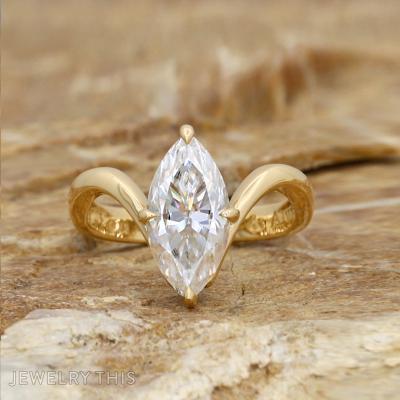
This engagement ring centers a marquise-cut moissanite in a four-prong setting, with pointed claw-style prongs ...

This custom engagement ring features a stunning “Toi et Moi” design, symbolizing the union of ...

This engagement ring was built around a request for a masculine design that still felt ...
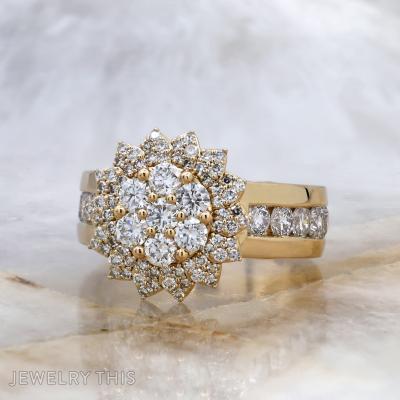
This engagement ring centers on a round flower-shaped cluster of lab-grown diamonds, designed as a ...

Crafted with meticulous attention to detail, this custom sterling silver wedding band is a symbol ...

A dazzling testament to sophistication and elegance, this custom ring is crafted in 14k yellow ...

This exquisite sterling silver ring intertwines an elegant heart outline with the timeless infinity symbol, ...
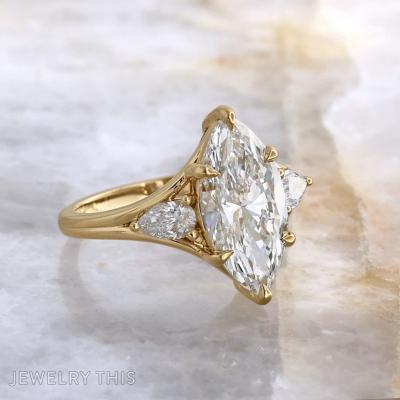
This engagement ring centers a 3.03 carat marquise-cut lab-grown diamond, flanked by two pear-shaped lab ...
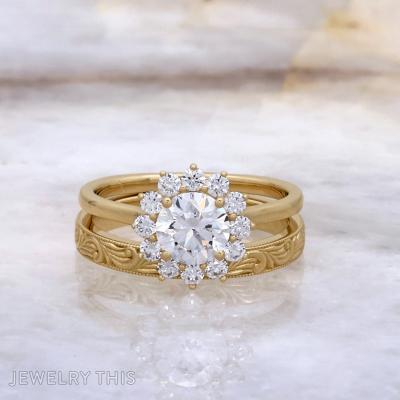
This exquisite 14K yellow gold wedding set seamlessly blends timeless romanticism with modern ethical luxury. ...
This signet-style ring was designed around a company’s logo, rendered in raised 14k yellow gold ...
This enchanting engagement ring is a celebration of timeless love and individuality. At its heart ...
This cohesive white gold wedding set radiates contemporary elegance through its balanced geometry and brilliant ...



