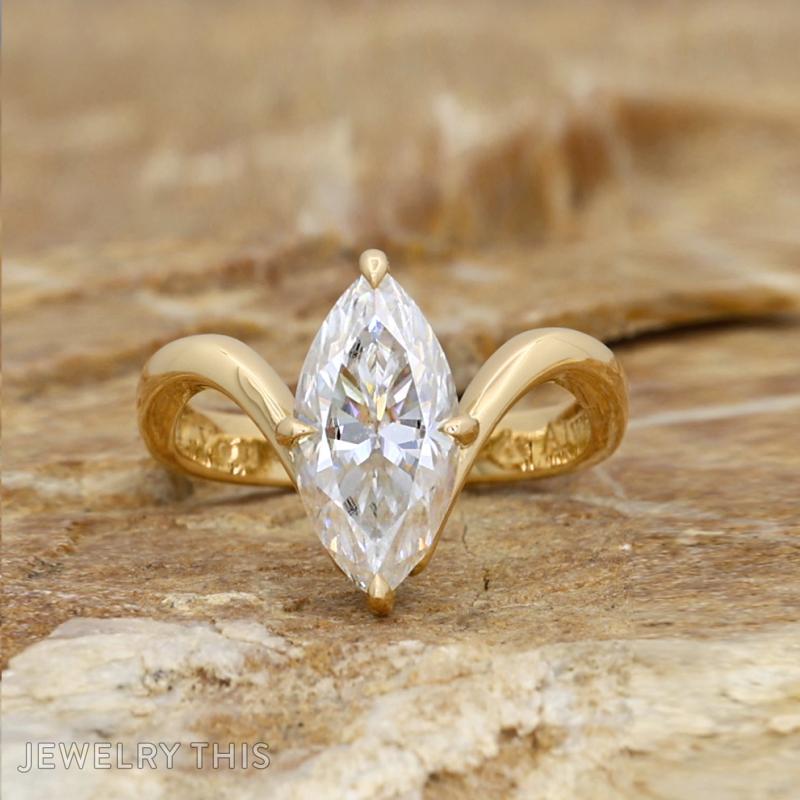
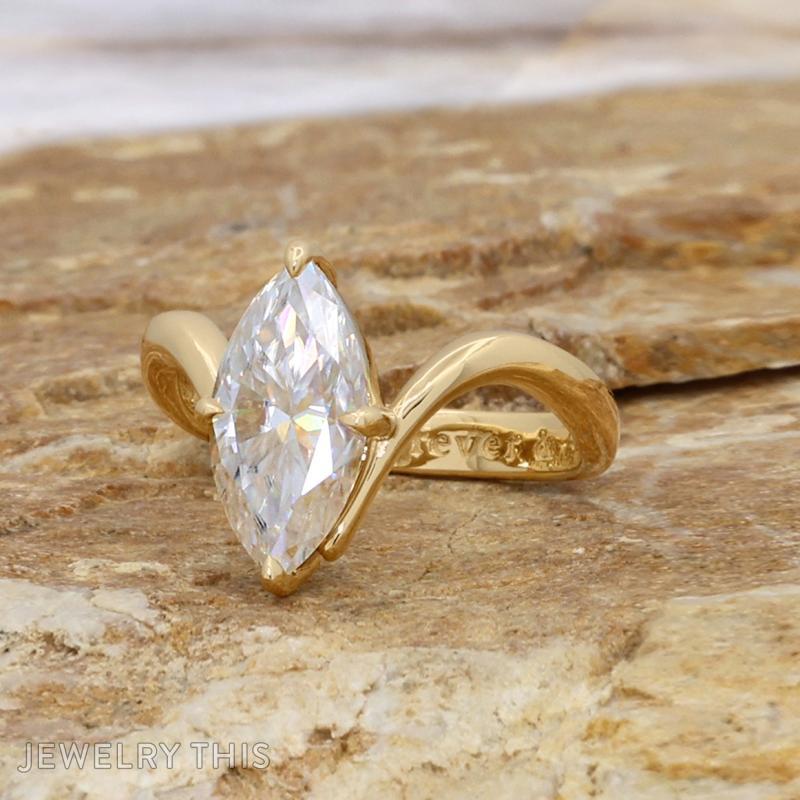
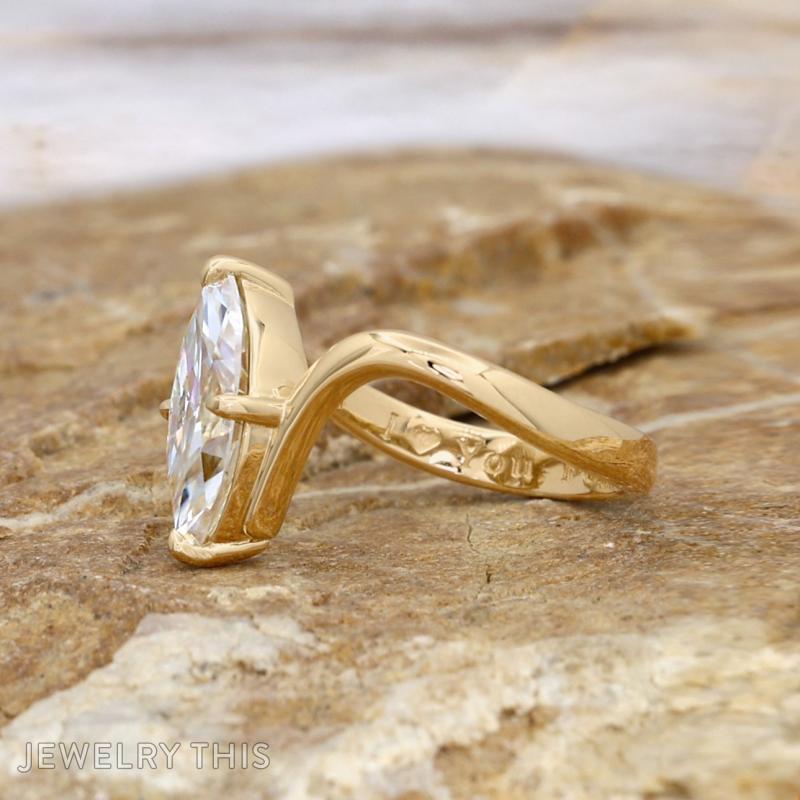
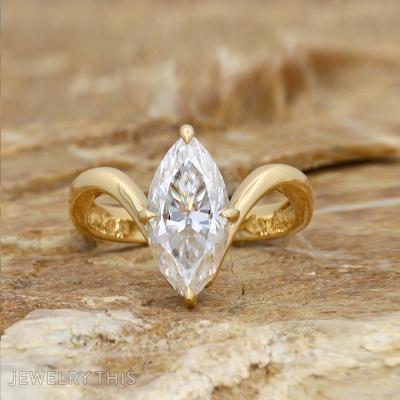
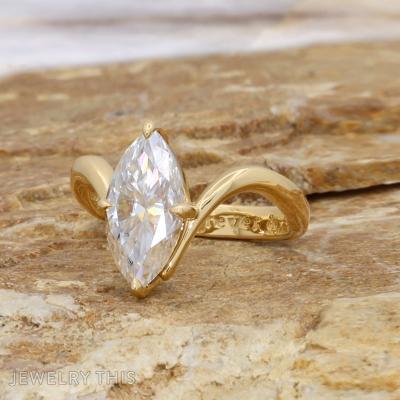
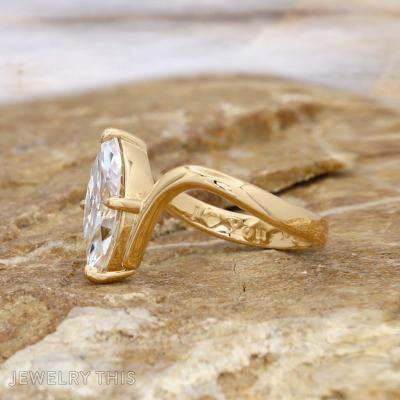
Symmetrical Marquise Moissanite Engagement Ring
$$$
14k yellow gold, moissanite
M. found a ring design he instantly loved for its mix of classic and nature-inspired lines, and worked with the team to build it around a 2-carat marquise moissanite. After trying on a printed resin model together, he and his partner decided the original asymmetric band felt right in theory but not on the hand, and asked for a symmetrical version instead. When the resin arrived, both of them teared up seeing it in person, and once the finished ring shipped, the reply was simple: 'I got the ring, and it's amazing!'
'This rendering is beautiful, I do really like it.' — on seeing the first render
'We received the resin version of the ring this evening and both my partner and I started tearing up when we saw it! It is gorgeous and exactly as we imagined.' — on receiving the resin model
'I got the ring, and it's amazing!' — on delivery
Quick specs
Design type
Primary Metal
Shape / Cut
Primary Stone
Accent Stones
Design Complexity
Intent
Intent: Certainty
Size
Ring size 6 US. Band width 3mm at back tapering to approximately 1.5mm on either side of the center stone.
How they made it distinctive
-
01
Band redesigned from asymmetric to fully symmetrical after the couple tried on a printed resin model and preferred the mirrored curve
-
02
Four pointed claw prongs shaped and tapered only after the moissanite was already set, so they sit flush against the marquise outline
-
03
2-carat DEF color moissanite chosen for a near-colorless look at a different cost profile than an equivalent diamond
-
04
Band tapers from about 3mm at the back to roughly 1.5mm near the stone, keeping the profile refined at the center
-
05
Hidden inside engraving using a heart symbol and ampersand to fit a longer personal phrase into a limited space
How you'd make it yours
Stone: this piece uses a 2-carat DEF moissanite; a new commission could use a diamond, sapphire, or a different moissanite color grade for a different look or budget
Metal: this piece is 14k yellow gold; the same curved band design works well in white gold or rose gold
Band profile: this piece tapers from 3mm to about 1.5mm; a new commission could use a different taper ratio or a consistent width throughout
Engraving: the inside of the band can carry a new phrase, date, or initials on a fresh commission
Prong style: this piece uses four pointed claw prongs; a new commission could use rounded prongs or a bezel for a different look
One of a kind: this exact ring was designed for one client and is not reproduced — a new commission is an original piece inspired by this one, not a copy
Design changes made
The band was changed from an asymmetric bypass design to a fully symmetrical one after the client tried on the printed resin model and felt the mirrored curve fit better. The band width was also refined to taper more narrowly on either side of the center stone than in the first render.
Who this is for
This piece is for someone who wants an engagement ring that feels both classic and a little unexpected — traditional enough to last, but with a curved, organic line that sets it apart from a standard straight-shank solitaire. It's especially right if you're drawn to a large center stone without wanting the cost of an equivalent diamond, and you value being able to see and approve every stage before it's finished.
How it's made
Once the design was approved, a detailed sketch was translated into a 3D CAD model, which let the team calculate the metal needed and plan the hand-finishing and stone-setting work ahead. A resin model was 3D-printed from that file and shipped to the client to try on before any metal was committed. After the design was finalized as symmetrical, the model was rebuilt, connected to a wax tree, and invested in a mold; molten 14k yellow gold was then cast into the hollow cavity left after the wax burned out.
After casting, the raw ring was cleaned up and the marquise moissanite was set into a four-prong setting, with the claw-style prongs shaped and tapered to a point around the stone only after it was in place. The band was then polished to a bright, mirror finish along its full symmetrical curve, and the inside of the band was engraved with a short personal phrase before final quality checks.
Key note
The pointed claw prongs are not pre-formed — they are shaped and tapered around the stone only after it has been set, which is why the finished prongs sit flush against the marquise outline.
Pricing guidance
A custom solitaire engagement ring in 14k gold with a 2-carat center stone sits toward the lower-to-mid range for engagement ring commissions of this complexity. Choosing moissanite over diamond keeps the cost down relative to a stone of similar visual size, while the curved symmetrical band and hand-shaped prongs add a moderate amount of finishing labor. Stone size, gold karat, and band design detail are the main levers that move the price from there.
Moves price up ↑
- ↑ Increasing the center stone size beyond 2 carats
- ↑ Upgrading from moissanite to a natural or lab diamond of comparable size
- ↑ Choosing 18k gold instead of 14k for a richer color and higher metal cost
- ↑ Adding pave or accent diamonds along the band
- ↑ Requesting a more complex multi-prong or halo setting
Moves price down ↓
- ↓ Reducing the center stone size to 1 to 1.5 carats
- ↓ Choosing a lower moissanite color grade instead of DEF
- ↓ Selecting a simpler, non-tapered band profile
- ↓ Omitting the personal engraving
- ↓ Using a thinner overall band gauge
Questions people ask
Moissanite rates 9.25 on the Mohs hardness scale, just below a diamond's 10, which makes it very well suited to daily wear on an engagement ring. It resists scratching from most everyday activities and holds its polish well over years of use. The main practical difference from diamond is optical: moissanite has a higher refractive index, so it throws more colorful flashes of light rather than the whiter sparkle typical of diamond. For a marquise cut specifically, moissanite's brilliance tends to fill out the elongated shape nicely.
DEF refers to the top color grading tier for moissanite, meaning the stone is colorless or near-colorless with minimal to no visible tint. This is a step up from the more common G color grade, which can show a very faint warmth in certain lighting. Choosing DEF color typically adds a modest amount to the cost of the stone compared to G color. Side by side, a DEF stone will look whiter and closer to a high-color diamond than a G-color moissanite would.
The bow-tie effect is a dark, bowtie-shaped shadow that can appear across the center of elongated cuts like marquise, oval, or pear stones, caused by how light reflects through the facets. It can occur in any elongated stone, including moissanite, diamond, and other gems, and its intensity depends on the specific cut proportions of that stone. A well-cut marquise minimizes this effect, which is why reviewing photos or video of the actual stone before it's set is a reasonable step. It is a normal characteristic of the shape rather than a flaw specific to one material.
Yes, a tapered band in 14k gold can typically be resized within about 1 to 1.5 sizes without affecting the design or the stone setting. Larger adjustments are possible but may require the jeweler to evaluate whether reshaping the tapered sections would compromise the band's structural integrity. Because the design was built from a 3D model, the jeweler has an exact record of the original proportions to work from during a resize. It's worth having a professional confirm feasibility before requesting a resize beyond that standard range.
A 14k gold solitaire with a 2-carat marquise moissanite in a tapered, symmetrical band setting falls in the lower-to-mid range for custom engagement ring commissions. The center stone choice is one of the biggest cost factors, since moissanite runs considerably less than a diamond of comparable visual size, while the custom curved band and setting still require real design and hand-finishing labor. Adding features like pave accents, a higher gold karat, or a larger stone would shift the price upward from this baseline. The specific total depends on the final stone size, color grade, and any additional design details.
The design phase, from sketch to an approved 3D render, generally takes about a week. Once the design is approved and materials are sourced, including the center stone, full production typically takes another 4 to 5 weeks, covering wax modeling, casting, stone setting, engraving, and polishing. Sourcing a specific stone, like moissanite in a particular color grade, can add several days on its own. Altogether, most custom engagement rings are complete within roughly 4 to 6 weeks of final design approval.
Yes, when an engagement ring is custom-built, the 3D model used to create it is saved and can be referenced later to design a wedding band that sits flush against the engagement ring's curve. This makes it easier to achieve a cohesive look between the two pieces even if the wedding band is ordered well after the engagement ring is finished. There is typically no time limit on accessing that saved file for a future order. It's worth discussing the wedding band design early if there's a specific fit or symmetry you want preserved.
Yes, most bands can accommodate a short personal engraving on the inside surface, though the available space depends on the band's width and the point where the engraving needs to fit. Longer phrases sometimes need to be shortened or use symbols in place of full words, such as a heart in place of the word 'love,' to fit comfortably. It's best to confirm the exact wording and any symbol substitutions with the jeweler before the ring goes into final production. Engraving is typically added in one of the last steps, after stone setting and before final polishing.
Explore Similar Creations
Every masterpiece starts with a spark. Explore how our clients raw ideas - sketches, heirlooms, inspirations - were transformed into bespoke works of arts.
Embrace the promise of forever with this captivating custom engagement ring set. Crafted in 14k ...

This 18karat yellow gold engagement ring exudes elegance and vintage charm. At the heart of ...
This captivating white gold wedding set features a harmonious design rich in meaning and artistry. ...
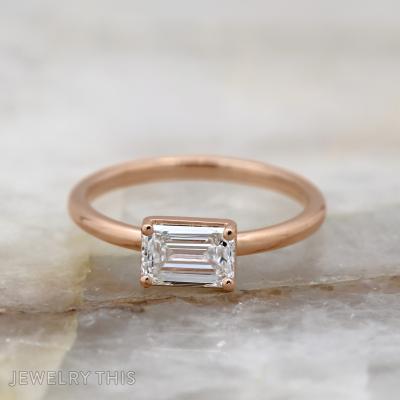
This Rose gold solitaire ring is a timeless symbol of elegance and grace. This ring ...
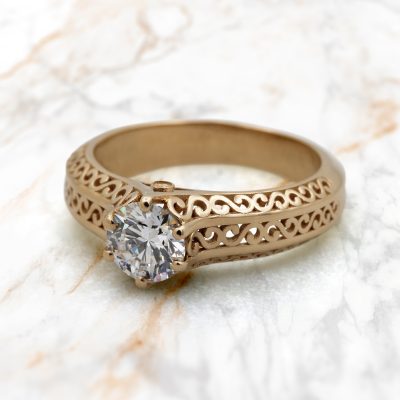
A 14k yellow gold engagement ring with filagree details set with a round lab created ...

Introducing our Modern Three Stone Engagement Ring. A new twist on the timeless three stone ...

This is a custom-designed travel ring created to replicate the client’s original engagement ring. The ...

This white gold wedding band is a masterful fusion of elegance and individuality. The U-shaped ...

A symbol of enduring love, this custom engagement ring, a recreation from cherished photos, embodies ...

This sleek white gold ring features a distinctive flat rectangular top, designed for a modern, ...

Elevate your love story with this exquisite custom engagement ring, a testament to timeless beauty ...

This ring was built to bring back a one-of-a-kind piece that had been lost — ...